
By Hazel Burgess
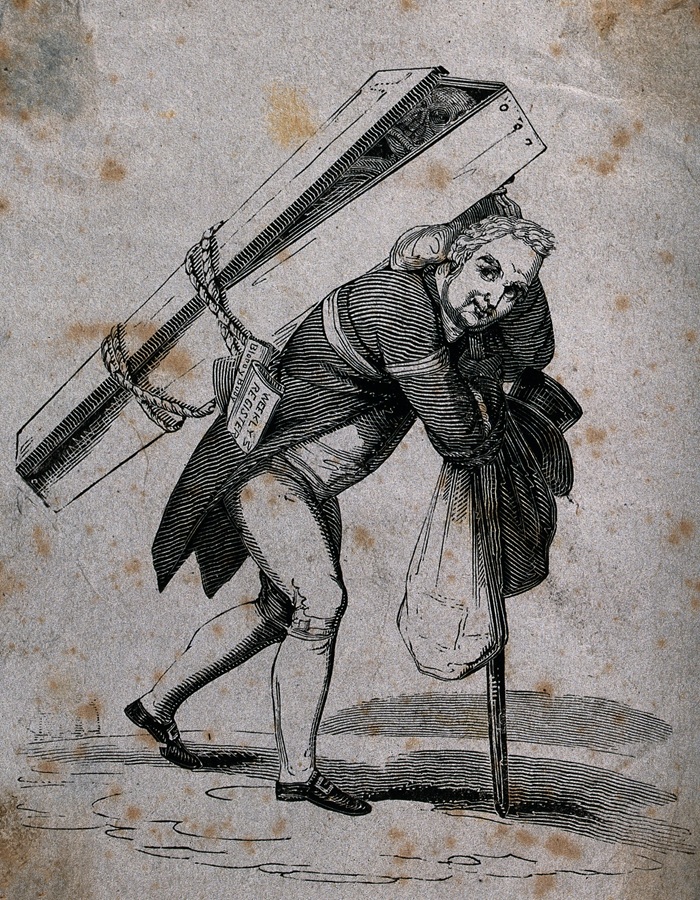
The following saga combines the most comprehensive account yet of the fate of Thomas Paine’s remains, the intriguing story of the recent discovery of a vestige of those, and the recounting of a bizarre, scientific endeavour to validate that piece. It is a tale of fact, probability and possibility. It is a personal rendition, not a scholarly work. Space does not here allow the full story, but it is hoped, in time, to elaborate on its historic components in a more substantial form. With the exception of some minor details of some few participants, the research for the extended paper is complete.
The story began in 1988 with the small circumstance of a newsagent having run out of my husband’s preferred newspaper which, prior to retirement, he always bought on his way to work. He took another paper, and glanced at the front page before settling down to work. Later in the day, he opened the paper and, on reaching the seventh page, a large photograph caught his attention. It was captioned -Thoughts, thoughts … the skull of Thomas Paine …,” and showed a woman behind a table on which a skull had been placed. The story told of the relic being that of Thomas Paine, one of the items on display at a forthcoming antiques fair. The accompanying article read:
A lot came out of Thomas’s skull, including those great monuments of late 1811 century political and religious thought, The Rights of Man and The Age of Reason.
But while Mr Paine’s skull is not for sale, a lot of other things are.
The photograph and short report intrigued us, because my husband, John, has always accepted family tradition that he was directly descended from Paine; he had not read a biography to know that all who wrote of Paine’s life told of his never having fathered a living child. We decided to visit the antiques fair the following weekend to view the skull. There, seeking the exhibitor, we found our way through the large rooms of the early nineteenth-century mansion where the fair was held. The object of our excursion was not visible, but, on asking the owner if we might see the skull of Paine, he reached behind a long-case clock and brought out a splendid, hand-crafted leather box which looked rather like a hat box. He opened it, and unwrapped several intact sheets of newspaper which proved to be from the Sunday Express, 29th May 1966. Beneath that were some torn and crumpled sheets of newspaper which later, after careful ironing, indicated their origin as being from the Diss Express and Norfolk and Suffolk Journal, 14th April 1899. Under the Diss-paper were several layers of yellowed and stained soft tissue paper which, when removed, revealed the skull. It seemed small, and had the name “Thos Paine” inscribed in copperplate, ink writing on the frontal bone. The custodian of the piece explained that the mandible was not the original. Our attention was distracted, and we neither asked for, nor were given, an explanation.
John asked if he might hold the skull, but the dealer hesitated. My husband told his story, and showed some few possessions of his famous, supposed ancestor which were passed on to him when he was young. At that time, his grandmother had said, “You had better have these. Nobody else will be interested.” The nature and markings of those relics identify them indubitably as having belonged to Paine. The dealer in) fine antiques was fascinated with the story and relics. To our astonishment he said “This belongs to you,” and handed the skull to my husband whose response was to stutter “B-b-b-but, th-th-this b-b-belongs to you. I can’t take it. You paid for it somewhere.” Nevertheless, the serendipitous coincidence of part of the remains of a long-lost “ancestor” appearing in the city where an interested “descendant” lived was too much to resist,- so John offered to pay what the dealer had paid. “Done,” he said. A minor condition of the purchase of the box and contents was that it remain at the exhibition until the following Monday as it had had some publicity, and people were asking to view it over the holiday weekend.
A few days later, in awe, we collected the prize. Excited and emotionally affected by our acquisition of something we thought to have been irretrievably lost, we opened the box to examine its contents. We gently unpacked the cranium and mandible. We then lifted out two pristine copies of a bicentennial edition of Common Sense. Beneath these was an old, brown envelope which contained a smaller, yellowed envelope within which was a copy of the rare pamphlet, A Brief History of the Remains of the Late Thomas Paine from the Time of Their Disinterment in 1819 by the Late William Cobbett, M.P. Down to the Year 1846; it was printed in London in 1847. There was also an early albumen photograph depicting the tabernacle in the guild oratory of Or San Michele, Florence, possibly a nineteenth century Paine admirer’s idea of a fitting monument to the great writer, the original having been to the Virgin Mary. On the back of the brown envelope, in handwriting yet unknown to me, was written:
Thomas Paine, died at Greenwich, New York 1809.
Buried at New Rochelle. Disinterred by William Cobbett in Sept. 1819, his remains were taken back to England by Cobbett in Nov. 1819, & kept by him at his house Normandy Farm near Famham until his death in 1835. Cobbett’s son then inscribed Paine’s name on the skull & various limbs & put them in a tin trunk. Shortly afterwards he was arrested for debt, & the trunk & other Cobbett property was seized by the receiver, who held it until 1844 when the debts were discharged. Payment of these reduced Cobbett junior to become a farm labourer, and Paine’s remains then passed to Mr. Tilly of Bedford Square London, who still had them in 1846.
The fact that the writer told of Tilly holding file remains in 1846 suggests that he knew of their whereabouts and had probably seen them that year. It is probable that the envelope and contents have been together with the skull since about 1853-54.
Examination of the skull and information contained in the pamphlet in the box suggested authenticity. Cobbett’s eldest son, William, had “inscribed his name in several places on the skull and on most of the larger bones of the limbs.” As he penned an article entitled “Where are Paine’s Bones?,” Moncure Daniel Conway was under the impression that this meant that Cobbett’s son had inscribed his own name on the bones, but it is more likely that he wrote the name “Paine.” An obvious inscription on the skull we had obtained is that already mentioned. With the aid of digitally enhanced high resolution photography, other markings became visible and worn scratchings, possibly of the name Paine, were discernible. My husband and I were of the opinion that it would be in nobody’s interest to inscribe the name of Paine on a skull if it was not that of the man himself.
Aware of the fact that Paine’s remains had been exhumed by William Cobbett in 1819, and that they had subsequently become lost, it became obvious to us that there was an interesting story for the telling, or rather the writing. I began to research the life, times and posthumous career of Thomas Paine as I had never researched anything before. My findings astonished me, but those are the subject of a larger work than this. Fieldwork led me to many important documents in England and the United States of America, some of which corroborated parts of Conway’s story of the remains. He had managed to purchase documents and relics, some now owned by the Thomas Paine National Historical Association of New Rochelle, New York. There I was shown a note written by Benjamin ‘Tilly, William Cobbett’s secretary, which Conway had acquired:
Tuesday January 7th 1833 at 1 o’clock at noon I went to 11 Bolt Court. Fleet Street, and there, with Mr Gutsell and Mr. Dean, I saw, at the house of Mr. Cobbett, the remains of Mr. Thomas Paine, (that were brought from America by Mr. C.) when I procured some of his hair, and from his skull I took a portion of his brain which had become hard, and which is almost perfectly , black.
On either side of the skull’s frontal bone, above the orbit, or eye socket, is evidence of scalping. The first cuts were deep, and left marked lacerations which depleted as the knife proceeded to the posterior of the skull. These markings verify the fact that hair was taken from the biological owner of the Sydney skull. The “portion of brain,” which Conway described as being “about two inches by one, leaden in color, and quite hard,” could only have been removed through the foramen magnum, the hole through which the spinal cord passes.
Again, on 2nd December 1839, Tilly removed more hair from the skeleton while it was held by the receiver, George West, who had a farm adjacent to that of William Cobbett which, after his death, was leased to a Mr R.D. Thomson. It seems that Tilly intended to fulfill Cobbett’s purpose of Paine himself raising funds to erect his own monument. Fragments of his hair were to be enclosed in gold rings and sold as a means of paying for the memorial and his funeral “in a season, when twenty wagon-loads of flowers can be brought, to strew the road before the hearse.”
Apart from the obvious inscription, the most noticeable feature of the skull is a deep depression on the forehead. The obvious result of an injury, one scientist who examined the piece suggested that it was the result of “a strike from a heavy pointed (but not a sharp) object.” Healing processes have obscured signs of probable “cracking” which would have been evident at the time of the injury. It was thought that the injury occurred at least ten years prior to death, and that it would have shown during life as a “dimple on the skin.” Thomas Paine might have suffered such an injury in 1779 at the height of the Silas Deane Affair, when the former’s loyalty to the American cause was being questioned.
At that time, as he returned to his Philadelphia lodgings one night, Paine was spotted by some army officers and members of the legislature strolling in the opposite direction on their way home. They had enjoyed a fine dinner with the clothier, Mr Mease. One of the group, Colonel Attlee, on noticing Paine as he approached them in Market Street, announced to the party, “There comes ‘Common Sense’.” Matthias Slough of the legislature remarked, “Damn him, I shall common sense him,” at which the party leaned against the wall. Slough is said to have tripped Paine, throwing him into a filthy gutter where he fell heavily on his back. As it was the antagonists who passed on the story, it is quite possible that the tripping of Paine was in fact a strike.
The only other known injury to Paine which might have caused such damage to his head was that recorded by James Cheetham; he wrote of Paine, in 1806, returning to stay with the Dean family of New Rochelle where he had spent some weeks in 1804. He was not welcome. He is said to have arrived with a gallon of rum, “and in the evening got so drunk that he fell from his chair, broke his nose, and sprinkled the room with his blood.” It is most unlikely that the striking of Paine by an English army officer in Pads in 1793 or 1794 was vigorous enough to sustain such an injury.
The nose of the skull is broken, and deflects to the right as it would have done in life. On first sight of a photograph of Paine’s death -mask taken by John Wesley Jarvis, of which there are several in the literature, the most noticeable feature is the deviation of the nose to the right. The mask also shows the sunken upper lip of a man who may have lost his front teeth. All four incisors are missing from the skull as are one canine tooth and one premolar. Another canine is chipped. Two premolars on the left side are sheared off at the gum line. This loss of teeth would account for the sunken appearance of the upper lip in the mask. It has been said that the cast of the nose to the right was a mistake or sloppiness on the part of Jarvis, but, if he was modelling from the head of the skull now in Sydney, his mask was from a true cast. In fact, Jarvis thought the mask his finest work, as did Dr John Francis who had “many opportunities of seeing Paine.” It is worth adding that the face of the mask is pock-marked and the cheeks sunken.
The death mask exhibited at the Ancient House Museum at Thetford, Norfolk, was taken from the original cast. A fine illustration of it appeared with an article I wrote for Thetford and Breckland Magazine, in 1996. That illustration clearly shows the indentation in the forehead that is obvious on the skull. From physical evidence and the comments of writers. Over the years, there is no reason to doubt the authenticity of the cranium; it is that of Thomas Paine. The same cannot be said for the mandible. Several scientists have examined it, and are unanimous that it is a splendid match in colour and age, but not a practical fit. I have dismissed it as being that of Paine for the simple reason of its having no markings such as those to be found on the cranium.
The Brighton Herald of 6th February 1909 published an article telling of “a curious letter that had been received by a well- known local antiquarian, a Mr Bartlett. The letter had been written by William van der Weyde, best known for his Life and Works of Thomas Paine. He was preparing that work and, apparently, following up information supplied to him by Moncure Conway shortly before the tatters death. According to the item in the paper, Conway had written that the antiquarian was “believed to know the whereabouts of Paine’s skeleton.” Unable to assist Van der Weyde, Bartlett passed on the request for information to the editor of the newspaper. A fascinating response came within days. Mr George Homewood, of Brighton, wrote of his grandfather, a widower, having married a Mrs Wilkinson, the widow of a Liverpool exciseman. During the exciseman’s tenure, Cobbett landed with the bones of Paine. Mr Homewood wrote of the government not allowing the precious cargo into the country, and of the captain of the ship on which it had travelled having to take it back on board. Extraordinarily, the letter continued, the captain gave Mr Wilkinson the jawbone which came into the possession of Homewood’s grandfather when he married Wilkinson’s widow. It is not true that the government refused entry of the bones into the country, but it is highly likely that, in order to overcome reluctance on Mr Wilkinson’s part to allow them past his examination, the mandible was given to him by Cobbett as a bribe, or Wilkinson himself demanded the relic.
Mr Homewood’s grandfather became schoolmaster in a village where he and his sister, Margaret Homewood, as children, visited their grandparents. One day, Margaret noticed a grave being dug in the churchyard. She ran home to tell her mother who immediately asked permission of her father to bury the mandible in the open grave. That she did and, within minutes, a body was interred and the grave filled.
The story was taken from the Brighton Herald of 13th February 1909 by the London Star which, in turn, was read by the Reverend George Reynolds who, it will be shown, played a major role not only in the distribution of Paine’s remains, but also of many Cobbett manuscripts regarding not only the bones, but also the life of Paine. He immediately wrote to the Star refuting Homewood’s story as impossible because he had in his possession a wax mask that Cobbett had taken in 1822. The mask, one of many, was made to prove to his detractors that he had not returned to England, as rumour had it, with the remains of an African or an old woman. The Alexandria Gazette & Daily Advertiser of 11th February 1802 had noted: “It is gravely asserted in the London Courier, that the bones that Gobbet [sic] took to England as the bones of Tom Paine, were the bones of a ‘negro.’
The Homewoods’ story has persisted, and resurfaced at least twice. In 1924, the famous composer Algernon Ashton made enquiries of The Standard regarding the burial of Paine. Margaret Homewood read his letter, and contacted him telling her story of the open grave. He expressed great interest. In April, May, and June of 1951, Miss Homewood wrote several letters to interested people when, once again, Paine was the subject of a news item. In two of those letters, she described the location of the grave where her mother had laid the mandible. From her description, I have managed to locate the churchyard. I have no reason to doubt the Homewoods’ stories, and am convinced that the mandible of Thomas Paine was buried as Miss Homewood recounted. The biological owner of the jawbone that was visible in the corpse mask owned by the Reverend George Reynolds, the same as is now held in Sydney, will never be known.
On 5th July 1900, a small part of Paine’s brain was sold to Moncure Daniel Conway by Charles Higham, a second-hand bookseller of Farringdon Street, London, who specialised in the trade of theological books. Conway did not personally purchase the prize; a letter held by the Thomas Paine National Historical Association at New Rochelle, addressed to him at the Hotel Strasbourg, Paris, reveals that the piece was bought on his behalf by a representative of the publisher’s GP. Putnam’s Sons. Dated 5m July, 1900, it reads:
I now enclose herewith a receipt for payment made on your behalf of £5. for the fragment of the Brain of Thomas Paine. I hold this to your order. I do not know at present of anyone crossing the Channel, but in the event of any friend of mine going across, I shall be only too pleased to be the means of conveying this fragment to you.
The signature is illegible. The enclosed receipt, on the letterhead of Charles Higham, is also dated 5th July 1900:
Received from Dr Moncure D Conway the sum of Five Pounds in payment for a fragment of Thomas Paine’s Brain this being thq whole of the fragment that I received from Mr George Reynolds and all that exists of Paine’s brain to the best of my knowledge and belief.
The receipt was signed by Higham over a one penny Postage and Inland Revenue stamp.
Conway returned to America with his precious cargo and, in 1902, wrote of it being under a glass cover. In 1905 when he learned that the monument to Paine at New Rochelle, which had occupied several positions in the vicinity, was to be moved to the spot where it now stands, he decided that the brain should be interred as close as possible to the original grave site. On 14th October 1905, it was paraded before “thousands of persons who attended the public transfer of the key of the Paine monument to the city of New Rochelle.” A report of the occasion concluded by noting that “the discovery of the brain of Paine leaves little doubt that the story told concerning the theft of his body, that it fell finally into the hands of vandals, who cut it up and sold it for relics, is true”.
George Reynolds, who had sold the portion of Paine’s brain to Higham, acquired it in 1878 from a man named Timothy Ginn, a cabbie of Bethnal Green. At that time, Reynolds was a Baptist minister at Stepney, and Mr Ginn’s daughters attended his chapel. Ginn was head of an extended family consisting of his wife, his mother, his sister, and his six children. It was with them that Benjamin Tilly, Cobbett’s former secretary, boarded, and in their house at 3 Chester Place that he died of stomach cancer, in the presence of Ginn’s wife Caroline, on 31st August 1869. He was possibly nursed by Ginn’s sister, Adelaide, who was a monthly nurse. It is very likely that he left his few possessions to the Ginns, as suggested by Jabez Hunns, in recognition of their kindness in his illness. It is presumable that, apart from the skull and right hand of Paine, which became separated from the rest of his remains about 1853 or 1854 when ‘Tilly became bankrupt, all relics of Paine, of which Tilly had been a diligent custodian for twenty five years, remained in possession of the family until purchased by Reynolds for £25. It will be shown that he bought more than the portion of brain, and withheld information of his ownership of other items when questioned on the matter by Conway and Hunns a few years later. He probably prevaricated in leading Conway to believe that he had been told by Mrs Ginn that she had sold the bones to a rag—rd-bone collector. Conway wrote of that story being untrue, but did not elaborate. It is clear from my own research that stories of Paine’s bones being made into buttons are not true; neither is the report of a rib being in France.
In either 1853 or 1854, the skull and right hand of Paine were purchased at auction by a Reverend Robert Ainslie. He was a Congregational Minister and writer, whose best known work was the first translation into English of Lobegott Friedricyh Konstantin Tischendotfs Greek text of the New Testament which followed his discovery of the Codex Sinaiticus, a notable manuscript of the Bible. Having been Minute Secretary to the London City Mission, with which he was associated from 1835 to 1844, Ainslie left as a result of having offended fifty four missionaries during one of his Saturday devotional meetings. With the skull and right hand of kine among his belongings, he became Minister of the Unitarian Church at Brighton in 1860. He referred to both his church and himself as “unsectarian.” He resigned in 1874.
It was by chance that Conway learned that Ainslie had been in possession of the Paine items. Soon after Conway had given a lecture on Paine in London in 1876, Edward Truelove, a well- known rationalist bookseller at 256 High Holborn contacted him, and recalled a gentleman who had visited his shop about 1853 or 1854. On noticing Paine’s works on the shelves, the visitor offered the startling information that he was in possession of the great writer’s skull and right hand. Truelove had once attended a lecture given by Ainslie, and recognised him as the former Secretary to the City Mission. .The reverend gentleman refused to offer further information on either himself or his curios. Truelove expressed astonishment that such an orthodox person should take an interest in Paine, but it is now obvious that he did not realise that Ainslie had long left the Mission and set off on a rationalist journey of his own. It is possible that, on the day he told Truelove of his treasures, Ainslie purchased the very rare pamphlet that still rests in the leather box holding the skull. It is also possible that the box was crafted by or for him.
When Conway wrote to Robert Ainslie in 1877 to make enquiries about Paine’s remains, his letter was answered by Ainslie’s daughter, Margaretta, who informed him that her father had died. She wrote of having vague, childhood memories of the bones being in her father’s possession, but knew nothing of their whereabouts. Conway placed.. some reliance upon j her inhumation, and speculated that her father must have acquired the pieces prior to 1844 when the remains were brought to London from Surrey where they had been kept since Cobbett’s death. It was impossible for Robert Ainslie to have had the bones prior to 1844, when they were forwarded to Tilly, because, as noted by William James Linton who wrote the Brief History of the Remains in 1847, ‘Tilly was able to verify that they were the same that had been in Cobbett’s possession. It seems obvious that the writer of the holograph on the reverse of the envelope containing a copy of Linton’s pamphlet, which my husband obtained with the skull, had seen the remains, and confirmed the fact that they were entire in ‘Tilly’s possession at his abode in Bedford Square. I have compared the handwriting with that of Linton; it does not match. Surely the writer would have written with some anguish if the skull and right hand had been missing; he did not. Margaretta Ainslie’s account of childhood Memories must be dismissed.
The story told by her brother, Oliver, is more acceptable. According to Conway who himself interviewed him, Oliver told of their father, Robert Ainslie, having learned from his brother, a veterinary surgeon with connections to the estate of Lord King not far from where Cobbett had lived in Surrey, that the remains of Paine were at Richards’ auction rooms, 43 Rathbone Place, Lincoln’s Inn Fields, London. It was there that Reverend Ainslie acquired the two pieces, unknown to either Tilly or James Watson, the radical publisher, who kindly bought what he thought to be all of the former’s goods and returned them to him. It seems that Watson might have arrived late at the auction rooms, and did not know that the skull and right hand had been removed from the box in which Tilly kept the remains and some manuscripts by William Cobbett. Nevertheless, it is obvious that Watson was concerned about the near loss of Paine’s remains because in 1853 he spoke with Mr Joseph Cowen, an advocate of reform who became the Member of Parliament for Newcastle in the 1860s, regarding a public funeral and burial for Paine at Kensal Green Cemetery. They decided to call upon Tilly at his workplace where he was employed as a tailor for a Mr Swaine, described as a merchant clothier, who lived near St. Bride’s church, Fleet Street. They found that Tilly had left without leaving an address where he might be contacted.
It is not surprising that Tilly had disappeared; his wife had died, he was poor, aging, and I suspect, probably did not wish to be found. He had moved from his lodgings in the house of the widow, Anna Prentice, at 13 Bedford Square, to stay with his niece at Norton Folgate, and, from there, to stay with the widow of an old friend, Mrs Ball, and her family. From there he moved to board with Mr and Mrs Ginn at Bethnal Green. His circumstances were reduced, and he would have had to pare down his belongings. In doing so, I think he might have opened Cobbett’s box and discovered that the remains of Paine, of which he had taken great care, were not entire. He certainly knew before he died that the skull, if not the hand, was missing because he left a note telling how to recognise the skull of Thomas Paine. He became lost forever to those interested in carrying out Cobbett’s plan for a monument, or even a humble burial at Kensal Green. Mrs Ball later described Tilly as “a kind, affectionate, and gentle old man; in fact, a perfect English gentleman.” If my suspicion is right, such a man would not easily forgive himself; it is possible that he never did. James Watson died on 29th November, 1874, having sold his publishing business to George Jacob Holyoake, probably believing
that Tilly had disposed of the precious relics in his care.
Conway wrote of some of Paine’s bones having been sighted by the Reverend Alexander Gordon, “a Unitarian tutor at Manchester,” in 1873, who again heard of the bones in 1876. Gordon was a great scholar and fluent in several languages; he contributed to the Dictionary of National Biography, and provided 778 biographies to the original volumes and two following supplements. In the early twentieth century, he became the first lecturer in Ecclesiastical History at Manchester University. Conway was under the impression that Gordon would have wished for a burial of the remains, possibly at Thetford. The bones seen by Gordon in 1873 were probably the skull and the right hand, both of those being in the possession of Reverend Ainslie, still a Unitarian minister at Brighton with whom Gordon would have been acquainted. Gordon’s hearing again of the bones in 1876 was probably in discussion as to their whereabouts after Ainslie died in August that year. Soon after his death, according to Oliver Ainslie, the bones were taken by a Mr Penny. Ainslie’s son claimed to have known no more of Penny than his name, not even his given name. In all probability, Penny was one Edward Penny of Brighton, who might have known Ainslie as the Unitarian minister. Working forward in time, the whereabouts of the right hand, at this stage, can be traced no further.
In reading Hunns’s 1908 account of the handling of Paine’s remains, it is obvious that he spoke at length with George Reynolds. He wrote of Reynolds being the “chief authority” for his article. Interestingly, Conway also had interviewed Reynolds, but neither he nor Hunns spoke with Timothy Ginn or his wife who, by the time they wrote on the remains, were dead. It is on the word of Reynolds alone that both writers accepted the fact that the bones were either handed over to a rag-and-bone man by Mrs Ginn after Tilly’s death, or disposed of by some other means as intimated by Conway. As he noted, Mrs Ginn’s story had “an accent of sophistication about it.”
A note from James M. Dow of Liverpool appeared in Notes and Queries of 17th July 1909, in which he briefly told of Hunns’s account of Paine’s remains. He also told of his lately having been informed that part of the skull of Paine was in possession of Dr Stanton Colt, the well known American leader in the Ethical Culture movement and opener of the first settlement house in New York in 1866. Dow’s note brought a response, in the issue of 4th September, from H. Percy Ward, who also gave his address as Liverpool. He was a secularist who had once studied for the Ministry. He quoted Dow’s statement and commented with a succinct “This is incorrect.” He continued: “In May, 1902, the late Mr. G.J. Holyoake wrote to me that Dr. Clair J. Greece [sic] of Redhill has relics of Paine and his friends.” “Relics” does not denote skulls. To have known that Dr Coit did not hold the skull, Ward was either dose to Coit with whom he had discussed the matter, or, he knew the exact whereabouts of the piece… It is tempting to think that he himself had it. It is possible. If he did, he most likely acquired it from the mysterious Mr Penny who relieved Oliver Ainslie of the skull that his father had purchased in 1853 or 1854. If I am correct in thinking Edward Penny was the same person, the 1901 census gave his age as seventy eight years, an age when one holding an extraordinary article would have been considering its destiny. lf, as suggested above, that article changed hands in 1899, it might have gone to H. Percy Ward. A possible problem with this theory is the Diss paper of 1899; the identity of the person who wrapped the skull in the paper is not known.
On 2nd June 1966, an English newspaper published a story regarding parts of a skeleton which had recently been found buried in a tin trunk at Ash, Surrey. It was thought that its plight had been that of Thomas Paine. Mr Ashton Booth, then Curator of Famham Museum, examined the bones carefully; he was hoping to find traces of ink marking which William Cobbett’s eldest son had placed on the larger bones of Paine’s remains, and would prove that the bones were those of Paine. There were no ink markings, and the bones, dated as being about 150 years old, were dismissed as being part of a skeleton used by a medical student.
On reading reports of the finding of the bones in 1966, a London man unexpectedly contacted the Curator of Famham Museum telling him that he had the skull of Paine in his possession. The Curator contacted the Chairman of the Thomas Paine Society to whom he had referred the London man. On 10th June 1966, the man visited the Chairman of the Society in London and showed him the skull. The Chairman told the man of his knowledge of a death-mask of Paine; they both thought it would be interesting to compare the two, the mask being in the possession of a member of the Thomas Paine Society. I am not aware of the comparison ever being made, but a search of correspondence and personal records of members of the Society at that time may yield some information. It would seem that the matter faded into oblivion, but the fact that the Sydney skull was wrapped in a London newspaper of that very week suggests that it is the same as that seen in London in 1966.
Hopes of having found the resting place of Paine’s bones were again raised on 18th July 1976 when a backhoe operator at Tivoli, New York, unearthed a seven-foot obelisk marked “In memory of Thomas Paine who was born at Thetford, England Jan. 29, 1737 Died at New York June 8, 1809 Aged 72 years 4 months And 9 days.” The stone also bore the name of another person, John G Lasher. This find too yielded no clues to the resting place of Paine. The stone had been personally chosen and inscribed on two sides to order by Lasher, who was known as a local “eccentric”; he was an admirer of Paine and wished to honour him on his own memorial.
Further interest in the remains of Paine was aroused in 1989 with publication of a speculative article suggesting that persistence of a local legend, said to have originated with the Cobbett family, gave some credence to his remains having been discreetly buried by a Cobbett descendant in the churchyard at Ash, Surrey, close to where Cobbett lived and died. That story may well be true, but there is no documentary evidence to support it. As with the mandible, the main skeleton might have been placed in an open grave. Nevertheless, by linking known facts and suggestions, it seems possible that by the end of the nineteenth century it was in possession of a most unlikely gentleman, the seller of theological literature, Charles Higham. To my knowledge, there have been no reported sightings of it since. Until now, with the exception of Ainslie and the man who revealed a skull in 1966, all who have held any of the bones of Paine have kept their ownership secret.
There are clues relating to the whereabouts of the skull over the last half century, but they remain to be covered in a later work. I managed to make contact with one person in the United Kingdom who had briefly held it in his possession in recent years, but he was reluctant to speak with me. He did tell me that he thought the person who passed it on to him was dead, little more. That is quite understandable in light of the fact that nobody can legally claim ownership of another’s remains. I am not aware, however, of any law against possession of an old box containing harmless contents.
I have sought diligently for any knowledge I have of the bones. Despite public appeals for information, none has come my way; the silence surrounding them endures. My husband and I have not maintained such silence. At a time when the Rare Books Library of the University of Sydney had an exhibition of material which had been suppressed over the years, we loaned the skull for discreet display in the same glass case as The Age of Reason, and other rare, early-editions df works by Paine.
Beyond my husband, many people have been led to believe from family stories that they are directly descended from .Paine. It occurred to me that DNA (deoxyribonucleic acid) analysis and comparison may clarify the point. I contacted, and have been contacted by, a number of such people, several of whom have drawn up family trees. Beyond a certain point in the first half of the 19th century, none of them has managed to make the link to Paine.
As a PhD candidate at the University of Sydney, I was recommended by an academic member of staff to approach a scientist at the University of Queensland who he thought would be interested in assisting in my quest. I spoke with him, and he agreed to be involved as an external associate supervisor of my work which was to cross disciplines. He was intrigued with the story of the skull and the fact that he himself might play a part in solving it. a genealogical puzzle. I first met with him in Brisbane in 1996. Dr Tom Loy, whom I initially sounded out in 1995, also of the University of Queensland, had already agreed to take samples from the skull in an effort to extract DNA for comparison with that of living persons. As Dr Loy, best known for having pioneered the field of archaeological residue analysis and his research on the tools of Otzi the Iceman, was overseas at the time, a rather nervous colleague extracted the stump of a broken tooth from the skull and,,a small piece of bone from the nasal septum. The plan at that stage was to try to extract DNA from the samples which would be held until I found people, preferably males, claiming a line of descent from Paine who would be willing to offer blood samples or other material for extraction and comparative analysis.
Of course, the obvious person to test first was my husband, but therein lay a problem. I had talked a little about the processes of DNA profiling, or fingerprinting, and realised that it would be an easier and less expensive process to find another male “descendant” who was directly descended in the male line. I knew that there were in existence some supposed relatives of our family who were still proud to be known by the name of Paine, but over the last eighty years or so they had drifted away and lost touch. Being a descendant of a known line of Burgesses traceable to the eighteenth century, but only four generations down from the wife of one who was a Miss Paine, my husband’s descent was through a woman. For purposes of DNA profiling, that meant, if taking samples from the skull and him, one would have had to work back through Y chromosomes, interrupted by a generation of the X (female) chromosome, and back to Y. Such a procedure was and still is impossible. Women do not possess a Y chromosome so are incapable of passing it to their children. A woman’s chromosomal composition is known as 46XX and a man’s as 46XY, there being twenty-two pairs of autosomes to every sperm and one X and one Y. It is the X or Y chromosome that ensures transmission of hereditary characteristics and determines sex.
Both jointly with my external supervisor and on my own account, beginning in Australia, and later in England, I made broadcasts on national and local radio appealing for likely “descendants” to contact me. I found such men, but others, like my husband, could only make the connection through a woman. In the early stages of my work, my advisors led me to believe that those men by the name of Paine, who knew of stories in their families of descent from Paine, were the most desirable subjects for sampling. As I learned more about the processes of DNA analysis, I soon came to realise that following that path would be futile. The time may come when it will be possible to trace hereditary descent through the male line, but, at this stage of scientific development, the likelihood of a man even tracing his own father remains a mere matter of probability utterly lacking in certitude. Beyond that, there is the problem of possible lack of marital fidelity; the fact of a surname is not a guarantee of paternity.
The best way of attempting to match the skull with other material would have been to have had access to further biological relics of Paine or the remains of his mother Frances Pain who was buried at St Cuthbert’s Church, Thetford, on 18th May 1790. I admit to pondering upon the possibility of the latter course, but at no stage did I seriously consider exhumation of the bones of Frances Pain. Beyond my reluctance to disturb an old grave, I learned that the church was rebuilt in 1921 when the tower collapsed. All signs of a churchyard are long gone. Had that option been available, and approval given by church authorities for such an undertaking, it would have been the first time that excavation to obtain DNA material for such a scientific undertaking would have taken place. On making serendipitous finds, I decided to change my course.
During my research, I discovered that, apart from the brain, there were still some few physical relics of Paine in existence; the hair taken by Tilly had never been put into gold rings as envisioned by Cobbett. I realised it would be a more viable proposition in validating the skull to attempt to match it with one of these relics rather than seeking descendants. Scientific proof of the identity of the skull would satisfy the sceptics who scoffed at the idea of a vestige of Paine’s remains having found its way to Australia. On sighting two swatches in the United States, at the Thomas Paine Memorial Museum at New Rochelle, I realised they met the criteria for sampling; there was soft tissue attached, roots and scalp, just as obtained by Benjamin ‘Tilly long ago. Despite the wonderful cooperation of some former officers of the Association, similar circumstances to those that led to their departure and setting up of other organisations commemorating Paine, forced me to allow my membership to lapse and search for a similar vestige elsewhere. I had pieced together stories of the hair from various sources and found that there were at least five pieces and possibly up to ten. Two are held by the Museum at New Rochelle, and another is still held at the Thetford Library, Norfolk, in the town where Paine was born. As an interesting aside, when undertaking my research at the Goldsmiths’ Library, University of London, I came across a small bottle containing locks of William Cobbett’s own hair. It bore a typed label: “Mr Cobbett’s Hair,” and marked in the glass of the bottle itself was the following:
B. Keith & Co
Chemists
New York.
The hair was golden in colour. In the same collection were pieces of wood from the house in which Thomas Paine was said to have been born.
Public awareness of the locks of hair that Tilly had removed from Paine’s corpse did not seem to eventuate until 1887 when, in response to an enquiry on Paine’s remains, Edward Smith, a biographer of Cobbett, mentioned that he held a lock of hair which he had acquired some years before. It is probable that Smith acquired this piece and other mementoes of Paine when George Reynolds became involved in “ruinous litigation,” Perhaps he advertised, possibly by word of mouth, that he had such memorabilia for sale because he was contacted by Smith and Mr Kegan Paul. Whether or not the piece, which Smith presented to Conway, was sold to Smith is not clear, but it is known that Kegan Paul advised Reynolds to contact the British Museum regarding several of the pieces he had for sale. Hunns told of the Museum having purchased several of Cobbett’s papers. I sighted these when researching at the British Library in 1996. At the front of the folios containing these papers, a librarian had noted: “Purchased by G Reynolds 13 Dec. 1879.” That was less than two years after his acquisition of the Paine items from the Ginn family. Those other remainders, pieces of hair cut from his head and intended as lasting keepsakes in golden rings, had begun their own separate joumeyings.
It is probable that Reynolds gave Conway a second piece of hair about 1897 because in a letter dated 6th August 1909, written by Reynolds himself, he told of giving a piece to Smith, Conway and Hunns. (He had, no doubt, read Conway’s Life of Thomas Paine, published in 1892.) Reynolds’s letter told of how he kept a remaining piece of hair found in an oiled paper on which was written “Mr Paine’s hair brought from Normandy Farm on 21st January 1836 by Mr Wm Oldfield.” I have doubts about Reynolds having kept the hair beyond 1879, but he was certainly in possession of it again by 1897. At the time he was suffering his financial problems, all that he had of the Paine relics that he did not sell to Edward Smith, Kegan Paul, the British Museum on Cobbett’s son, James Paul, were sold to a friend, Louis Breeze. It is probably the piece of hair from that collection that is now at Thetford Library in the Thomas Paine Collection. Shortly before Breeze died late in 1897, Reynolds repurchased all that he had sold to him with the exception of some pamphlets and books which he regained at the sale of Breeze’s effects. He did not recover an oil painting of Paine or two portraits of Cobbett.
In 1908, Hunns wrote that Reynolds gave him a piece of hair. Reynolds had obviously treasured his collection and thought about the disposal of items after his death. At the Paine Memorial Museum at New Rochelle, I sighted an envelope bearing the following typewritten note:
Portion of the hair of the late Mr. Thomas Paine. Taken from an envelope with the following in the handwriting of Mr. B. Tilly: “Mr. Paine’s hair brought from Normandy farm 21 Jan’y, 1836, by Mr. Oldfield.”
The original packet of hair is in the possession of George Reynolds, Rookstone, Woodford Green.
The typed signature was Jabez Hunns. I saw the envelope containing the hair and, having seen Tilly’s writing, knew that Hunns was mistaken. The writing on the envelope was not that of Tilly.
In the previously mentioned letter that Reynolds wrote to the Brighton Star, published 13th February, 1909, he told of having the hair that was removed from Paine’s skull in 1833. Five years later, on the reverse of Hunns’s typed envelope, William Van der Weyde noted, as had Hunns, that the original packet of hair was in the possession of Reynolds. Van der Weyde continued: “Together with the original inscription on packet in Tilly’s writing, and other locks, &c., left by Tilly, has since (in 1914) been purchased from Mr. Reynolds by the Thomas Paine Nat’l Historical Association.” He signed himself as President of the Association, 1924, and did not mention the number of locks.
George Reynolds retained several of his relics. He led Hunns to believe that, due to failing eyesight and a wish that they should be kept together, he offered them first to a grandson of William Cobbett. He was not interested, so the entire collection was sold to Charles Higham who sold part of Paine’s brain to Moncure Conway in 1900. I have, however, shown that Reynolds still had swatches of hair which were bought by the Thomas Paine National Historic.* Association in 1914. In offering the material to Higham, Reynolds told Hunns, he hoped that Higham would advertise it in his catalogue so that it might capture the interest of a public institution or an interested person. It is clear that the brain had gone to Higham, but Reynolds still held some hair. In my opinion, it is possible that he held more than hair.
The hair now held in the collection at Thetford Library was possibly purchased from Higham at about this time, but it is more probable that it was bought from Reynolds himself about 1914 by Ambrose Barker, a prominent proponent of anarchism and atheism throughout his adult life. Paine’s hair was in his possession up to the time of his death in 1953.
So much for the dissemination of Paine’s hair.
As shown above, the late twentieth century rekindled curiosity in Paine’s remains when I embarked on the endeavour to obtain DNA from the skull and hair. There was rather more publicity than I should have liked, but my contacts at the University of Queensland sought and were given press coverage. As frequently happens when stories are passed on to journalists, they were picked up by other journalists and distorted beyond recognition and published beyond Australia.
The problems of obtaining hair samples from The Thomas Paine Memorial Museum had a rebounding effect. In order that it might be seen that all analyses were fairly practised, I planned to have the American samples tested in the United States. Without funding or wealth, I was dependent upon the benevolence of any scientist willing to undertake the extraction of DNA and compare it with the material already extracted in Australia which would be sent to the States.
I spoke with many but located only one willing scientist, a man of high profile and an international reputation. However, by then, problems had arisen that made it impossible for me to utilise the hair held in the States. As mentioned earlier, I turned my attention elsewhere, to the United Kingdom. Having learned of the expense that would be involved and the awkward inconvenience of forwarding extracted DNA from Australia to the United Kingdom, I decided to consult again with Dr Tom Loy of the University of Queensland. I was prepared to avail myself of the commercial services his department offered if I could obtain a sample from England.
The hair at Thetford was not without its own problems; a great deal of time was spent in establishing its ownership and the legalities of sampling it. I was assured by Mrs Sue Holt of the Thetford Library that the items in the Thomas Paine Collection were “available on deposit and available for public consultation and permanently safeguarded.” The planned exercise did not contravene the conditions. The Librarian took great care to make sure that the Library’s legal department and the Thomas Paine Society had full knowledge of the planned procedure, although I soon learned that the piece was in fact privately owned. The venture was to be the first attempt in the world to compare long separated biological relics of an individual figure of history.
Having established that the owner is the present Secretary of the Thomas Paine Society, he agreed to a sample being taken. He had bought the Ambrose Barker collection, and placed the relic in the Library as part of the Thomas Paine Collection. Dr Loy was happy to do the work, and all I needed to do was to find an interested scientist in England who would take a sample from the hair under the sterile conditions required by Dr Loy. I was extremely fortunate in locating an interested biologist in Professor Godfrey Hewitt of the University of East Anglia, a short trip from Thetford. Professor Hewitt agreed to take the sample and, with Loy’s requirements for the sterile conditions and method of sampling sent to Hewitt, the project was, after several years of negotiations, contact with likely people, and many disappointments, under way. I did not ask Professor Ilewitt to attempt any DNA analyses. The comparison was to be done in Australia.
Dr Loy advised that a further sample from the skull would be required. The submission date for my doctoral thesis, of which the scientific endeavour was to form a part, was approaching fast, but I was confident of including the results, be they positive or negative, despite Dr Loy’s tardiness in responding to correspondence. When I heard from Professor Hewitt that he had taken the sample at Thetford on 1st February, 2001, I confirmed with Dr Loy that my husband and I would visit his laboratory at the University of Queensland on 7th February. Professor Hewitt had his doubts about the hair. He thought “some dark material adhering” to it might be “blood, dye or other.” He was very surprised to find that the hair was dark. He wrote to Dr Loy, with a copy to me: “Thomas Paine was 73 when he died, and most certainly grey. So the hair is either not his or from earlier times.” Conway had noted that the hair he owned was “soft and dark, with a reddish tinge.”
John and I, together with my external supervisor who had, some time before, resigned from his position with the University of Queensland to set up a private commercial laboratory, met with Dr Loy as arranged. He was fascinated with the skull, photographs of the hair, and documentation on Paine’s remains which I had taken with me. After discussing the enterprise, we donned masks and gowns before entering the sterility of his inner, clean room where the skull had been irradiated with ultraviolet light to remove any contamination from handling since exhumation. Dr Loy had a student to assist him, later described by Loy as a “very sharp paleopathologist.” All being done under strictly sterile conditions, the student held the skull steady on silver foil while Dr Loy drilled a hole through the bone and obtained small fragments of cancellous (porous) bone from within the mastoid process close to the right ear opening. After gently shaking from the skull through the foramen magnum onto the foil, the sample was ground into a powder with a pestle and mortar.
Having discussed my thesis and research at some length, and how I had moved from seeking people to relics, as we were leaving, Dr Loy’s student asked if he might extract some eyebrow hairs from my husband. I thought to myself that to do that he should have approval of his University’s Ethics Committee, such as I had sought and obtained from the University of Sydney prior to travelling overseas in 19b6, and the written consent of my husband. As I thought about that, I decided it was a good idea as, some time in the remote future, science may develop improved methods of establishing kinship rather than having to rely heavily on mitochondria! DNA, the DNA of each individual inherited intact from his or her mother. The hairs could be stored in the student’s care. Some were taken, and I decided the matter of formal consent could wait until such time as they were subjected to analysis, if ever. So far as we were concerned, that was the end of matters; it remained for Dr Loy to endeavour to extract DNA from the material he had secured.
The business done, we returned to Sydney. So much had all participants enjoyed the morning that I quite forgot to pay the required deposit. I emailed Dr Loy with an apology’to which he replied not to pay anything until I received an official invoice after receipt of the full report. I anticipated that report with enormous interest. In the meantime, according to Loy, the sample had not arrived from the United Kingdom. I was anxious to thank the English scientists for the part they had played, so after some time and no news from Brisbane informing me of its arrival, I prodded him. In an email of 8th March, he told of the hair having arrived about a week before. He described “a sample of short hairs in a congealed mat of as yet unknown material, ‘perhaps blood or dye or other'” as observed by Professor Hewitt. Loy mentioned that he planned a laboratory day for that very day when he’d look at it and let me know what could be seen under a microscope. He also said he would be able to verify that the hair was human, promising to send the results to both Hewitt and myself.
I was impressed. I had the report that same evening. It concluded: the hair was human; it was a mixture of colours ranging from light straw yellow to a darker brown, but including a few grey strands; the congealed matter was almost certainly blood C a couple of red blood cells were evident; what appeared to be a fragment of skin was embedded in the blood with the hairs; the sample had come from a deceased person who had been in contact with, or buried in, clay soil (this observation was based on the presence on the skull of vivianite, a dark blue/greenish mineral which occurs as concretions in clay); the sample was covered with a network of waste matter of insects and web silk suggestive of soil mites and indicative of contact with soil particles. In all, Loy concluded that the hair sample was of “some antiquity,” had been in contact with soil or soil particles, and was human. Simple tests to follow would confirm or deny the congealed matter being blood. Only one third to half the sample would be used for DNA analysis and the rest left in case of any future testing being required.
I heard nothing more.but, knowing how busy and involved Dr Loy was with other matters, dismissed my concerns, although I had been led to believe that analysis time would be in the order of approximately thirty days. I too was busy, finishing off other aspects of my thesis. With the project now understood to be on a commercial basis, and hoping to have results soon, I sent a cheque in the amount of half the full fee to him. I felt the arrangement to be on a more solid basis with a deposit in place. I had heard nothing by December so telephoned Dr Loy. He had some results, but not very useful for our purpose. He did know with certainty that both the skull and hair/blood sample were from the same maternal population group, that being British. He was able to rule out German, Scandinavian, Spanish/Portuguese, Italian, etc. as the maternal population group. He mentioned that the DNA was damaged which prevented the usual testing for identity and sex. However, all-.was not lost, his team had a repair project under way and they hoped to have prepared a methodology in three months or so. The Paine project was second on the list for analysis as soon as a “reliable repair” had been achieved.
The months went by and I completed my thesis but for the scientific side of the story. I nudged Dr Loy several times, each message more urgent than the last. Eventually, in response to a one-worded message, °TOM!? I received a strange reply in light of the brief of which he had complete understanding. The entire project had changed direction. Loy told of discussing the situation in terms of scalping and “other Paleopatholy [sic],” with the student whose expertise lay in that field, “and further DNA analysis.” It was agreed between them that the student could write a much more detailed pathology report including scalping and the healed depressed fracture” on the forehead of the skull. Also, Dr Loy wanted to have “another crack” at DNA analysis, but he needed further “raw material”? I was asked if it would be possible to travel to Queensland “in the very near future.” The student’s analysis could be done in a day, and DNA sampling would take only twenty minutes or so. It was considered that, with results having been so long in coming and results inconclusive, my payment to date was all that would be charged inclusive of any future analysis. My opinion was sought.
My opinion was that it was time to ask questions. I queried my being told the previous year of the DNA being damaged and asked if that meant post-sampling or degraded by age. I asked, if it was the latter, would not another sample produce the same results? I asked if the repair had been perfected. If so, would not a little extra time help in making use of the DNA already extracted? I asked if it was possible to work with the DNA extracted in 1996, and mentioned that at the time Dr Loy had concluded that the subject was male. I had been told that some of that sample was held in case any further testing would be required. I quoted his messages with dates and mentioned that, before I would consider anything, I required answers; he had already had two “cracks” ‘at DNA analysis from three samples. I did not want to subject the skull to further impairment, and another trip to Brisbane was more than I could afford. In just over an hour, I had a reply. Yes, Loy still had DNA from the tooth in his freezer, he had forgotten that he had it. And, yes, “it may be possible to attempt to re-extract from the bone sample recently taken.” However, the extraction method was so efficient that it left little behind. As to damage, it happens that during the process of post- mortem drying out of bone and the eventual stabilisation of the DNA, some damage is sustained. This is caused by enzymes present in cells which are part of the repair mechanism in the living cell. Beyond this, water and other compounds change into ruinous “free radicals” which damage the DNA at random, but, once stabilised, there is little further damage until efforts to extract and amplify the DNA. It was hoped that there would be some measure of DNA repair by mid-June, and my samples would be “at the top of the list” once the repair process could be controlled. My response was further questioning regarding the utility of the 1996 extraction and, if it was of sufficient quantity, would not use of that at that stage be a viable option? I did not receive a reply.
In mid-June, I again wrote to Dr Loy asking if he had managed to achieve a repair process and, if not, was it likely to be achieved in the foreseeable future? I further asked whether anything at all had been done with the DNA extraction taken in 1996, and if it was necessary to wait on achieving “some measure of DNA repair.” It was time to tell him that it was well past time that I had a report of what had been done, what had been impossible to do, or simply what had not been done. It was time to tell him that I had not had my money’s worth (a four figure sum), and to remind him, as he well knew, that journalists were harassing me seeking results. I found it embarrassing to tell them that there was nothing to report. Once again, I did not receive a reply. It was time to take the matter further.
A few days later, I wrote to the Dean of the School which employed Dr Loy telling the full story and offering him copies of all correspondence. All I asked was a written explanation, completion of the project as far as was then possible, and/or a reasonable refund. All I had received for my money was a collection of contradictory emails. I should have appreciated the expected and promised return, a written report. Copies of my letter were sent to the Head of School, the Director of the commercial arm of the Department, Dr Loy, and to the Chair of the Department at the University of Sydney in which I was working on my thesis. Within four days of writing, I had a reply from the Director of the commercial arm. He was most apologetic, and wrote of having instituted an investigation to determine the state of the consultancy, the causes of the delays, and the best way of bringing the project to a successful conclusion as quickly as possible. He asked for copies of my correspondence with Loy, assured me that he was available to me at any time, and would write again soon. Dr Loy proved to be out of the country. Despite sending reminder emails on 6th and 8th August to the Director, I did not have a reply. Meantime my thesis had been submitted with the scientific details relegated to an inconclusive appendix; all that could be said was that the skull and hair samples were from the same population group, British, and that the matter of my not having been provided with a report was being investigated.
It was, again, time to go further, to the top, the Vice Chancellor of the University of Queensland. I sent him an email on 15th August with a copy of the self-explanatory letter I had sent to Dr Loy’s superiors. I also sent the same content in a formal letter of the same date. I waited; there was no longer any urgency. Seven weeks on, I had still heard nothing from Queensland. On 26th September, I picked up the telephone, rang the Vice- Chancellor’s office, and asked to speak with him. I was given the expected reply: “He’s not here, he is at a meeting.” I did not mind the lack of confidentiality, so told his secretary that 1 had written to him on 15th August and had not had the courtesy of a reply. I was told that she would check a database and call me back. To my astonishment, she did, informing me that the letter had been forwarded to the Executive Dean and that I would be hearing from the Deputy Vice Chancellor with some “information.” Again, I waited.
I telephoned the secretary again on 14th October. She assured me she had personally seen a letter written to me by the Deputy Vice-Chancellor on 2nd October. She said she would photocopy it and send it to me. A letter dated 2nd October, processed by Australia Post on 13th October, arrived on 17th October. It was an original signed letter, on letterhead, not from the Deputy Vice-Chancellor, but the Vice-Chancellor. The writer had had an opportunity to investigate the matters raised in my letter. His response was absurd in light of the occasional email reports I had had from Dr Loy. He told how the tooth sample had degraded in storage, but in 2001, was crushed and another extraction taken, but it yielded nothing; the hair sample was entirely destroyed after repeated sub sampling; and the entire sample from the skull was eventually used. The results of the exercise revealed that the skull was from a male person, the skull sample did not share a common maternal lineage with my husband, but, most surprising of all the results, it was found that the hair sample DNA was from a micro organism. I had been informed that it and the skull were from the same maternal population group, that being British. The writer also believed that I had been furnished with a full report on the findings; he understood that no target date was set for the completion of the analyses and report, and that Dr.Loy had explained the difficulties they were encountering. At the same time, he felt that I was justified in feeling that I had had too little information. The scientists, he wrote, had been informed that they must respond in a timely fashion to communications from clients. He understood my disappointment with the results. The entire fabrication was reminiscent of the description of Nanki-Poo’s execution as it unfolded in Gilbert and Sullivan’s Mikado. The letter necessitated a reply.
In a letter of 25th October, of necessity long and involved, I informed the Vice-Chancellor that he had been misinformed; that I was not disappointed with the results because I had not been informed of any results; and was still waiting for the work to be completed. I asked, if possible, that Dr Loy should continue with the project. So far, as I was aware from our communications, DNA from the tooth wall available, the more recent extraction from the skull might have proved viable, and there should have been sufficient hair to continue. If it was not possible to continue, I asked that I be furnished with a full report from Dr Loy of what had been done, the state of the hair sample, the difficulties encountered, the reasons for discrepancies in the information provided to the Vice-Chancellor and to me, and what, if any, valid conclusions were reached in comparing samples. I sought a refund for services not performed or any unauthorized service; the latter covered misuse of an unapproved sample taken from my husband, and unnecessary pathological observations. I also told of the need to fulfill the request made by the owner of the hair when he approved the project, that I write a summary of it for the journal in which it appears. It was necessary to advise the Vice-Chancellor that his letter did not constitute a report such as might have been expected from reading the summary of services offered, and that it was antithetical to the short “reports” I had received. My letter brought a response by express post in the form of a large plastic envelope, received on 15th November, but of the two letters therein one, unsigned, was dated 15th August.
The day on which I first emailed the Vice-Chancellor was 15th August. He had not then received my formal letter, but perhaps, or perhaps not, had then stirred the Director of the commercial service. Obviously back-dating his letter, he advised me that all the delays had been due to the diligent work that had been put into the project, the latest being his personal insistence that every possible attempt be made to produce a positive result. Images of the aforementioned description of-execution resurfaced. Enclosed were a report and a CD outlining in brief all the laboratory procedures that were undertaken and possible explanations for the inconclusive results. In light of the delays and the results, I was offered negotiable discussion on the fee I had paid. It was pointed out that it was not normal to reduce the fee on obtaining such results, but due to the lengthy time delays, it seemed “appropriate.” The letter ended with an apology that the institution had not been able to supply the positive results I was seeking. I was quite prepared, at all times, to accept a negative result, but I was not prepared for the astonishing correspondence still to come. I read the report, of which the CD was an exact copy; it was ridiculous. In the opening summary of fourteen lines, which included the conclusion, the brief was described as concerning three separate questions: whether the skull was from a male human; to investigate any population affinity between the skull and my husband; and to report on pathological features consistent with it being that of Thomas Paine. At no time were these questions part of the brief. It was established as early as 1990 that the skull was male, a fact ascertained by examination of muscle attachment (that of a male is more robust than that of a female). My husband was not concerned in the investigation, and all the pathological features had already been noted before Dr Loy was engaged.
However, the conclusion was that DNA sexing revealed that the skull was from a male; the skull and my husband were not of the same mitochondrial subgroup which indicated they did not share the same maternal lineage; and pathology provided the clearest evidence that the skull is that of Paine.
The second letter that accompanied the report was dated 13th November; it was from the Deputy Vice-Chancellor. Not surprisingly, as I should have been had I been given the task of dealing with this extraordinary matter, he seemed to find it tiresome. He told me the Vice-Chancellor himself had provided me with a detailed statement of the sequence of events and results, and of his “fear” that the report that was sent to me by the Archaeological Unit on 17th August had not been received. He enclosed a second version, which he hoped I’d find interesting, together with the letter of 15th August. There was further correspondence; I requested the Deputy Vice-Chancellor to seek for me an explanation in writing from Dr Loy of the many inconsistencies in the various “reports,’ the reason for use of material from my husband, and credible clarification of those matters for inclusion in this article, the planning of which Loy was aware. My letter was acknowledged and, I was told, passed to Dr Loy, it being “entirely up to him as to whether he engages in any further dialogue” about this matter. He advised that he himself would not be entering into any further correspondence. By then I was not interested in further correspondence or seeking a refund.
There, sadly, ended an exciting project that, regardless of positive or negative results, either expected, was a fascinating enterprise which captured the interest of the international press. Unfortunately, the truth of the matter will never be known. It is known, however, that Dr Loy’s work has been called into question on other occasions. That, however, does not necessarily detract from his professional aptitude as a teacher. His knowledge in his field was impressive.
As mentioned above, I have presented facts briefly, and speculated on possibilities; I have shared the wonder of acquiring an intriguing box and contents; and I’ve faithfully recounted the drawn-out ordeal of an unfathomable business arrangement. The story ends with a tragic twist. When concluding this account, I thought to discover what project Dr Loy was currently engaged in. I was shocked to learn that he died just over a year ago. To my knowledge, his death has never been explained, apart from the fact that foul play was not suspected. He died alone and was not found for some days. He was a personable man who initially showed enthusiasm for the Paine project.
© Hazel Burgess 2007