
By John Roberts
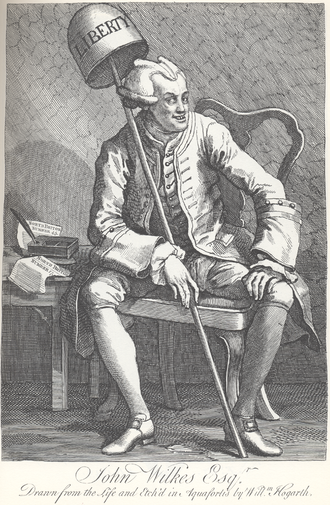
John Wilkes, A Friend Of Liberty. Peter D.G.Thomas. Oxford, Clarendon, 1996.
Radical and Rascal
Although he would have denied the charge and hated the idea, Wilkes was in some ways a precursor to Thomas Paine. His career, foreshortened in history textbooks to the slogan ‘Wilkes and Liberty’ is a fascinating one. Wilkes was a Londoner and made the City of London his political power-base for the several years that he flashed across the public stage, discomfiting established politicians of government and opposition alike. He had a unique power to disturb and irritate everyone from king George M down; and during his best years he succeeded in shifting the power from the oligarchic Whig lords to ensure that the shop-keepers and others of the lower middle-class who constituted the part of the political nation that was most keen on liberty and a say in the governing of the country that they were fiercely patriotic about.
It is sometimes overlooked that the genesis of much of the later emphasis upon the Rights of Man lay in the political experience of the English revolution of 1688. The subsequent legislation restricting the power of the monarchy and the constitution that evolved was much admired in France and elsewhere. In 1769 a ‘Society of Gentlemen Supporters of the Bill of Rights’ was formed with the intention of maintaining and defending ‘the liberty of the subject’, notably through support of Wilkes and his cause. At the time he was in prison and the society was principally concerned to uphold his right to take his seat in Parliament as Member for Middlesex, where he had won the election. It was the refusal of the government (and the House of Commons) to accept that verdict which provoked widespread discontent and popular, probably radical, opposition to the Whig oligarchy who dominated politics during the 18th century.
This book, ending with the statement that Wilkes ‘was a genuine Radical as well as an undoubted rascal’ uses its 200 odd pages to prove both. A profligate and generous womaniser, Wilkes was also a charming and highly educated man, with a taste for literature as well as bawdy. He spent years in prison to defend the independence of elected members of Parliament and was rewarded with the devotion of radicals and reformers. If he disapproved of the war to subdue the American colonists it was not from any sympathy with the idea of an independent republic, but he clearly saw that the British government would fail to prevent American independence and he was given financial help by the colonists.
Wilkes was always in debt. It was his inability to curb his spendthrift ways and his insouciant attitude to the political estab- lishment that enabled the government often to shrug off his trenchant and accurate criticisms of its illegal and unconstitutional actions. By damning the man as a rogue and a wicked reprobate, his opponents muted his appeal to all but the Londoners. Nevertheless, his real talent for administration, aptitude for hard and steady work made him a formidable force on the mid-18th century political scene. Above all, his rare political skill in organising opposition to arbitrary authority led to the abandonment of general warrants of arrest and enabled the reporting of Parliamentary debates to be carried on without interference by the government. And with him he could be a charmed social companion even his doughty opponent, Samuel Johnson, who characterized him a ‘retailer of obscenity and sedition’ was won over to the point of uniting in their dispraise of their common whipping boys, the Scots.
Wilkes died in 1797 but retired from active politics two decades earlier, and although he had spent some of the happiest years of his life in France he seems to have been little interested in the Revolution that Thomas Paine was so involved in. This is the first researched biog- raphy for eighty years as Wilkes has been claimed as ‘the founder of British radicalism’ he is a fitting prelude to Paine’s greater career.