
By Terry Liddle
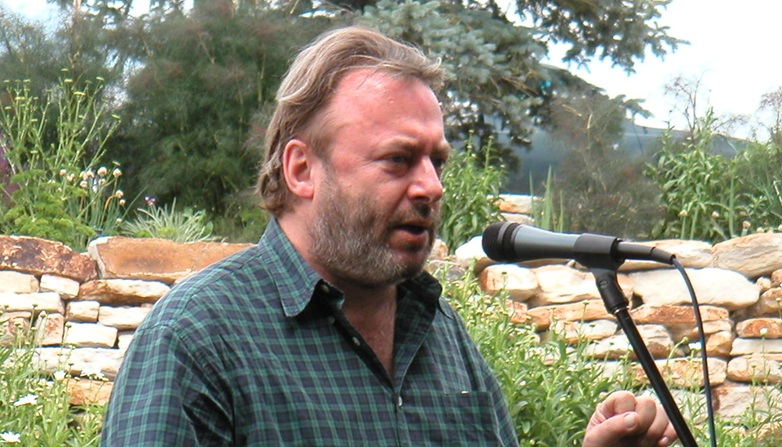
If I were granted three wishes, the first would be to be free of the physical ailments and afflictions which blight my life. The second would be to write like Christopher Hitchens and the third would be to write like Thomas Paine Although in our youth we were in rival Trotskyist groups, Hitchens and I share a number of heroes on the Left, the Pole Jacek Kuron, the Trinidadian CLR James and the Russian Victor Serge. We share an interest in George Orwell, although Orwell’s class origins are nearer to those of Hitchens than to mine. And for both of us Thomas Paine is a hero of heroes.
Both Hitchens and Paine are in that fine tradition of English radical dissent which blasts the pretensions of autocratic rulers and canting priests. Both men were far from teetotal, it was exciting to see the allegedly alcoholic Hitchens lambastes the teetotal Catholic turned advocate of political Islam George Galloway MP. It would have been fascinating to down a glass or two with both men and talk long into the night.
In his autobiography Hitch 22 Hitchens says little about Paine. He writes: “….I read Thomas Paine saying that to have played a part in two revolutions was to have lived to some purpose. This was the sort of eloquence I wish I could have commanded…” The idea of a time before kings and lords and bishops and priests, says Hitchens, can be found in Paine.
Paine is dealt with at greater length in God Is Not Great, a work which ranks beside Paine’s Age of Reason as a demolition of religious orthodoxy. Hitchens writes of Paine, “…his memory has outlasted the calumnious rumour that he begged to be reconciled with the church at the end. (The mere fact that deathbed repentances were sought by the godly, let alone subsequently fabricated, speaks volumes about the bad faith of the faith-based).” He reveals that the Calvinist Abolitionist John Brown kept Paine’s works in his camp.
The magnum opus by Hitchen’s on Paine is Thomas Paine’s Rights of Man. Perhaps The Independent was indulging in hyperbole when it called Hitchens “a Tom Paine for our troubled times”, but there can be no doubt that he writes eloquently and sympathetically about his subject.
Although he only got a third class degree from Oxford, his days were spent advocating socialism and his nights partying and swilling champagne with the middle class, Hitchens has a good knowledge of radical history. He writes at length about the Sheffield file maker and poet Joseph Mather. At a time when what Hitchens calls the “Hanoverian usurpation which endures on the British throne to this day” was adopting God Save The King as the national anthem, Mather penned a parody which began ” God save great Thomas Paine.” It is, says Hitchens, taught in no school and sung in no assembly.
Hitchens discusses the tree of liberty, which Paine’s friend Thomas Jefferson held should be watered with the blood of tyrants. As a radical symbol particularly among the United Irishmen, Rights of Man was translated into Gaelic. He writes that Bums wrote a poem dedicated to the Tree of Liberty, and states that Bums best known poem For ‘a’ That “breathes with a mighty scorn for the conceits of heredity and the heredity principle, so comprehensively lampooned by Paine.” Bums wrote “The rank is but the guinea’s stamp, the man’s the gold for ‘a that.” Paine would have echoed this sentiment.
Of Rights of Man itself Hitchens writes that it is “both a trumpet of inspiration and a carefully wrought blueprint for a more rational and decent ordering of society, both domestically and on the international scene.”
Hitchens reminds us, as Paine stated, that monarchy has a tendency to over breed and inbreed. The spare children which are many are maintained at the public expense. Hitchens compares Burke’s “tear stained” evocation of Marie Antoinette with the hysteria surrounding the mysterious death of Diana Spencer, also in Paris. Hitchens asks ” which European royal house since 1791 has not lamented , like our very own Windsor’s, the ghastly problem of what to do with the proliferating, subsidized and under- achieving offspring? ” Perhaps they should be sent to doss under London Bridge on one of the government’s make work schemes.
Chapter 5 of the book by Hitchens discusses Paine’s The Age of Reason, which he sees as a counterpart and completion. Paine
wrote “The most formidable weapon against errors of every kind is reason. I have never used any other, and I trust I never shall.” Hitchens recounts that when Paine was writing part one of the book he did not have access to a Bible. Hitchens writes: “Paine was an engineer and amateur scientist, and stood on tiptoe to see as far as he could over the existing horizon.”
Hitchens writes that “Paine was a leading member of that British radical tradition that saw wars and armies as additional burdens on the people, and as reinforcements of existing autocracies. What better way for a ruling class to claim and hold power than to pose as the defenders of the nation? And what better way to keep unschooled and unemployed serfs in line than give the king’s shilling and put them into uniform… ” Hitchens seemed to endorse this view. He was on the 1966 CND march from Aldermaston. I too was on that march. He came into politics because of his opposition to the Vietnam war being recruited into the International Socialists, the forerunner of today’s Socialist Workers’ Party. The SWP is now an apologist for political Islam.
Yet by the time of the First Gulf War despite his obvious detestation of George Bush we find Hitchens quoting his fellow Marxist Fred Halliday “You can oppose war, but only by leaving Kuwait in the hands of Saddam…you can be anti-imperialist but you will have to decide if imperialism is worse than fascism” as his defence of what was in essence an imperialist adventure. If Iraq grew carrots rather than produce oil, the West would not have been interested.
Although he had broken with organised socialism, Hitchens still claimed to be a Marxist; still admired Che and Lenin. He had become an apologist for Western imperialism which differs from Saddam and his Ba’ath Party which disgraces the name of socialism as America disgraces the word democracy, only in quantity not in kind. It is as if Paine had joined the Church of Rome on the grounds it was somewhat better than Lutheranism!
Hitchens was a man of many unresolved contradictions. How anyone could find Mrs Thatcher sexy is beyond me. And there are far better examples of the distillers’ art than Walker’s Black Label. But if his writing about Paine encourages people to read Paine’s works he will have earned his redemption.