
By Malcolm Chase
The 2008 Eric Palme Memorial Lecture
His creed was – and Thomas Spence had taught it to him – that ‘the Land is the people’s farm’ and that It belongs to the entire nation, not to individuals or classes. Thus did George Julian Harney, one of the pivotal figures of 19thC radicalism, begin a speech to a Chartist meeting in south London in 1845. I am sure I do not need to explain to this audience what Chartism was; but neither Thomas Spence nor Harney may be familiar to you. Born in 1817 on a troopship lying off Deptford, Harney was the son of a naval rating. Too sickly to follow his father to sea, he started his working life as a potboy in a London pub until, aged seventeen, he was taken on by the great radical bookseller and publisher Henry Hetherington. Hetherington was at the height of his influence, publishing the great unstamped weekly Poor Man’s Guardian and the teenage Harney quickly absorbed his employer’s politics. He had only worked there for a few months when, in October 1834, London’s other great radical publisher of the time, Richard Carille, faced financial ruin when his entire stock was confiscated following his -refusal to pay church rates. Harney’s response was to decorate the window of his employer’s shop with grotesque effigies of a Church of England bishop and the Devil.
Harney was no milk and water radical, demonstrating but never fighting for his beliefs. In the same year as his vivid gesture of support for Carille, he served the first of three prison sentences for selling unstamped newspapers. He was co-founder of what – in effect – was a Painelte club: the London Democratic Association, the largest and liveliest of the capital’s Chartist organisations. From here Harney forged a reputation as one of Chartism’s outstanding national leaders. Then, in 1843, he joined the staff of Northern Star, the mighty Chartist weekly that, at its peak, outsold even The Times (and was thus, by definition, the biggest selling newspaper In history up to that point). As editor of the Star paper, Harney commissioned Frederick Engels to contribute articles on German politics, and he became good friends with both Engels and Marx who, by 1847, was speaking at Harney’s invitation at London Chartist meetings.
Despite the decline of Chartism, Harney’s career as a campaigning journalist continued. He was still writing a regular column of political comment and reminiscence for the Newcastle Weekly Chronicle when he died, aged 80, in 1897. I detail Harney’s political career because he was a pivotal figure in the history of British radical politics, a man who In his youth was the friend of veterans from the London Corresponding Society (LCS); who went on to become a close associate of Mark and Engels, outlived them both and who was writing newspaper columns into the late 1890s, some readers of which would have lived into the 1950s. One of the things that interests me as a historian is the transmission of political Ideas – not so much through the intellectual analysis of the Influence of one great writer upon another, but rather at the ‘grassroots’ level of day-to-day belief and conviction. Is there, after all, more eloquent testimony to the Importance of Thomas Paine than the words of the almost apoplectic Attorney General at Paine’s seditious libel trial in 1792? ‘In all shapes and in all sizes, with an industry Incredible, it [Rights of Man Part 2] was either totally or partially thrust into the hands of all persons in this country . . . even children’s sweetmeats were wrapped in parts, and delivered into their hands, in the hope that they would read it’.
So it intrigues me to see a Chartist of Harney’s stature nailing his political colours so firmly to the mast in 1845, not of Thomas Paine but of the other great radical Tom of the 1790s, Thomas Spence. In 1795 Spence, a London radical printer and author, published The End of Oppression, a dialogue ‘between an old mechanic and a young one’. In It he developed a theme to which he would return several times – notably in his pamphlet The Rights of Infants of 1797 – that Paine for all his manifest merits did not go far enough in prescribing what the future shape of society should be.
YOUNG MAN: I hear there is another RIGHTS OF MAN by Spence that goes farther than Paine’s.
OLD MAN: Yet it goes no farther than It ought.
YOUNG MAN: I understand that it suffers no private property in land, but gives it all to the parishes.
OLD MAN: In doing so It does right, the earth was not made for individuals
YOUNG MAN: It is amazing that Paine and other democrats should level all their artillery at kings, without striking like Spence at this root of every abuse and of every grievance.
So this lecture focuses on Spence’s critique of Paine. It’s not my intention to subvert Paine’s place in history and substitute Spence in his stead; but I do argue that an uncritical deference to Paine’s memory all too easily obscures the contribution of others among his contemporaries to radical political thought. In the field of agrarian ideas especially, that is of Ideas concerning the distribution and tenure of landed property, it was Spence not Paine whose influence was the more decisive. I want to trace that influence through to Chartism (and glimpse beyond it too), by considering Spence’s critique of Paine’s Agrarian Justice (1797) and the subsequent reception of that critique, notably Richard Carilie’s.
Spence’s life has never been accorded the scrutiny Paine has enjoyed and a few biographical details may be therefore helpful. He was born in 1750, the son of an impoverished Newcastle fishing net maker. He probably met the future French Revolutionary Jean Paul Marat during the latter’s residence in Britain In 1765-77. But the formative influences on Spence’s distinctive brand of political radicalism were seventeenth-century and Enlightenment ideas, especially the neo-dassical concept of natural law. The young Spence was also shaped by an iconoclastic Calvinism and until his death his political beliefs had a strongly millenarian tone. His critique of private property was qualitatively different from the customary eighteenth-century radical attack on land as inducing effeminate and corrupting luxury, or for having abrogated its reciprocal obligations to society at large. Private property in land, Spence argued, was a wholesale theft, for the loss of which there could be no act of reciprocity – certainly not the system of taxation and pensions proposed by Paine. In terms of the development of natural law theories of property he may not have made a break as decisive as Paine did; but I would argue that this is – literally – an academic issue. Greater historical significance should be attached to the impact of political ideas on contemporary popular political practice and thinking.
For Spence the original state of nature is a simple axiom and therefore one to which he devotes comparatively little time:
That property in land and liberty among men, in a state of nature, ought to be equal, few, one would faint hope, would be foolish enough to deny. Therefore, taking this to be granted, the country of any people, In a native state, is properly their common, In which each of them has an equal Property.
Spence’s idea of an original state of nature owes a little – but only a little – to divine intervention: there are none of Paine’s contortions in accepting this. In fact Spence does not seem to have been very interested in the issue. Instead concentrating on building up extensive moral and political arguments in favour of the community of property (exactly what he means by community of property is a point to which I shall return). For Spence the true significance of the state of nature was wider than that advanced by Paine in Agrarian Justice. It is as much liberty as land which Is Important in this condition, which in Spenceanism is far from being notional. The biblical authority he emphasised was not Genesis, but elsewhere In the Pentateuch in the early Hebrew republic under Moses. The state of nature on which Spence mainly rested his arguments was not the Garden of Eden. Neither was It John Locke’s or some kind of arcadian wilderness. Rather, in the tradition of the civic humanists of the seventeenth century, It was an economic and social democracy In which an active civic life was possible for all: in the Spencean vision of how society should be, ‘each parish is a little polished Athens’.
Spence therefore rejected any notion of a social contract, arguing that private property in land anathema. ‘Our boasted civilisation Is founded on conquest’; if the ‘country of any people, in A NATIVE STATE is properly their common’, than they jointly reap its fruits and advantages: ‘for upon what must they live if not upon the productions of the country In which they reside? Surely to deny them that right is in effect denying them a right to live?’ It follows from this view that members of any one generation cannot, by personally appropriating the soil, deny rights to that soil to those generations that succeed them. ‘for to deprive anything of the means of living, supposes a right to deprive it of life; and this right ancestors are not supposed to have over their posterity’.
Here again Spence broke free from the prevailing conception – derived from Locke – of the development of private property in land. And here, too, lies the fundamental difference of his views from those of Paine, in the disavowal that time confers innocence upon private property in land. ‘There is no living but on the land and Its productions, consequently, what we cannot live without we have the same property in as our lives’. It should be noted though, that Spence followed Locke in using the term property to embrace selfhood: ‘what we cannot live without we have the same property in as our lives’. It is this property in one’s own life that is the most important of all property rights, and upon which communal rights of ownership in land are contingent. The so-called `right’ of private property in land is no right at all but its very antithesis: a pretence and usurpation sanctioned only by the apathy or ignorance of the population as a whole about their true rights. Any ascendancy over lands is hence an ascendancy over people. Therefore in Spence’s view the issue of land ownership lay at the root of all social inequality, economic exploitation and injustice.
In his early works, Spence advanced the argument that the power of education would suffice to secure universal assent to a system of agrarian equality. It was to be some time after he moved to London, and immersed himself in the radical maelstrom of the capital as it reacted to the French Revolution, before Spence sharpened his perception that other – and more direct – means might be needed to persuade land-owners to yield up their property. His perception of the ends, however, was unchanging – a partnership in every community of the residents of all ages and both sexes, equally dividing between them the revenue from the lease of the land to those who actually cultivated it. Restrictions would be placed on the duration of leases, and the size of holdings. Each community would be self-governing, but joined with others in a federation to coordinate the defence of the nation by citizen militias.
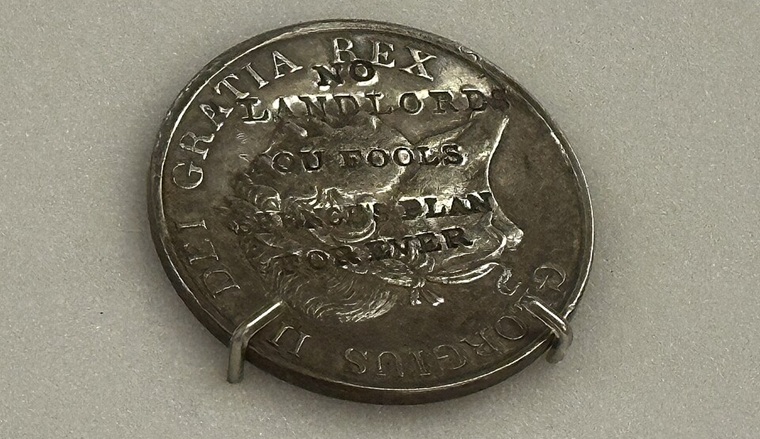
Spence had been a school teacher on Tyneside, but once In London (he moved here In 1788) he devoted himself full-time to radical politics, printing and writing and – his own unique contribution to popular political culture, the manufacture of copper token coins depicting radical icons and figures (including Paine) and inscribed with slogans. From his shop a few hundred yards from what is now Conway Hall, Spence devoted himself to the affairs of the ICS, to whose general executive committee he was a delegate and some of whose publications he printed. In 1793 he was one of a distinguished group of signatories to the Declaration of the Friends of the Liberty of the Press. He was arrested several times, including twice in December 1796 for selling Tom Paine’s Rights of Man. In 1794 Spence was detained without trial for seven months on suspicion of high treason. Imprisonment only had the effect of galvanising him more. Soon after his release he published the pamphlet to which I referred earlier, The End of Oppression. Here Spence re-evaluated the means by which his reforms could be secured and conceded for the first time that compulsion would be necessary. It was at this point that he attacked other reformers (Paine included) for passing over the critical issue of agrarian reform. Not only did Spence now explicitly endorse the use of force to secure radical objectives, he was emphatic that the destruction of the economic basis of political power must be chief among those objectives. It was a controversial and far-reaching step, and it met with considerable opposition among metropolitan radicals. Spence answered with his biting satire Recantation of the End of Oppression, containing this barely-veiled reference to Thomas Paine:
Adieu then to striving against the stream, since the readiest way to get to port is to go with it. So here goes, my boys, for an estate and vassals to bow to mei Who would not be a gentleman and live without care! Especially a democratic gentleman without a king. Avaunt rights of man! I am henceforth a democrat, but no leveller.
Spence further developed his critique of Paine in The Rights of Infants (1797). It also contained an extensive argument in favour of women’s rights, including the vote. This concern to widen the constituency of radical politics was also reflected in his continuing preoccupation with education and it was as an educator and author that he was mainly content to concentrate his energies. However from the beginning of the nineteenth century until his death In 1814, Spence attracted a small but loyal circle of followers, the Spencean Philanthropists. His book The Restorer of Society to Its Natural State, published in 1801, the year the Spencean Philanthropists were founded, again reiterated the justice of applying force to secure reform, this time invoking the examples of the American and French Revolutions and the British Naval Mutinies of 1797. For this he was arrested and tried for seditious libel. William Cobbett attended his trial: `he had no counsel and insisted that his views were pure and benevolent. . . He was a plain, unaffected, inoffensive-looking creature. He did not seem at all afraid of any punishment, and appeared much more anxious about the success of his plan than about the preservation of his life’.
Spence was jailed for a year. It ruined him financially. On his release he resumed bookselling from a barrow, usually stationed in Oxford Street and more enterprisingly sometimes in Parliament Street, Westminster. But the Spencean Philanthropists continued to meet and were responsible for a flurry of publications in which their leader’s ideas were further refined to embrace forms of public ownership for ‘Shipping, Collieries, Mines and Many other Great Concerns’. It was they who organised Spence’s funeral in 1814.It Is clear from the Spence’s Recantation of the End of Oppression, that his very real admiration for Paine was tinged by envy – and this even before Paine’s Agrarian Justice was published. The latter served only to strengthen Spence’s conviction that republicanism alone would not suffice to secure real justice. The very name of its author secured for Agrarian Justice an audience far beyond Spence’s vainest hopes. One senses a certain righteous indignation that Paine (for selling whose publications Spence had after all been twice Imprisoned) should venture upon specifically agrarian reform entirely without reference to him. We can only conjecture how far – if at all – Paine was acquainted with Spenceanism.
Like Spence, Paine postulated the historical reality of the state of nature, in which the right of every individual to an equitable share of the soil was absolute; both believed that such a situation was still obtained among North American aboriginal peoples. In such a state, Paine points out, there were none of,
…those spectacles of human misery which poverty and want present to our eyes In all the towns and streets of Europe. Poverty therefore is a thing created by that which is called civilized life. It exists not in the natural state.
Spence and Paine therefore shared their primary supposition: but thenceforward their proposals diverged. Paine does not countenance the real yet figurative state of nature that Spence sought to restore. On the contrary, he held that, it is never possible to go from the civilised to the natural state’, because the latter was Incapable of supporting the level of population that, through manufactures and commerce, could in civilisation.
The problem as Paine perceived it therefore was not really agrarian at all: it was one of poverty. ‘I am’, he declared, ‘a friend to riches because they are capable of doing good. I care not how affluent some may be, provided that none be miserable in consequence of it’. Thus it was that he posited in Agrarian Justice that all landowners should pay ‘to the community a ground-rent’, to be accumulated in a national fund. From the latter every person reaching the age of 21 would receive a bounty of ‘Fifteen Pounds Sterling, enabling him, or her, to begin In the World’; and all persons aged fifty and over would receive an annuity of £10, ‘to enable them to live in Old Age without Wretchedness, and go decently out of the world’. Having made this postulation, virtually the rest of Agrarian Justice is devoted to the arithmetic of the proposal – calculations no more or less spurious than those which feature in the writings of other reformers – Cobbett, say on how the population of early C19th England was declining, or Robert Owen on how much more productive the soil can be If ploughs were abandoned in favour of spade husbandry.
Paine’s proposals had sufficient in common with Spenceanism for Spence to feel perhaps that his Ideas were In danger of being eclipsed. But mainly Spence was irked by Paine’s refusal to return to first principles and disavow that the passing of time rendered private property in land morally innocent. Agrarian Justice would extend no democratic control over the land, and no opportunity for the landless to return to it should they so wish. In Spence’s view, Paine’s plan would effectively reinforce the landed interest by incorporating it into a centralised state system of welfare payments.
Under the system of Agrarian justice, the people will, as it were, sell their birthright for a mess of porridge [sic], by accepting a paltry consideration in lieu of their rights. . . . The people will become supine and careless in respect of public affairs, knowing the utmost they can receive of the public money.
This was a major issue for Spence, the latter-day civic humanist in each of whose little polished Athens’ there would be extensive public participation in the processes of government He was quick to point out that Paine’s version of Agrarian Justice would give use to ‘the sneaking unmanly spirit of conscious dependence’. In Spence’s opinion, his own plan would be an incentive to vigilance over public expenditure, necessitating parliamentary democracy and stimulating education. His greatest fear was that Paine’s vision of Agrarian Justice would deteriorate into a placebo for social ills, masking the continuation of oppression. For Spence, the distribution of property, rather than political systems in themselves, determines the real character of a nation and the liberties it enjoys. ‘What does it signify whether the form of government be monarchical or republican while (landed) estates can be acquired?’, he demanded.
This critique of ‘Paine and other democrats who level all their artillery at kings’ Is essentially a civic humanist one. Indeed, it is the formative thinker of British civic humanism, the philosopher James Harrington, whom Spence quotes more frequently than any other author in his writings. If there is a pivotal transitional figure in the development of radical ideas about property It is Spence, not Paine. The hitter’s Agrarian Justice represents at most a fine-tuning of the secularisation of natural law arguments. It is doubtful what impact – if any – these actually had. In the nineteenth century Agrarian Justice received little attention other than as a coda to its author’s earlier and more significant works. It was not reprinted after the 1790s until William Sherwin’s edition in 1817; Guide produced another (1819). It then lay dormant until the 1830s.
Why this neglect? Great as his reputation as a democrat and polemicist was, Paine’s Agrarian Justice is deficient as an argument for land reform. Its most eye-catching proposal, for old age pensions, simply repeats without much elaboration remarks he had made in Rights of Man Part 2. Its fiscal proposals, concentrating as they are due on death duties, are arguably less radical in scope and intent than the progressive taxation proposed In Rights of Man. Paine’s Agrarian Justice was markedly less-Innovative in character than the work of Thomas Spence, and it was less-precise In identifying the roots of injustice – all this without the compensatory merit of being any more plausible or practicable. Arguably, it reveals an estrangement between its author and English popular radicalism, the consequences maybe of its author’s years of exile. This so-called agrarian reform, doing nothing to reduce the power of the landed interest, attracted little attention other than on account of its author. It was Spence’s agrarianism which more commonly informed theory and practice in the early labour and radical movements. This is evident even in the writings of Richard Carille, where Paine’s writ might have been assumed to have prevailed.
For example in November 1822 Cartile, in an extensive review and critical development of an otherwise obscure pamphlet on taxation reform, rejected its argument that financial investments should alone be subject to taxation, thus creating an equitable tax that would avoid discriminating against the poor whilst taxing only those able to pay. CarHie was not opposed to implementing a socially progressive tax regime; but he argued that to base a so-called `equitable tax’ on investment in the funds would Ipso facto be an affirmation of the legal and moral right to such property. Carifie opposed this: ‘land, and land only’, he argued, was ‘the only tangible property’. The only sensible, and morally defensible, equitable tax would be ‘the Spencean plan . . certainly the most simple and most equitable system of society and government that can be imagined’. The Spencean plan, Cattle continued, had been run down by its critics without proper examination. It was eminently suited to immediate adoption by the emerging republics of Latin America but it was vain, he went on, ‘to urge it against the prejudices of those who have established properties in this country’.
Instead, Cattle argued for a single equitable tax on land as the most effective social and financial strategy for a reformed parliament to pursue. The owners of large estates, much of them unproductive shooting land or parkland, would be forced either to give them up or turn them over to productive cultivation in order to meet the burden of the tax. This incentive to full cultivation was in turn a guarantor of greater employment, which would in turn increase demand for goods and produce that – because no longer taxed – would be more affordable.
Thereafter the ‘equitable tax’ would be a recurrent feature of Carfile’s political thinking. And whenever he returned to the land question, he would cite Thomas Spence as his prime authority, reiterating the merits of equitable taxation:
The sentiment of Thomas Spence, that THE LAND IS THE PEOPLE’S FARM, is incontrovertible by any other argument than that of the sword. The land cannot be equitably divided among the people; but all rent raised from it may be made public revenue, and to save the people from taxation.
The case against agrarian monopoly and usury . . . the two master evils of society’ was one of the few economic issues (perhaps the only one?) Carlfie consistently advocated across his long and turbulent career. Indeed, this was the economic policy that sat alongside his advocacy of Paineite republicanism in the political arena. Less than four years before his death, Celine engaged the Chartist leader Bronterre O’Brien in a heated exchange on agrarian reform:
Here is a subject worth thinking, worth talking, worth wilting, worth printing, worth a Convention. Universal Suffrage, in the present state of mind, and church, and kings, and priests and lords, is all humbug and trickery compared to it.
And he concluded by repeating the ‘People’s Farm shibboleth’, concluding, ‘I am for getting the rent paid to the right landlord’.
This is an instructive moment in the history of radicalism. Richard Garble, perhaps Paine’s foremost disciple, urged the nascent Chartist movement to abandon universal suffrage in favour of Spencean land reform. Carlile had republished Agrarian Justice but, clearly, he regarded Spenceanism as the more authoritative marker on the issues of agrarian and fiscal reform and – no less-crucially – more-familiar to his readership. It seems reasonable to conclude that CarlIle regarded Spencean theories as central to the pedigree of radical ideas about property and taxation in a way that Paine’s were not.
In doing so Carille was not alone, as I indicated when I begun with Hamey’s tribute to Spence and the concept that ‘the land is the people’s farm’. Robert Owen recounted with pride in his autobiography how he was once mistaken for Spence. Francis Place, architect of the repeal of the Combination Acts which had made trade unions Illegal between 1798 and 1824, endorsed the views ‘of my old and esteemed friend . . . making the whole country the people’s farm’. The innovative thought of Thomas Spence on the issue of land reform was a bench-mark to which subsequent radicals (and sometimes their opponents) often referred. Among opponents, for example, Thomas Malthus singled out Spence for special criticism in the extensively revised 1817 edition of his Essay on Population. And John Stuart Mill warned of the dangers of falling ‘into the vagaries of Spenceanism’. Marx enlisted Spence in his German Ideology. Beyond Chartism, Spencean Ideas became a point of reference for a variety of reformers, including the pioneer of the Garden City movement, Ebenezer Howard. The rediscovery of Spence by H. M. Hyndman was especially significant. In 1882, at the insistence of Henry George, Hyndman republished what he described as ‘Spence’s practical and thoroughly English proposal for nationalisation of the land’. This was the first of three important late nineteenth-century reprints of Spence, the others being the Initiatives of the English Land Restoration Society in 1896, and the Independent Labour Party Labour Leader in 1900.
But it Is within Chartism that Spence’s influence was particularly influential and this, I suggest is significant because – with over 3 million supporters at its zenith, the Chartist movement was (as it remains) one of the high points in the history of British popular politics. It was in effect Britain’s civil rights movement, and we should not let its concentration upon securing the vote for men alone obscure the fundamental challenge that it posed to the political establishment of early Victorian Britain. And that establishment, of course, was still overwhelmingly a landed one.
Throughout the years after his death, former members of the Spencean Philanthropists were pivotal figures in London radical politics. For example, the London Democratic Association, the organisation that absorbed G J Harney’s earliest Chartist energies counted among its members several influential Spenceans, including Spence’s biographer, the poet and early socialist Allen Davenport, and the Brick Lane tailor turned radical bookseller Charles Hodgson Neesom (who, in 1847, would go on to be a founding member of Britain’s first ever Vegetarian Society). The young Harney was profoundly influenced by the Spencean generation and In turn – disseminated awareness of Spence through the Northern Star. Studies of Chartist attitudes to landed property have overwhelmingly focused upon its Land Plan, a remarkable (though, sadly, also remarkably flawed) initiative to settle its members on the land in cottage smallholdings. It speaks volumes for the extent of popular interest in agrarian reform that the Land Plan could mobilise well over 70,000 subscribers in the teeth of the economic crisis of 1847-1848.
But the sheer scale of the land plan has obscured the extent to which agrarian ideas were central to all currents within Chartism. Furthermore, historians traditionally have had difficulty reconciling the sturdy possessive individualism of the Plan with those other arguments within the same movement, for public ownership of the soil. Chartists advanced arguments for, variously, forcible re- appropriation, land and building societies, a free market in landed property, deeply radical taxation regimes and, from 1850, `the Charter and something more’ (a social democratic programme with land nationalisation at its heart).
Yet three common elements underpinned them all. First was an outright hostility to large accumulations of landed property, irrespective of the legal form in which they might be held. Thus, secondly, Chartism was suspicious of the central government as the putative owner or manager of the national estate. Thirdly, all Chartist conceptions of the reform of landed property shared a ‘way of seeing’ land that was shaped by ideas of shared access, usage and control rather than by possessive individualism. These three elements very much encapsulate the essence of Spence’s thinking.
A powerful adjunct to this argument was that – of all methods of organising land holding – smallholding maximised the productivity return from labour input Into the soil. This in turn would alleviate poverty by widening employment opportunities and the production of plentiful food countering the spectre of starvation, so frequently used by Whig Malthusians to justify the reform of the poor law. This notion was itself powerfully rooted in contemporary idealization of spade husbandry (just about the only principle held consistently and unanimously by three of the greatest figures of early 19th century radicalism, William Cobbett, Robert Owen and Feargus O’Connor). Even Bronterre O’Brien, the Land Plan’s fiercest critic from within the Chartist movement, eulogized smallholding.
The development of arguments favouring large-scale collective farming was an ideological Rubicon that none of the Chartists ever crossed. Land nationalisers and Land Planners alike favoured small- scale cultivation. Support for land nationalization certainly did not equate with any interest in the collectivization of agriculture. For the Chartists, suspicion of centralizing state power was a leitmotif. This, like the promotion of the smallholding ideal, was one of the elements that bound together supporters of the Land Plan with its critics in the movement. And it was an element which acted to curtail enthusiasm for land nationalization, because the mechanism needed to administer the national estate was essentially incompatible with the Chartist concept of light government nationally and significant local autonomy. The main Chartist land nationaliser, Bronterre O’Brien’s response to this was to argue (just as Thomas Spence had done) in favour of local community control, once the nationalisation of property in soil had been secured by nationwide legislation.
For Chartists of every persuasion, the first duties of a reformed parliament would include land reform. For, to quote the movement’s great newspaper Northern Star once more:
Monopoly of land is the source of every social and political evil . . . every law which ‘grinds the face of the poor’ has emanated from time to time from this anomalous monopoly . . . our national debt, our standing army, our luscious law church, our large police force, our necessity for ‘pauper’ rates, our dead weight, our civil list, our glorious rag money, our unjust laws, our game laws, our impure magistracy, our prejudiced jury system, our pampered court, and the pampered menials thereunto belonging, are one and all so many fences thrown round the people’s inheritance.
The land plan’s presiding genius and Chartism’s greatest leader, Feargus O’Connor, specifically interweaved mechanisation into this catalogue of injustice:
What is the loud demand of the working people for a plain, simple, and efficient PLAN for practical operations on THE LAND, but the effort of man to regain his natural position, from which he has been dislodged by the combined operations of high-taxation, paper-money, and an unduly- hot-bed-forced amount of manufacturing machinery?
This abiding perception of history as a continuing decline in the people’s fortunes re-echoes both Spence and William Cobbett and it had an important impact on Chartist Ideology. It meant that even within the deepening economic problems of the 1840s, an agrarian analysis of contemporary problems – and an agrarian prescription for them – was not redundant. The key social problem that Chartists perceived was not so much a society that was rapidly industrialising, but a society that was increasingly divided (politically, socially and economically) between rich and poor.
To sum up, then. All Chartists agreed that land reform would be a political, economic and social imperative for a reformed parliament. There was virtual unanimity that the basis on which land should be held for cultivation must be that of smallholdings and small farms. The emergence of arguments in favour of land nationalization was attenuated by a continued disposition in favour of small-scale ownership (which In time meant ex-Chartists were a significant element with the emergence of building societies). The concept of land nationalization was also constrained by suspicion of the State and its centralizing tendencies.
Was there a single defining feature of the various Chartist positions on land reform? I would argue there was, and I would describe it as neo-Spencean. It is a commonplace of Chartist historiography that the movement appealed particularly to displaced domestic outworkers such as handloom weavers. A disposition towards small-scale production is evident too in Chartist agrarian ideology. The movement’s overarching political outlook privileged issues of equity and access over that of public ownership. Access to – and control of – the land, rather than the democratization of ownership itself, was the essential basis from which all Chartist land reform emerged. The ostensibly Janus-headed stance of the Chartists, at once critical of private ownership of the soil and yet zealous In promoting smallholdings, ceases to be problematic once we register that the key issue for all Chartist land reformers was access to – rather than direct ownership of – the land.
And so in conclusion I return to where this lecture began, with George Harney, the main architect of the 1851 ‘Charter and something more’ social democratic programme, telling his audience of Londoners: ‘His creed was – and Thomas Spence had taught it him – that “the Land is the people’s farm”, and that it belongs to the entire nation, not to individuals or classes’. When Spence spoke of ‘the real rights’, or ‘the whole rights’ of man, he was signalling that the profoundly radical prescriptions of Thomas Paine had to become more radical still. Republicanism, even accompanied by a fiscal regime of progressive taxation, would not alone suffice to restore humanity to the natural state Spence believed possible and necessary. In Chartism’s emphatic drive for radical parliamentary reform, we can see the working out of Paineite thinking. And in the same movement’s impulse towards agrarian reform, we can see the working out of Spencean thinking. Tom Paine and Tom Spence walked with the Chartists: both should walk with us still today.