
By Zofia Libiszowsk, University Of Lodz
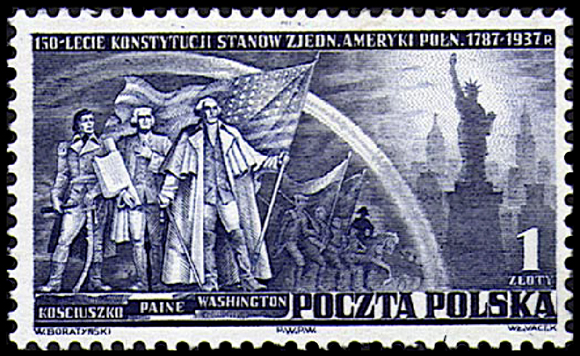
Poland in the 18th century was in decline. The first partition of the country among its three neighbouring powers occurred in 1772 without contradiction on the part of Europe and with England’s acquiescence. Thomas Paine could have been aware of this because the English press published information about it and even satirical engravings appeared illustrative of this unprecedented event which violated the principle of the balance of power (equilibre European).
However, the first partition gave rise to the awakening of the Polish nation. In order to save the state and its endangered independence fundamental reforms were to be undertaken and all social power and activities activated. The privileges and habits of magnates had to be curbed and parliamentary anarchy overcome. In Poland in the last quarter of the 18th century the splendour of the enlightenment was glorified in an attempt to overcome the country’s backwardness in comparison to Western Europe.
The reforms of the Four Years Diet (1788-1792), which is called the Great Diet, amongst the best known being the Constitution of May 3, 1791, were a result of these endeavours. Next to the Constitution of the United States, the Polish Constitution was in advance of even the French Constitution of September 1791. The most important article of the May Constitution was the law of towns which gave civil rights to the burghers. This gave birth to the Tiers Etat in Poland where the nobility voluntarily renounced part of their privileges and the peasants given the protection of the law. In place of an hereditary monarchy an elective monarchy was introduced and the elector of Saxony, Frederick Augustus was elected heir to the Polish throne with his daughter having the possibility of becoming his successor.
Decisions were taken concerning the security of the state and financial measures adopted to pay for the defence forces. The Constitution was for the most part based upon Anglo-American models which aroused admiration although it also roused doubts and opposition. The Polish court was following European attitudes and attitudes resultant upon the publicity changes had brought, as are recorded in newspapers as well as diplomatic and private correspondence.
Amongst English politicians it was Edmund Burke’s eulogy which resounded the loudest and was included in his pamphlet Appeal to the New Whigs, a polemic against Thomas Paine and his radical supporters. Within the context of polemics Paine’s name appears for the first time in Poland, where his ideas soon gained support. During his time in the United States, Paine had met Tadeusz Kosciuszko and it may be he also met other Polish volunteers taking part in the War of Independence, although no information on this reached Poland, where lengthy extracts from Paine’s, Common Sense, were published in translation in the Polish press (Gozeta Warszawska, May 25, 1776), although it was wrongly ascribed to John Adams’ Manifesto. Large parts from Common Sense also appeared in the Polish translation of Abbe Raynal’s work (1783). It can be presumed that the Polish press also reprinted excerpts from the Crisis papers, although these are not easy to identify as the Polish press printed many comments and opinions about the American Revolution.
Following his return to Europe, Paine travelled between France and England. In Paris he associated with a circle of friends which included Jefferson and La Fayette and through these he came into contact with the Polish Princess Lubomirska, S. Potoki and S. Piattoli. He also became acquainted with American agents working for the Polish king, Stanislaw Augustus Poniatowski such as Lewis Littlepage and Philip Mazzei. He was also familiar with John Adams’ Defence… (1784), which has a critical chapter dedicated to Poland. Paine also took an interest in the Polish monarch, Stanislaw Augustus, described as ‘le Roi Philosophe’ or `Citizen King’, and told Thomas Christi that although being an enemy of monarchy he would like to take away much of the power from existing kings and hand it over to Stanislaw Augustus (T. Christi to the Polish king, May 22, 1791. Ms. Czart, Krakow, No.938 – pp.633-655). To judge by this letter, Christi not only told the king about Paine’s Rights of Man but also included a copy along with his own pamphlet replying to Burke. S. Piatolli purchased a copy of Rights of Man for the library of Ingnatius Potocki the leader of the Polish Patriots. There is, however, no reference to Polish changes in the first part of Rights of Man, although the Diet was in full session when it was written.
In England news about the new Polish Constitution was well received, and because of the events in France excited much interest. To conservatives the Polish Law of Government was considered a different reform to what was taking place in France and was considered to be based on the British parliamentary monarchy (Burke), while the left Whigs as well as the radicals considered it as a revolutionary step and another step in the process began by the French Revolution.
The Polish ambassador in England, Francis Bukaty, reported that Paine was unpopular with the English government and steps had been taken not to ban any celebration of the anniversary of the outbreak of the French Revolution, festivities for which had been announced for July 14, 1791 and in which Paine was to have participated. Despite government hostility around 900 supporters of the Revolution gathered together at the Crown and Anchor tavern to celebrate. Amongst the many toasts proposed was one expressing ‘good wishes to the Polish revolution’.
Paine does not refer directly to changes in Poland in Part Two of Rights of Man, but he does state that in contradiction to a hereditary monarchy ‘Poland, through an elective monarchy, has had fewer wars than those which are hereditary’, adding, ‘and it is the only government that has made a voluntary essay, though a small one, to reform the condition of the country’. A few pages further he characterises features of a republic and considers Poland a country which have effected to style themselves a republic. ‘Poland called itself a republic, which is an hereditary aristocracy, with what is called an elective monarchy’. And that is all which was written about Poland in transition.
Although Thomas Paine did not say much about Poland he was regarded there as a supporter of the Polish Constitution, probably because of the words of praise for it from his circle of friends. Paine’s name was also associated with celebrations and demonstrations commemorating the Polish Constitution. When the first anniversary of the Constitution was celebrated in London on May 3, 1792, the participants were supporters of Paine, though the Polish ambassador, who was invited to the gathering at the Mitre Court tavern, anxious not to upset the court and the government, apologised for not attending because of official duties. The meeting also supported the notion of universal revolution and Burke came in for condemnation for his political blindness. Revolutionary songs were sung and the author of Rights of Man toasted. The last demonstration at which such slogans were expressed occurred when the third anniversary of the French Revolution was celebrated at a time of Russian military intervention in Poland was occurring and war was taking place with France. The demonstration was supported by the extreme radicals and Thomas Paine cheered and the desire expressed that the ‘Revolution in France and Poland be a challenge to all despots on earth’.
The last gesture of friendship of the English nation towards Poland was a goodwill subscription with support from representatives of governmental and parliamentary circles, merchants and businessmen as well as the radical opposition (letter of T. Christi to the Polish king, AGAD Warsow. 2b. Popiel Coll. 206. 3 August 1792), as the latter were supporters of Thomas Paine they preferred anonymity in order not to evoke the animosity of the bitter enemies of the French Revolution. In a long letter to Stanislaw Augustus, Thomas Christi characterised the feeling at the celebration as being of general sympathy for the Polish cause and the wish to help it (August 3. 1792. AGAD Warsaw. Popiel Coll. 206). The May 3 Constitution was abolished in Poland following the second partition of the country by victorious despots.
Thadeus Kosciuszko, who took part in the American War of Independence and, like Paine, an honorary citizen of France, did not give up the struggle for independence. With the support of the then Girondistic legislature he set off the insurrection as a last fight to save, if not the country, then at least its honour and dignity.
In the days when Thomas Paine fell victim to Jacobinic terrorism the Polish people struggling for their rights had recourse to his ideas. This idea came from “Polish Jacobins” and from the leaders of the insurrection and, one can suggest, from Kosciuszko himself. A German edition of Rights of Man had been prepared in Poland. The editor of The Free Warsaw Gazette (Gazeta Wolna Warszawska), the newspaper of the insurrection, stated that: ‘The work of Thomas Paine Rights of Man had reached in a short space of time nine editions, 50,000 copies of which had been bought with enthusiasm in England alone, it will always remain for mankind of inestimable value and for despots a fearful act’.
Paine’s later works, The Age of Reason and Agrarian Justice also found their way to the libraries of Polish statesmen. Paine’s close friendship with Kosciuszko was renewed after his captivity. R.R. Palmer, the author of the fundamental work, The Age of Democratic Revolution, says Paine considered the possibility of applying for Polish citizenship, although no confirmation of this can be found.