
By Terry Liddle
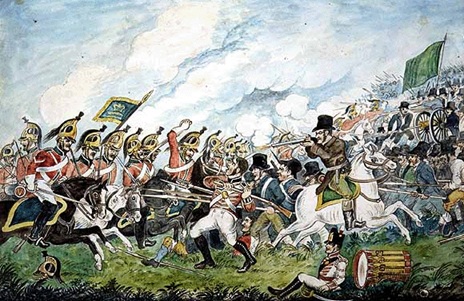
This year sees the bicentenary of the Irish rebellion, part of a world historic process which started in America in 1776, continued in France and included such events as the slave revolt in San Domingo and the struggle of Paine’s colonies in the South American struggles for independence. Starting with high hopes of uniting a Protestant middle class in search of political rights and a land hungry Catholic peasantry, breaking the connection with England, emulating America and France and establishing a republic of liberty, equality and fraternity, it ended with the rebels being shot down with musket and cannon and slashed down with yeomanry sabres in unequal battles such as that at Vinegar Hill in Wexford. Pikes and courage were no match for the redcoats fire-power. To their cost. The Scots had discovered that at Culloden. For the Scots the price of rebellion was the Highland clearances, for the Irish it was An Gorta Mor, which English history calls the famine.
The influence of Paine’s political thought on the Irish rebels cannot be underestimated. In the Ireland of 1790 many minds were fixed upon the French Revolution. For Burke, Ireland was either a strong dike to keep Jacobinism out or a broken bank to let it in. It was in reply to Burke that Paine wrote Rights of Man, a work which many in Ireland read with enthusiasm. For Protestant Dissenters in Belfast, Rights of Man became their Koran. Influenced by their fellows who had been in the forefront of the American War of Independence in which Paine himself played a major role, they formed, in Wolfe Tone’s words, ‘…the flower of the famous volunteer army of 1782 which extorted from the English minister the restoration of which is affected to be called the constitution of Ireland’. At a time when the nation was fairly divided into two great parties, the Aristocrats and the Democrats, Rights of Man not only influenced the middle class Dissenters but also the Catholic peasantry; indeed it sold more copies in Ireland than in England and Wales together. From Connaught to Wexford, peasants in market places and taverns discussed Rights of Man. A teacher was exposed as a rebel spy when a copy of The Age of Reason was found on him and there were reports of the book being sold in Mayo. For many inspired by Paine liberty and equality were no mere slogans and the republic more than an end to rents and taxes. What they wanted was a social revolution.
Wolfe Tone, the son of a coachmaker, had studied law. Despite obtaining a degree, he claimed he knew as much about law as he knew about necromancy and turned his hand to political pamphleteering. Tone’s work struck a chord and after a celebration of the French Revolution, a Society of United Irishmen was formed in Belfast to be quickly followed by a Dublin society. Paine was made an honorary member. The United Irishmen complained that at a time when ‘…the Rights of Man are ascertained in Theory and that theory substantiated in practice…when unjust governments are falling in every quarter of Europe… we are ruled by Englishmen and the servants of Englishmen…’ Their remedy was ‘…an equal Representation of all the people in Parliament’. It was proposed that the country be divided into 300 constituencies with a vote for every man. There was even a proposal that women be given the vote. Other proposals included annual parliaments, no property qualification for public representatives and payment for members of parliament. Thus the United Irishmen anticipated the demands of the Peoples’ Charter by nearly half a century.
Echoing Paine, Tone wrote, ‘The greatest happiness of the greatest number. On the rock of this principle let this society rest; by this let it judge and determine every political question, and whatever is necessary for this end let it not be accounted hazardous, but rather our interest, our duty, our glory and our common religion. The Rights of Man are the Rights of God and to vindicate the one is to maintain the other’.
The United Irishmen maintained contact with similar radical societies in England and Scotland. In Margate, Arthur O’Connor and Father Quigley were arrested in possession of a large sum of money and incriminating documents, one of which was allegedly an invitation from English Jacobins in France to stage an invasion. It was thought they were en route to a meeting with the United Britons. At their trial O’Connor was acquitted, Quigley was sentenced to death. He was hung and then beheaded. Among the literature being distributed by English Jacobins at this time was Paine’s Agrarian Justice. When the Irish rebellion broke out, the London Corresponding Society issued a supporting address which called upon British soldiers to refuse to act against the Irish. The authorities ordered a general crackdown and in 1799 most leading English Jacobins were behind bars, often being held in the most appalling conditions.
In Scotland the government had struck much earlier. Thomas Muir, a young advocate, received fourteen years’ transportation for participating in a convention of Scottish reform societies. His “crimes” were circulating Paine’s works and reading an address from the United Irishmen. T.F.Palmer received seven years for encouraging the reading of Paine and membership of a Dundee society. Back in England, Thomas Hardy of the London Corresponding Society had been luckier. Charged with high treason in that he had expressed sympathy with the French revolution and distributed Paine’s works, he was found not guilty. Everywhere Rights of Man struck terror into the ruling class and it reacted accordingly.
In Ireland repression drove the United Irishmen underground, transforming it from a society of constitutional reformers into a revolutionary movement and Tone went into exile. He first went to America and then to France. In Paris he met Paine, who was already on friendly terms with James Napper Tandy of the Dublin United Irishmen. While describing Paine as vain and critical of his drinking habits, Tone wrote of Paine, ‘He has done wonders for the cause of liberty, both in America and Europe, and I believe him conscientiously to be an honest man’.
Tone managed to enlist the aid of the French for a landing in Ireland. A first attempt in 1796 had to be aborted when foul weather scattered the ships and prevented the troops getting ashore. Paine, who was still advocating a French invasion of England as late as 1806, noted. `The suspicion that England governs Ireland for the purpose of keeping her low…will always operate to hold Ireland in a state of sentimental hostility with England’. Paine commented on Irish events in Le Bein inform’, one issue of which detailed his friendship with Thomas Muir.
In Ireland the authorities had unleashed a reign of terror. Martial law had been proclaimed and the yeomanry, a kind of territorial army in which many members of the sectarian Orange Order had been enrolled, on the pretence of searching for arms wrecked and burned homes and carried out floggings and even hangings.
In Dublin in May 1798 despite the loss of many arms, the arrest of leaders such as Edward Fitzgerald and a disrupted organisation riddled with informers, the United Irishmen decided to rise. The signal for the rising was to be the interception and burning of the mail coaches. This went off at half cock. In many areas the rebels failed to muster and where they did often had not a clear plan of action.
In some areas the people were panicked into rising. The activities of the yeomanry who flogged, tortured and even murdered anyone thought to be a rebel spread fear of an Orange pogrom. A desperate people, sometimes led by their priests, resisted with scythes, spades and stones, anything that came to hand. Atrocity was answered with atrocity.
Where the rebels managed to form something like an army, they marched to the tune of the Marseillaise. Officers wore a green cockade on red regimentals and other ranks a green or white hatband.
In Wexford Ireland’s first republic was set up. Liberty and equality as well as Erin go Bragh were the watchwords. Officers were elected, a committee of public safety established, food rationed and paper money put to practical use as pipe lighters and musket wadding. A new anthem, Cod Save The Rights of Man replaced God Save the King. Many politically minded artisans looked to the abolition of a ruling class who `consider the people an inferior and degraded mass’.
In August, a small French force led by General Humbert had landed in Mayo. By September it had surrendered. It was in Mayo that month that the last battle of the rising was fought. By October 2nd., the English were celebrating victory.
Tone himself had again set sail for Ireland but after a hard fought sea battle in which he commanded a battery of guns, he was captured by the English. Back in Dublin he was sentenced to be hanged despite requests to be shot. History records that he took his own life, many think he was murdered.
Irish history since 1798 is well known – failed risings, civil war, partition and a thirty year struggle in the six counties. At the time of writing,* a fragile peace has been broken by riots in Portadown triggered by an Orange march. Sectarianism has mostly been triumphant, Protestant and Catholic only rarely uniting in a common cause. Ireland, it seems, has a long way to go before the democratic, republican ideas of Paine and Tone are realised.
*The manuscript was received in June.