
A Talk by Christopher Hitchens at the Brighton Festival on Thursday, 25 May, 2006.
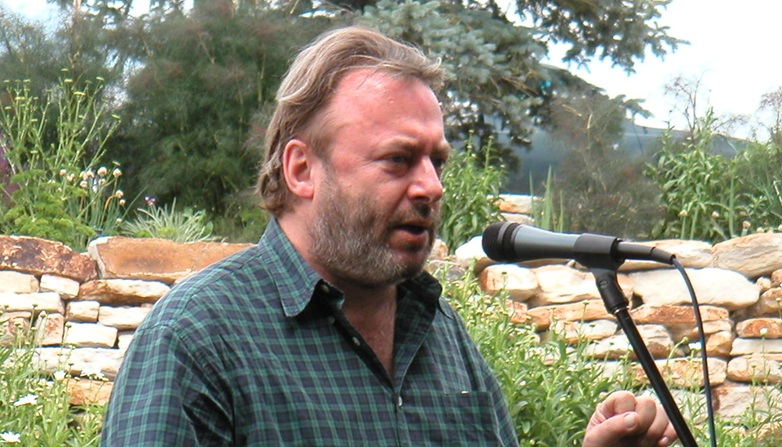

Chris Staples went to this talk with some foreboding, as a person of left wing sympathies, I had felt alienated by Christopher Hitchens’s progression from a broadly left-wing position to that of being a high priest of the right. However, I knew that Hitchens was about to publish a new book about Thomas Paine and that his talk was to inaugurate a regular series at the annual Brighton Festival about a fascinating historical figure who spent much of his early life in the nearby town of Lewes.’ Moreover, I hoped to hear an articulate case put forward by an admirer of Paine for supporting Bush, Blair and their allies and their foreign policy.
The best part of the talk came in the first five minutes when Hitchens projected a short poem of two verses composed by Arthur O’Connell when being sentenced for being an Irish patriot.
The pomp of courts and pride of kings
I prize above all earthly things
I love my country: the king
Above all men his praise I sing.
The royal banners are displayed
And may success the standard aid.
I fain would banish far from hence
The Rights of Man’ and ‘Common Sense’
Confused to his odious reign
That for to princes, Thomas Paine!
Defeat and ruin seize the cause
Of France, its liberties and laws!
At first sight this appears to be an attack on Paine and his doctrines but closer examination reveals a different story.
If one reads the first line of the first verse and follows this with the first line of the second verse followed by the second line of the first verse and then the second line of the second verse and so on, its true meaning is shown. So we have:
The pomp of courts and pride of kings
I fain would banish far from hence
prize above all earthly things
The Rights of Man’ and ‘Common Sense’
etc.
After this promising start, the talk degenerated into a very generalised account of Paine’s life, which did not provide any insights, which would be new to any TPS member. Hitchens took an inordinately long time over this exercise but I hoped that the question and answer session might prove more scintillating.
As was to be expected, most of the questions revolved around current issues and about Paine’s likely attitude to these. The answers were extremely ponderous and by the time Hitchens had finished his replies, one had almost forgotten the original question, which, when one could remember it, he had not actually answered! There were also many factual errors in his replies and snide comments about the motives of those who did not share his views.
I will give a very few examples. When questioned by a man from Pakistan about the worldwide hatred of the USA because of its uncritical support for Israel, he countered by a long attack on Pakistan. When asked about the injustice meted out to the Palestinians, he grudgingly accepted that they did have some grievances but the reply was mainly an attack on Bin Laden. It failed to answer the accusation that the suffering of the Palestinians has increased Bin Laden’s following dramatically, a connection which Paine would surely have made. It would be perfectly fair to attack Bin Laden — how one wishes Bush had taken him seriously before 9/11 and, indeed, after that grotesque event instead of being sidelined into adventures in Iraq.
Hitchens criticised Bin Laden again for opposing the independence of East Timor from predominantly Muslim Indonesia. He appeared to be ignorant of the fact (or chose not to mention it) that US President Ford and Secretary of State Kissinger had given the green light to the Indonesian dictator, Suharto, to take over that unhappy country in 1975. This, of course. brought about the deaths of at least 100,000 of its population and probably more so. Had Ford and Kissinger not made this recently revealed, though long suspected, deal, East Timor would never have become part of a Muslim state in the first place.
Islam itself was dubbed as merely an Arab tribal religion, ignoring the fact that the overwhelming majority of Muslims are not Arabs. Those who opposed the violence of attacking Iraq were branded as supporting the violence of the insurrection in that unhappy country. He was pleased that the USA now attacked dictators like Saddam rather than democrats like Allende of Chile. I suppose this IS progress of a sort! Of course no mention was made of the fact that the USA had supported Saddam for a very long period. There was no mention, naturally, of strategic oil. He alleged that British support for the war in Iraq is something to be proud of and he prophesied that we would all reap the benefits of this. This seems an extraordinary view for an alleged Paineite. It seems certain that Pain would have attempted to understand the CAUSES of ‘terror’ in the world today and would have been horrified to see the role being played by his adopted country.
Hitches may be a polemical writer but, judging by this performance, is certainly not an effective public speaker, except that his inordinately long and ponderous replies to questions, a technique perfected by many politicians, makes it difficult to challenge his highly controversial views I shall be interested to read review of his forthcoming book on Paine but I am unlikely to read it myself and will certainly not be adding it to my fairly large collection of works by and about Thomas Paine.
- Thomas Paine’s Rights of Man, A Biography. London, Atlantic Cooks, 2006. Reviewed in News Briefing 37. P.9.