
By Terry Liddle
Text of a talk given at the Thomas Paine Society AGM, November 4, 2006 in Conway Hall.
The advertised title of this talk/article is something of a misnomer. It will go well beyond South London and will include the 20th as well as the 19th century.
Described by T. E. Uttley of the Daily Telegraph as “that evil man Tom Paine”, Thomas Paine was for generations of radicals, secularists and republicans an example and an inspiration. My first port of call was the Great Harry public house in Woolwich. On the walls there is a pictorial display about Paine and Cobbett, which rightly says that Cobbett married the daughter of a sergeant stationed in Woolwich. It also claims that Paine had a staymaker’s shop in Woolwich High Street, but I’ve been unable to find any evidence of this. What is certain is that from the 1830s the area became a centre of radicalism and secularism.
The link between the Jacobin Corresponding Societies of the late 18th century and the Chartists of the mid 19th century was the tailor Francis Place. While awaiting the birth of his child, Place read Paine’s The Age of Reason. So impressed was he by the book that he sought out its owner who persuaded him to join the London Corresponding Society. Place remarked that Paine and Burke had made every Englishman a politician. In 1796 Place decided to produce a cheap edition of The Age of Reason, feeling sure he could sell 2,000 copies through the LCS. The printer Thomas Williams was sentenced to a year’s hard labour for producing a seditious and blasphemous libel. In 1819 Place offered to help Richard Carlile who had been imprisoned for publishing The Age of Reason. Place wrote for Carlile’s Republican, which he produced from behind bars. The Republican for February 22, 1822 reported a gathering in Stockport to celebrate the natal day of Mr Paine “whom Englishmen ought to consider the greatest man their island ever produced.”
By the mid 1830s Place was a member of the Chartist London Working Men’s Association which had been formed by Dr James Black. In the London Mercury of March 4 1837 Bronterre 0′ Brien reported a meeting of 4,000 democrats in the Crown and Anchor in The Strand. (The tavern had been the scene of a celebratory dinner for the radical Unitarian Jerimiah Joyce on his acquittal on a charge of treason. As a member of the Society for Constitutional Information he had been involved in the distribution of 200,000 copies of Paine’s Rights of Man at the low price of 6d. It was later a meeting place for supporters of the 1832 Reform Act): He wrote that Henry Vincent had given ” a capital spicy hash of Paine’s exposure of Blackstone’s old humbug about the checks of our nicely balanced Constitution.” One London Chartist group named itself for Paine, others took the names of Wat Tyler and William Wallace.
O’Brien, editor of The Poor Man’s Guardian and biographer of Robespierre, had read and admired Paine’s Agrarian Justice in which “the contrast of affluence and wretchedness…like dead and living bodies chained together” is attributed to the landed monopoly. In a speech made in Glasgow he said “Read Paine…and a host of others and they will tell you labour is the only genuine property.” For making a similar speech in 1840 O’Brien was imprisoned for seditious conspiracy. In prison he was allowed to read only the Bible and the Book of Common Prayer.
A dose associate of O’Brien was George Julian Harney. Born in Deptford (the local Chartists met in the Earl Grey pub in Straightsmouth, Greenwich), he went to sea at 14 and on his return became printshop boy at the Poor Man’s Guardian. Harney organised the East London Democratic Association described by Dr David Goodway as a Painite Club. With a membership of 4,000 it had a strong base in the impoverished Spitefields silk weavers. Hamey edited several Chartist publications, the best known of which is the Red Republican in which appeared the first English translation of the Communist Manifesto. Whenever Hamey mentioned Paine’s name he printed it in capitals. The issue for October 5, 1850 carried an article on Paige’s trial in 1792 for publishing “his admirable and unanswerable attack on Kingcraft – Rights of Man.”
At numerous Chartist dinners and banquets (such events were less likely to attract the attention of the authorities than overtly political meetings) Paine’s name was toasted with great gusto.
As Chartism declined as a national force many members joined secular societies. The Greenwich and Deptford Secular Society was formed by Victor Le Lubez, a freemason and member of the First International, in 1862. In 1865 secularists in nearby Woolwich and Plumstead held a tea party and soiree to celebrate Paine. Such events were quite common. Bradlaugh’s National Reformer for February 19, 1871 carried a report of a meeting in Liverpool ‘e had an address from Mr Watts on Paine” On January 31 there had been a ball and soiree in the New Hall of Science, Old Street, to celebrate Paine’s birthday. The proceeds went to the Secular Sunday School Fund. The Association of Eclectics in Glasgow had celebrated Paine’s birthday on February 2. The meeting was enlivened by songs and recitations. The National Reformer for February 4, 1872 reported an address on Paine’s birthday given to the South Staffordshire and East Worcester Secular Union.
Some secularists named their children after Paine. The National Reformer of July 20, 1873 reported that a Mr and Mrs Coates of the Manchester Secular Institute had named their son Thomas Paine in a ceremony conducted by Harriet Law. The leading Hastings secularist and republican Alfred King also named his son Thomas Paine. Sadly the boy died as an infant.
Hypatia Bradlaugh Bonner’s The Reformer published in its issue for May 15, 1897 a previously unpublished letter from Paine to Thomas Jefferson with a commentary by Moncure Conway, Paine’s biographer.
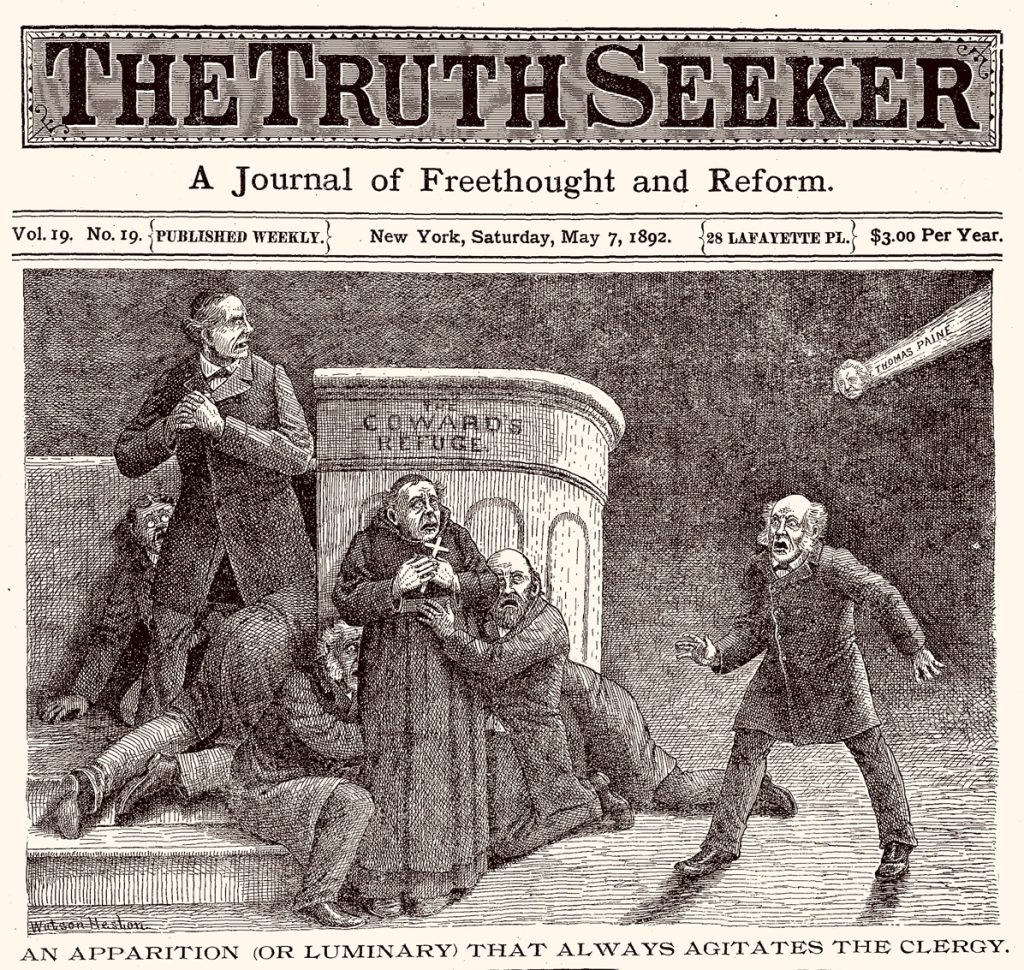
The Bradford secularist and socialist J. W. Gott published a monthly The Truthseeker to promote mental freedom and social progress. A special issue carried a cartoon of Paine surrounded by the symbols of his struggle for liberty. The August 1902 issue had a quotation from Paine on its front page and a “marvelously cheap” edition of The Age of Reason was advertised price 6d. Gott was the last Englishman to be imprisoned for blasphemy, his imprisonment led to his premature death.
1909 was the centenary of Paine’s death. The National Secular Society held various events to mark the event. The Freethinker January 31, 1909 reprinted an article from the Toronto Secular Thought by Michael Monahan which pointed out that Paine was 5 inches taller than President Roosevelt who had called Paine ” a dirty little atheist”. The issue for February 7 carried an advertisement for an edition of The Age of Reason published by the Edinburgh Rationalist Club. The March 7 issue reprinted an article from the Brighton Herald which claimed that Paine’s jawbone had come into the hands of a Mrs Wilkinson of Liverpool. It was claimed a member of her family had buried it in an Anglican churchyard. Branches of the NSS held open air meetings on Paine. Bethnal Green branch held in Victoria Park addressed by F. A Davies. There were two lectures in Birmingham Bull Ring and one in Liverpool by H Percy Ward, a former Wesleyian preacher who had been secretary of the British Secular League. The main event was a meeting in St James Hall, Great Portland Street. Speakers included Herbert Burrows, Harry Snell, Chapman Cohen and G W. Foote. Watts reprinted Conway’s biography of Paine for the Rationalist Press Association. It sold for half a crown. The Times of June 8 published an article on Paine calling him the greatest of pamphleteers.
1937 was the bicentenary of Paine’s birth, The Freethinker for January 31 was a special Paine issue with a portrait on the front page. At the time illustrations in the radical press were rare. Chapman Cohen spoke at NSS branch meetings in Liverpool on Paine The Pioneer. The’ Man That shook The World and on Clapham Common W Kent spoke. NSS members were urged to step up their sales of The Age of Reason. It sold for 4p, Ingersoll’s Oration On Paine cost 2d. The West London branch sold both at Hyde Park. The Freethinker for March 14 published an article on Paine and Bourgeois Myths by Jack Lindsay. Another article by H. Cutner was entitled The Apostle of Liberty. A bicentenary dinner at which 200 people were present was organised in the Holborn Restaurant, High Holborn. Tickets were 8 shillings and Cohen took the chair. Evening dress was optional. The BBC refused to make a broadcast about Paine but a meeting was held in Thetford with the Mayor in the chair.
In 1965 F. A. Ridley, who had edited The Freethinker , was writing about Paine in the Independent Labour Party’s weekly, which he had also edited. On a different level Harvey’s brewery of Lewes makes an excellent Paine ale and in the original Star Trek series a star ship was named for Paine. Another was called Potemkin.
2009 will provide many opportunities to celebrate Paine but best of all would be the final victory of his struggle against kingcraft and priestcraft.