
New-York tribune (New York [N.Y.]), May 4, 1902
PAINE’S FIRST GRAVE
HISTORIC SPOT IN WESTCHESTER COUNTY MARKED BY A MONUMENT
ON THE FARM WHICH THE STATE BESTOWED FOR PATRIOTIC SERVICES—HOW WILLIAM COBBETT TOOK BODY AWAY.
In many parts of Westchester County can be found landmarks and historic spots that serve as constant reminders of literary men and their creations, investing the region with that element of human interest without which even the most charming scenery becomes after a time monotonous.
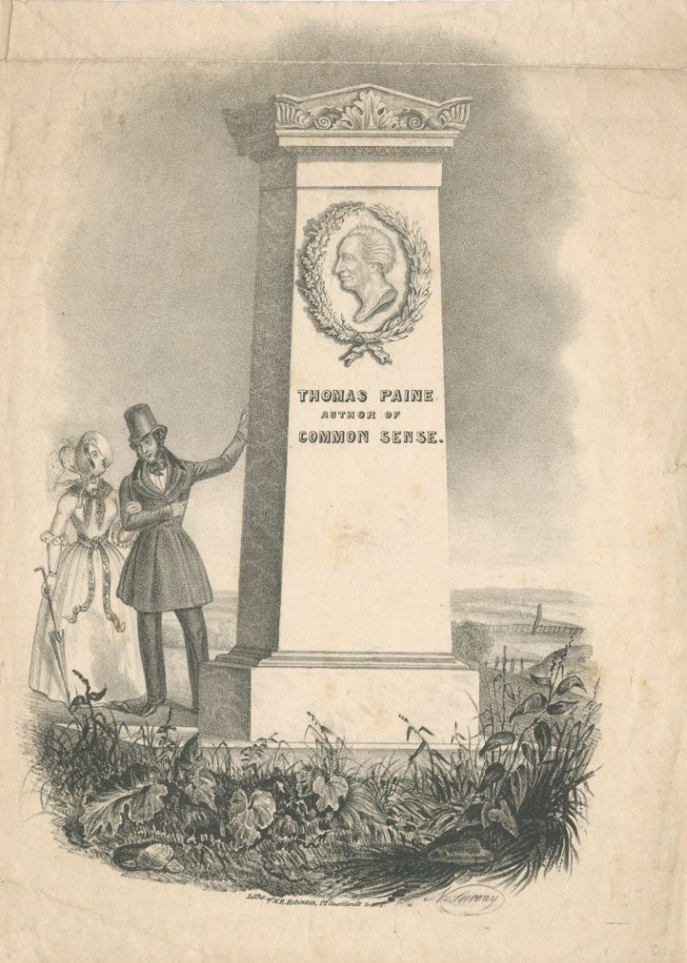
In the suburbs of New-Rochelle, facing North-st. on the east, stands a granite obelisk, inclosed by a stone fence and overshadowed by trees. It is the monument erected in 1839 in memory of Thomas Paine, the author of “The Rights of Man,” “Common Sense” and “The Age of Reason,” by the Paine Historical Society. The farm presented to the patriot by the State of New-York, in 1785, in recognition of his services to the cause of freedom during the Revolution, extends beyond the monument, and the lane that branches off here to the east leads to the farmhouse in which Paine lived for several years. It was not, however, until his return from France, in 1802, that he made it his permanent home.
During his sojourn abroad Paine had taken an active part in the French Revolution, having been chosen a member of the National Convention for the Department of Calais. On the trial of Louis XVI he voted against the sentence of death, proposing the King’s banishment instead. This conduct offended the Jacobins, and he was excluded from the convention, arrested and committed to the Luxembourg.
It is said that during his confinement he finished the first part of his work against revelation, “The Age of Reason,” and, having confided it to the care of his friend Joel Barlow, it was published. The ideas expressed in the work raised a storm of popular indignation against him, and when on his return to America he took up his residence among the descendants of the stern Huguenots of New-Rochelle they treated him as an outlaw.
Indeed, he appears to have enjoyed little comfort in his country home. He had lost his first wife the year following his marriage to her, and had separated from a second by mutual consent. He afterward had as a companion a Mme. de Bonneville, a Frenchwoman, whose husband had been ruined in England by publishing “The Rights of Man.” With her two sons, she accompanied Paine to America and took up her abode with him on his farm.
Here they lived a life of the strictest seclusion; for, although Paine was occupied in a variety of active pursuits, his attacks upon religion had greatly narrowed his circle of acquaintances and rendered him an object of aversion to his neighbors. Under the leadership of the clergy, they instituted a crusade against him with the avowed object of driving him from the town. He furnished the text for passionate discourses from the pulpits, and was subjected to continuous insults and annoyances from the townspeople, but without result. Paine continued to reside in New-Rochelle, seemingly oblivious to the detestation of the inhabitants.
Finally the feeling against him assumed a more aggressive form. It was Paine’s custom to retire at night to a small rear room on the north side of his house to read and study, and this gave his enemies an opportunity to attempt his assassination. It is related that on one or two occasions, while he was sitting in his study absorbed in his literary labors, he was shot at through the window and compelled to desist from work. At last, believing his life in peril if he continued to reside in New-Rochelle, he left his farm and made his abode in New-York.
His last days were spent in his city house, No. 59 Bleecker-st. It was a melancholy ending to a brilliant and active career. Suffering from a complication of disorders brought on by his habitual intemperance, he dragged out the last hours of his life propped up in a chair by a window, poring over the pages of a book and drinking at frequent intervals from a bottle of brandy that stood on a table at his elbow. It is said that as death approached, the noise in busy Bleecker-st. caused him excruciating agony, and it was found necessary to remove him to a house in Grove-st., where he breathed his last on June 8, 1809.
Paine was born a Quaker in England, and permission was asked to bury his body in the cemetery of the Society of Friends. This was refused. Application was then made for a place of burial at Trinity Churchyard, and permission was obtained to bury the body in the graveyard of Trinity Church; but the vestrymen ordered it removed. The funeral started from New-York and proceeded over the old Boston Post Road, and, as it passed several churches along the route, was greeted with demonstrations of intolerance that it is difficult for the present generation to understand. The clergymen, seeing the procession coming, set up a vigorous ringing of the church bells to indicate their joy in the great infidel’s death.
On arriving at New-Rochelle the procession went to the little cemetery of Trinity Church, where the grave-diggers were waiting by the side of the grave they had prepared. The coffin was lifted from the hearse and lowered into the excavation; but as the grave-diggers were in the act of covering it with earth the Rev. Mr. Bayard, the rector, rushed up in great excitement and ordered them to stop.
“Who ordered that grave to be dug?” he asked.
“The vestrymen of the church,” replied the chief grave-digger.
“What, bury an infidel in hallowed ground?” he cried. “As long as I am rector I forbid it.”
Then he turned to the grave-diggers, and commanded them to disinter the coffin. Paine’s friends now remembered that in his will he had reserved for himself twenty acres of his farm as a place of burial; but, unfortunately, he had omitted to name a location on the farm to carry out his last wish, and Nehemiah Purdy, who had acquired an interest in the premises, objected to burial there. In this dilemma they were obliged to bury Paine’s body in the corner of a field adjoining his farm.
Several years after its burial the corpse was taken from its grave by William Cobbett, the celebrated political writer, who, at the time, was an exile from England, on account of an attack he had made upon the Government. Cobbett was one of Paine’s warmest admirers, regarding him as one of the greatest of political writers. He remembered that, like himself, Paine also had been prosecuted by the British Government for publishing “The Rights of Man” in England, and that he had been obliged to escape to France to avoid imprisonment. So, on becoming an exile in America, Cobbett made a pilgrimage to New-Rochelle, in which town he held his meetings, and finding that the body of his idol lay in a neglected grave, without a mark to indicate its location, he became indignant, and resolved to take it to England for honorable burial elsewhere.
The present monument is not upon the spot where the body was buried, but those who raised the shaft made an error as to the exact location. About thirty feet away stands a flourishing hickory tree, and near it are the stumps of two locust posts. Henry H. Lester, of New-Rochelle, says these posts, with two others that have long since rotted away, stood at the four corners of Paine’s grave. Subsequently only the hickory tree sprouted from the mound.
For this purpose he engaged the services of two negroes, and, having sworn them to secrecy, awaited a favorable opportunity to put his project in execution. Selecting a dark, cloudy night, he hired a team and wagon, and, accompanied by the negroes, started out from New-York. They reached Paine’s grave shortly before midnight, and disinterred the body.
As they were in the act of lifting the coffin into the wagon, Andrew Contant, of New-Rochelle, a former friend of Paine’s, happened to drive by, and, noticing the glimmer of lanterns by the roadside, stopped his horse. He saw the shadowy figures of three men moving mysteriously about Paine’s grave, and a team and wagon waiting close by. Presently the men lifted an oblong object from the ground, deposited it in the wagon, mounted to the seat and drove off in the direction of the city.
According to this story Mr. Contant then hastened to Paine’s grave and found that his friend’s body had been stolen. On making this discovery he hurried to New-Rochelle and informed the constable of what had happened. That officer immediately organized a party to pursue the grave robbers.
There now ensued a desperate race between those with the body and their pursuers. By the time the constable had collected his posse and procured arms and horses, Mr. Cobbett and his assistants were well on their way to New-York. At that time the main road turned westward at Williamsbridge, where it crossed the Bronx and wound over the hills to the Harlem River. It crossed the Harlem and entered Manhattan Island over the King’s Bridge.
Anticipating the possibility of pursuit, Cobbett urged his team to a brisk trot, and rattled over the rough highway at a great rate of speed. For he knew that if he could cross the King’s Bridge without detention he would be safe from arrest, as he would be in New-York County, beyond the jurisdiction of the officers of Westchester.
But the constable was hot on his trail. A mile from Kingsbridge pursuers and pursued came within hearing of each other. The constable’s men could plainly distinguish the sound of wagon wheels ahead, realizing that those with the body were making every effort to escape them, whipped their horses to a furious gallop. But it was in vain. Mr. Cobbett reached the King’s Bridge ahead of them, and dashed over it to safety, just as they came galloping up on their panting steeds.
According to another story it was not Mr. Contant who brought word of the grave robbery to the constable, but a country boy, who was a witness to the deed.
Numerous theories have been advanced as to Mr. Cobbett’s disposition of Paine’s body. The corpse is supposed to have been taken to England, Mr. Cobbett intending to demand its interment in Westminster Abbey. But the people of England refused to receive it, and Mr. Cobbett, it is said, to avoid arrest, threw it into the Thames; others say that the body was exhibited in a museum, and still others that it was taken to the East Indies. The most probable story of all, however, is that which credits Cobbett with having given the body decent burial in a remote English churchyard, although some authorities say it rests in France.
Although Cobbett’s motive in exhuming Paine’s body was a generous one, a majority of people regarded the deed with horror. He had gone about his task in such a mysterious, clandestine way that he was accused of desecrating a grave. Lord Byron celebrated the incident in an epigram that was widely quoted at the time:
“In digging up your bones, Tom Paine,
Will Cobbett has done well;
You visit him on earth again;
He’ll visit you in hell.”
The unfortunate circumstances attending Paine’s burial have led to the belief that his ghost haunts the vicinity of his monument. For this reason people residing in the neighborhood hesitate to pass that way alone at night.
Not long ago a young man, living in North-st., happened to be detained in the town until a late hour, and it was close to midnight before he started for his home. When he began his walk it was bright moonlight; but, ere he reached Paine’s monument, a bank of heavy black clouds swept over the sky, and it became so dark that he could barely see the road.
As he was in the act of passing the haunted spot, he was startled to hear a sound as of lamentation. At first he thought it was the night wind moaning through the trees; but, when the sounds were repeated and he could distinguish the tones of a human voice, he was overwhelmed with fright.
Casting a terrified glance into the shadows, he saw a ghostly figure wrapped in a shroud hovering back and forth between the monument and the hickory tree. Presently it raised its voice for the third time, bewailing the ingratitude of mankind, and crying out in plaintive tones:
“Where is my grave? I have lost my grave.”
It is said that the young man did not wait to test the evidences of his senses, but fled precipitately from the spot. The superstitious aver that the apparition appears at frequent intervals, and that it undoubtedly is the ghost of Paine searching for the grave from which his body was removed.