By Gary Berton with Judah Freed
Part Three of Three Parts
When most founding members of the Thomas Paine National Historical Association no longer served on the TPNHA board, others joined the association and took active leadership roles. They reflected the founding philosophy and ideas that prevailed at the turn of the century.
The philosophy of “anarchism” was popular in leftwing circles in the early 1900s. The American socialism advocated by northeastern progressives often mixed with anarchism. Emma Goldman, the ideological lightning rod, advocated an “anarcho-communist” philosophy that did not separate from socialism, per se, until after World War I.
Edwin C. Walker and Theodore Schroeder stepped into TPNHA leadership in the early 1900s. Walker was presiding at meetings by 1901, becoming vice president as TPNHA incorporated in 1906. Schroeder became the secretary at that time.
Edwin C. Walker was respected as a political philosopher and outspoken opponent of the Comstock Law. He wrote the 1903 pamphlet, Who is the Enemy: Anthony Comstock or You?
His 1904 book, Communism and Conscience, espoused free-market anarchism (related then to individualist anarchism, anarcho-capitalism and libertarian socialism). “I can have little faith,” Walker wrote, ”in the professed love of liberty of one who denies to me the opportunity to hear what he or she does not care to hear, just as I can have little faith in the professions of the Censor who denies to me the opportunity to read what he does not care to read.”
The TPNHA’s leadership had anarchist affiliations beyond Walker. The leading representative and advocate for anarchism, Emma Goldman, had ties to TPNHA’s Ned Foote and William van der Weyde, plus the Manhattan Liberal Club and the Liberal League.
Theodore Schroeder grew up in Wisconsin, earned an 1898 law degree, practiced in Utah until relocating to New York in 1900. In 1902, Schroeder formed the Free Speech League (precursor of ACLU) with Lincoln Steffens, TPNHA founder Ned Foote. and other progressives. As a lawyer advocating free speech rights and sexual freedom, he defended Emma Goldman at her Comstock trial in Denver circa 1910.

At the 1905 rededication of the Paine Monument in New Rochelle, the speakers featured Schroeder with surviving TPNHA founders Thaddeus Wakeman and Ned Foote plus the New Rochelle mayor. A year later Schroeder was voted secretary of the TPNHA.
Schroeder wrote on the legal absurdities of Comstock. The Free Speech League in 1906 published his booklet, What is Criminally “Obscene”? and a three-part, Freedom of the Press and ‘“Obscene’”Literature. He compiled the 1909 Free Press Anthology. He wrote the 1911 book on press freedoms, “Obscene” Literature and Constitutional Law. Years later he wrote two 1945 biographic pamphlets about Thomas Paine. A Paine statuette sat on Schroeder’s desk until he died in 1953.
Leonard Abbott exemplified a blend of anarchism and socialism among Progressive Era TPNHA leaders in the early 1900s The son of a wealthy English merchant, he read Paine’s Rights of Man as a student before immigrating to the United States in 1898.
Shortly after arrival in New York, Abbott met anarchist Emma Goldman. He befriended J. William Lloyd, a libertarian individualist anarchist and “natural law” mystic, The pair published Free Comrade from 1900 to 1912. Abbott joined the executive board of the Socialist Party of America in 1900. He joined Eugene V. Debs in leading the Social Democratic Party. He introduced Upton Sinclair to socialism in 1902. Abbott in 1906 joined the founding board of the Rand School. He was active in the TPNHA by 1908 and became president for one year in 1910.
After the 1909 execution in Spain of freethinker Francisco Ferrer, Abbot worked with Emma Goldman and Alexander Berkman to establish the Ferrer School and colony as educational centers for anarchist philosophy. The school was forced to close after a 1914 anarchist bombing against John D. Rockefeller. Abbott spoke about the bombers killed to a crowd of 5,000.
TPNHA links to activist anarchists could not have happened without the blessings of founder Thaddeus Wakeman, a guiding hand of the association until his passing in 1913. Respected as a political philosopher, T.B. Wakeman was a social progressive with an affinity for anarchist views. A Monist (monism versus dualism), he held that all existence has one origin, so all individuals share natural unity and equality. Wakeman stepped up when needed to become president in 1908 and 1911, meanwhile mentoring younger TPNHA leaders.
James F. Morton, an anarchist writer, served as the president between Wakeman in 1911 and William van der Weyde in 1914. Morton encapsulated the politics of previous leading board members. He graduated from Harvard with W.E.B. DuBois and became active in the NAACP in opposition to bigotry. A personal friend of writer H.P. Lovecraft, Morton wrote for Truth Seeker, Discontent and Mother Earth. He was part of the Ferrer School in New York City.
William van der Weyde, a noted photojournalist, succeeded Schroeder as TPNHA secretary in 1909. He served as secretary until becoming president in 1914, serving as president until he died in 1929. His legacy includes locating Paine’s death mask and a lock of his hair, still archived in New Rochelle.
An innovator in photography for newspapers and night photography, he photographed significant people of his day, such as Walt Whitman, Mark Twain and Capt. Alfred Dreyfus of France.
William van der Weyde and his photographer father were members of the Manhattan Liberal Club. For Mother Earth, he wrote, “Thomas Paine’s Anarchism.” His premise and arguments have since been undercut by modern Paine scholars, yet his anarchist influence is clear. “Paine was an ardent believer in civilization and education,” he wrote. “Were men [sic] but sufficiently civilized, they would have no need for government.”
More than anarchism, Paine and free thought have united and guided the TPNHA since 1884.
Premiere 1900s events for TPNHA — rededication of the Paine monument in 1905, the 1909 centennial of Paine’s death — were covered by Truth Seeker editor George Macdonald, who succeeded brother Eugene. He led TPNHA committees into the 1910s.
Honorary TPNHA vice presidents active in the 1910s and 1920s included Ernst Haeckel (German zoologist, Darwinian biologist and Monist with ties to Wakeman); Hypatia Bradlaugh Bonner (freethinking English philosopher and peace activist, the daughter of English atheist writer and Member of Parliament, Charles Bradlaugh); Anatole France (Nobel Prize winning author and freethinker); Eden Phillpotts (English novelist, poet and dramatist), Georg Brandes (Danish critic and scholar who advanced realism and naturalism); and William Archer (Scottish author, theatre critic and reformer in London).
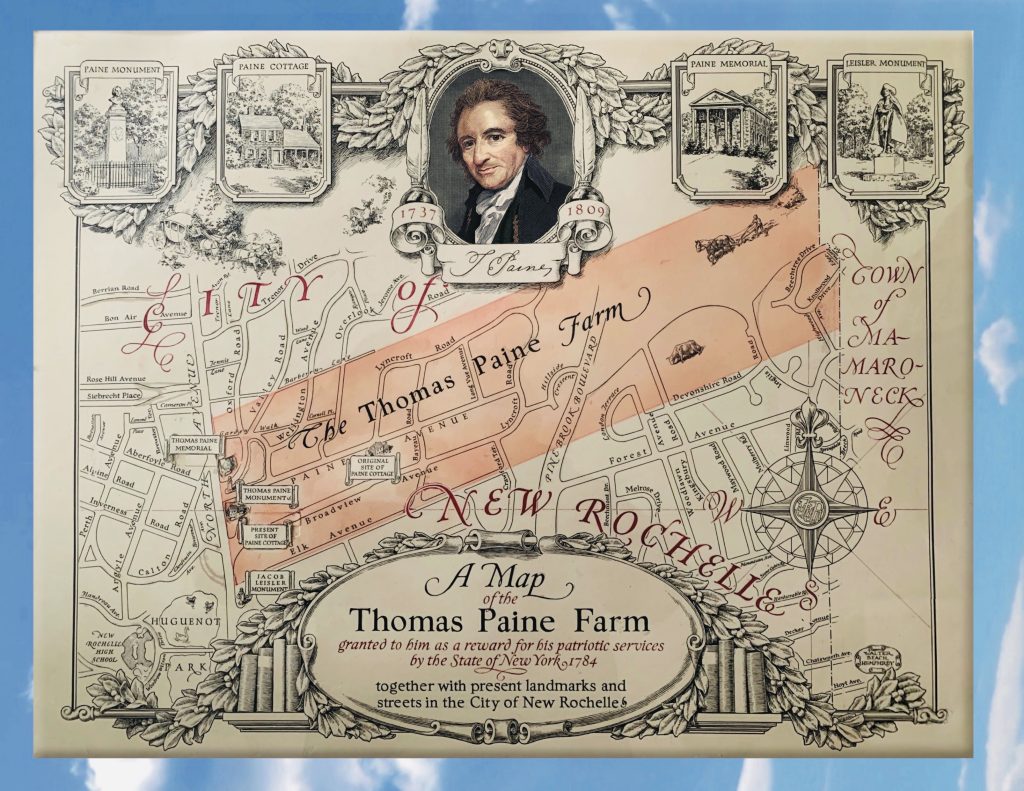
The association in 1925 built the Thomas Paine Memorial Building in New Rochelle near the Paine Monument, backed by freethinking inventor Thomas Edison. He became vice president. His advertising manager at New York Edison, Cyril Nast, became the treasurer to manage construction under van der Weyde. At the groundbreaking ceremony, Norman Thomas, a perennial Socialist Party presidential candidate, gave the keynote address.
TPNHA president van der Weyde took ill shortly after completion of the Memorial Building. He finally died in 1929 at the onset of the Great Depression. The association’s fortunes declined with depleted resources.
As leaders departed, the association was sustained by well-meaning staffers. The Memorial Building was used by other groups. TPNHA in the 1980s united with the local Huguenot historical group that ran the relocated Paine Cottage museum at the site.
Paine advocates began to reassert management of the Memorial Building in the 1990s. TPNHA regained independence. The association has evolved substantially since its first four decades, dropping politics and beliefs other than Paine’s own views.
The formative first 40 years of the Thomas Paine National Historical Association provides the historical memory informing our efforts. A broad-minded board now directs our affairs. We’re renovating the Memorial Building, reviving The Beacon and revamping our website (stay tuned). The association today plays a leading role in Thomas Paine Studies, advancing scholarship on Paine and his impact in world history. We’re a global resource for those researching Paine’s life and works. We’re now preparing for the 2026 release of the six-volume Thomas Paine: Collected Works, coinciding with the 250th anniversary for the publication of Common Sense.
The association remains an all-volunteer organization supported by the American and world freethought community and friends of Thomas Paine. Educating the public on Paine and his legacy is increasingly vital today.
Thomas Paine is an inspiring mentor for progressives to libertarians who value reason, freedom of thought and democracy. As T.B. Wakeman said at our founding, we act “to perpetuate the memory and works of Thomas Paine, to obtain and disseminate accurate information about him, to refute the various slanders and fables that have been circulated concerning him.”