
By Hazel Burgess
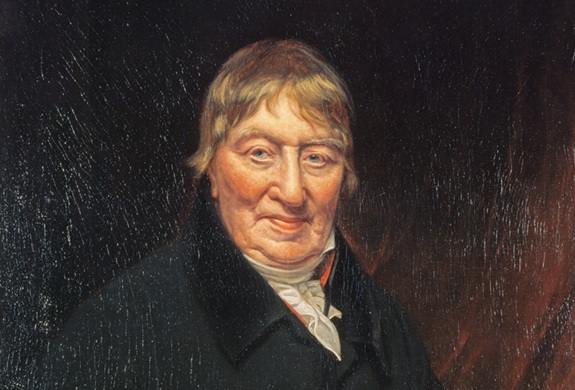
From the time that his first biographer, Francis Oldys, adopted Thomas Paine, the son of a Thetford stay-maker, as a subject,2 all others have accepted the fact that he fathered no children. Recent examination of records, from a long time past, suggest that he might have done.
Two hundred and forty one years ago an entry was made in the Parish Register of a church in Kent. Over the years, the pages yellowed and faded as further entries were made and the book was stored away when filled. That short mention of the baptism of a girl child might have evinced excitement in both conservative and radical circles if it had been sought and found during the late eighteenth and early nineteenth centuries, but, until now, nobody thought to look!
The little girl’s arrival and departure from this world went unnoticed in the way of most human beings, but her omission from biographies of a man who left an indelible mark on the world is remarkable. The extraordinary reason for this omission, over two hundred years, is difficult to explain. Oldys researched assiduously, and, from his work, all of his successors, good, bad and indifferent, have lazily borrowed. Some attempted to sweeten his words, as is done yet, in attempts to present a saintlike figure to admirers of their hero. Others have built upon that work which ran into several editions. Ironically, it is possible that the one biographer who had first-hand knowledge of his friend, Paine, was told of the child, but misheard.
Oldys, who worked as a clerk to Lord Hawksbury in the Board of Trade and plantations, was paid £500 by his employer to write a disparaging biography of Paine.3 To his credit, he treated as gossip the stories of the ‘fate’ of Paine’s first wife, Mary Lambert, whom he met at Sandwich, Kent. Mary was employed as a waiting woman to the wife of a woollen-draper, Richard Solly, who had formerly been twice-elected mayor of Sandwich.4 Thomas, aged twenty-two, and Mary married in September 1759. The bride, who was baptised on 1st January, 1738, was probably aged twenty-one.5 In 1760, Thomas and Mary moved to Margate where he set up a stay-making business. From that point on, nothing is known of Mary Paine.
By some [wrote Oldys] she is said to have perished on the road of ill usage, and a premature birth. The women of Sandwich are positive, that she died in the British Lying-in-Hospital, in Brownlow-street, Long-acre, but the register of this charity, which is kept with commendable accuracy, evinces that she had not been received into this laudable refuge of female wretchedness. And there are others, who have convinced themselves by diligent enquiry, that she is still alive, though the extreme obscurity of her retreat prevents ready discovery.6
Oldys, to no avail, thoroughly checked records of the Lying-in Hospital and the workhouse of St. George’s, Southwark, where newspapers of the 1790s had reported Mary to be living.7
Thomas [Clio] Rickman, a disowned Quaker from Lewes, Sussex,8 would-be poet, in- ventor, and friend of Paine, in whose house in London the latter wrote Part II of Rights of Man, merely wrote of Paine having married “…Mary Lambert, the daughter of an exciseman of that place [Sandwich]. In April 1760, he removed with his wife to Margate, where she died shortly after.”
The muckraking literature that has, since before his death, dogged Paine’s name began with the hireling writer, Oldys, yet he, possibly, more truly represented the story of Paine’s hapless, first marriage than any other writer. Over the years, on his foundation, writers and commentators have built imaginative narratives on the marriage of Thomas and Mary. Some tell of Mary becoming pregnant and dying in childbirth.
There is no entry in the parish registers at Canterbury bearing evidence of Mary’s death with possible mention of a child, but, in the seeking, a record of baptism leaps out of the pages of Register No.5, 1760, of the Parish of St. Lawrence in Thanet, close to Margate, where Rickman wrote of Mary dying.
[Figure 1 (missing): Entry in the register of St.Lawrence Church, Thanet, recording the baptism of Sarah Paine. Canterbury Cathedral Archives, U3/19/1/5.]
Another child, Elizabeth Gisby, was baptised on the same day.9 Just nine months later, a poignant, one line burial entry is to be found in the same parish register.
[Figure 2 (missing): Entry recording the burial of Sarah Paine in the register of St. Lawrence Church,10 Thanet. Canterbury Cathedral Archives, U3/19/1/5.]
Nobody who has written on Paine mentioned these entries, here reproduced for the first time, yet they clearly suggest that the short-lived baby, Sarah Paine, was the child of Thomas Paine who, in later life, wrote his way to fame and infamy.11
On the words of Oldys alone, biographers have written of Paine leaving Margate to live with his parents at Thetford during July 1761. He might have done, leaving an infant in care
of the Sollys or others, but it seems unlikely that the Sollys would have taken the child as Mary Solly was probably ill; she was buried just two months after Sarah Pain, on 14th November, 1761.12 It is more likely that Oldys was mistaken in the date of Paine’s return to Thetford. The child, Sarah, might or might not have been the daughter of Thomas Paine, but it seems a remote possibility that a child of like-named parents would have died in the area within a year of the birth of another.13.
Sarah Pain was buried just ten days prior to the coronation of George III. Richard Solly was a Coronation Baron of the Cinque Ports of Dover, Hastings, Romney, Hythe and Sandwich which, in the thirteenth century in return for certain privileges, were obliged to furnish ships and men to defend the English Channel. His position required him to hold the canopy over the king and afterwards sit at the right hand of the monarch at the coronation banqueting table.14 The Sollys were possibly the only friends of Thomas and Mary Paine. In the time of the young parents’ grief, both the Sollys and the people of Sandwich were probably exited at the prospect of the baron’s important role in the royal celebrations and too distracted to recall with certainty, more than thirty years after the event when questioned by Oldys, the circumstances surrounding the birth and death of an unknown stay-maker’s child in a nearby town. In the 1760s, they did not know the radical Thomas Paine, author of Rights of Man. Part I was published in 1791 and Part II in 1792.
It might have been that Oldys cut short his research, which is unlikely close to the beginning of such a work, or kept to himself details of a story which, in a small way, might have led to public sympathy for Paine at the height of his radical popularity. It might have been that, when writing of his friend who had died ten years earlier, Rickman, in 1819, had forgotten details told to him by Paine. It might have been that when the two last conversed, in the 1790s, Paine reminisced quietly of moving to Margate, looked away, sniffed the air or even a tear, and turned to his friend who only heard the words, “….where she died shortly after.” It might have been that Paine had told Rickman of the birth of Sarah who “….died shortly after.” It was Thomas [Clio] Rickman who invented the “Patent Signal Trumpet, for increasing the Power of Sound.”15 It might have been that necessity was the mother of invention; it might have been that he was hard of hearing.
It is possible that Oldys was correct in stating that Thomas Paine and his young wife were last seen leaving Kent for London. He quoted “the women of Sandwich” as having had knowledge of Mary being in London,16 but Margate, where Mary lived with Thomas, is ten miles from Sandwich so it would hardly have been local gossip. William Cobbett, in 1797, quoted and commented upon the London Review of Oldys’s Life of Thomas Paine and, in fiercely scurrilous prose, also wrote of Thomas and Mary leaving Margate for London. Francis Westley, in 1819, picked up, virtually word for word, the gossip reported by Oldys and related it as fact. Rickman and William Sherwin, both favourable to Paine and both published in 1819, merely state that Mary died at Margate in 1760.17 It is possible that Mary Pain was alive, in 1791, when Oldys first published his derisive biography of Paine! It is possible that she was the mother of little Sarah Pain! Diligent searching has revealed no clues to her ultimate fate.
From the finding of Sarah Pain in the Thanet registers, questions arise, which have never been posed, regarding the early years of Thomas Paine. Until now all commentators have relied and built upon the account of the hireling, George Chalmers. His version of the little-known, early life of Paine, freed from embellishments of later writers, leads to speculation and theories which, when followed and found to produce hard evidence, lead to a revised story on the life and times of the man who coined the phrase ‘United States of America’.18 There he is recognised as a founding father. It is possible that he also named the little child, Sarah Pain, of whom he may, with caution, be recognised as father.
REFERENCES AND NOTES
I. Spelling of the name Paine/Pain is taken from quoted documents or in the context of Paine’s own usage. It does not present the problem that most derogatory writers on Thomas Paine have found it to be. In the eighteenth century, spelling was as much phonetic as concise and it was Paine’s prerogative to spell his name as he chose.
2. The Life of Thomas Paine: The Author of Rights of Men [sic] with a Defence of His Writings. London, 1791.
3. Rickman, op. cit., p.2; Sherwin, op. cit., p.iv.
4. Richard Solly served as mayor in 1738 and 1749 and was to serve a third term in 1778. Personal communication, Bob Solly, November, 1999.
5. Oldys. The Life of Thomas Pain, The Author of the Seditious Writings Entitled Rights of Man. 10th ed., London, 1793. n.t, p.11.
6. Oldys, 1793. pp.13-14.
7. Ibid., n.e, p. 14.
8. Rickman was disowned for marrying a non-Quaker in Cliffe Church, in 1783. David Hitchin, Quakers in Lewes: An Informal History, Lewes, 1984. p36. Paine’s father was disowned for the same reason when he married Frances Cocke at St.Genevieve’s Church, in the Suffolk parish of Euston, on 20th June, 1734. In the minutes of the Quaker Monthly Meeting at Hingham, which included the meetings of Mallishall, Wymondham and Thetford, on 4th May, 1733, it is noted that “Several [Quaker members]…. have gone to the priest to be Married and Several proffering
themselves Quakers have taken Liberty in Life and Conversation to the reproach of our Christian Profession. This Meeting desires that Friends of Each particular Meeting will suspect into these and all other disorderly practises and deal with such according to Gospell Order [Mel” SF 169, Norfolk Record Office. “Gospell Order” required disownment.
9. “Baptised 1760,” St. Lawrence, Thanet Parish Register. Courtesy of Canterbury Cathedral Archives, U3/I9/1/5
10. “Buried 1761,” Stinwrenoe, Thanet Parish Register. Courtesy of Canterbury Cathedral Archives, U3/19/1/5. I am deeply grateful to Carol Gill who first checked the records for me.
11. In America, laurels were heaped upon the head of the, then, anonymous author of Common Sense, the pamphlet that convinced patriots and converted loyalists to knowledge of Independence being in their best interests; in England the author of Rights of Man was found guilty of sedition, and, throughout the realm of Christendom, the writer of The Age of Reason went, unforgiven, to a literally lonely grave for attacking the Bible and denying the Trinity. Paine was buried in unconsecrated ground on his farm at New Rochelle, New York, from where, ten years later, he was exhumed by a former vilifier turned idoliser, William Cobbett, English Member of Parliament and journalist, with plans for a grand burial in England. Such burial never occurred.
12. DCb/BT1/207/165, Canterbury Cathedral Archives.
13. Pain/Paine/Payne is a common name in Kent and Sussex and Thomas and Mary were common names of the time.
14. The Cinque Ports., imp://www.hythe-kentdemon.co.uklcinque 1.htm>„ 11 3.1999, p.3.15. Advertisement, Rickman, op. cit., following p.277.
15. Advertisement, Rickman, op. cit., following p.277.
16. 1793, pp.I3-14.
17. Francis Westley, The Life of Thomas Paine, London, 1819, p.8; Rickman, op. cit., p.36; W.T. Sherwin, Memoirs of the Life of Thomas Paine, London, 1819, p.8.
18. The phrase first appeared in Paine’s American Crisis, No.11, 13th January, 1777.
This article first appeared in the Thetford Magazine, No.22. Summer, 2000, and is here reprinted with corrections provided by the author. © 2001. Hazel Burgess.