
By Lynn Sorge
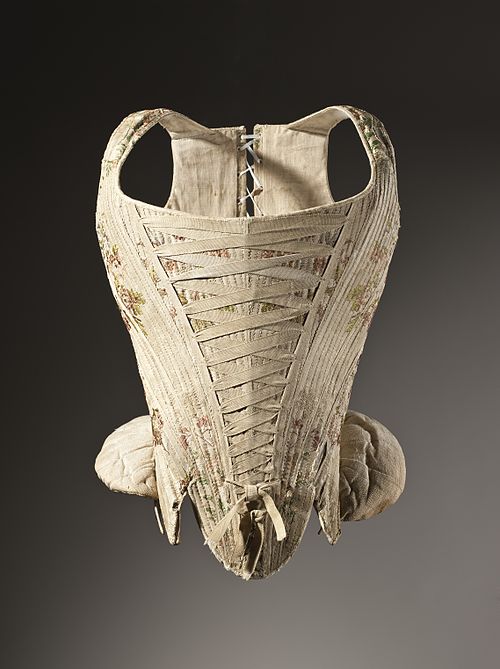
Los Angeles County Museum of Art

Whoever has a mind to abundance of trouble,
Let him furnish himself with a ship and a Woman,
For no two things will find you more Employment,
If once you begin to rig them out with all their Streamers,
Nor are they sufficiently adorned,
Or satisfied, that you have done enough to set them forth.
– Plaut. Poenulus. Act. 1, Scene 21
Although this play was written around 200 B.C., the sentiment expressed here may be timeless. This passage could easily refer to the importance of fashionable dress to the eighteenth-century woman, and to the complex nature of its many and varied components. Primary written documents, portraits, and artifacts reveal that the eighteenth-century lady was often clothed in fine attire, and undoubtedly spent much of her time with those craftsmen and trades people responsible for her overall appearance. She knew well her Stay-maker, Mantua-maker, and Milliner, for example.
The eighteenth-century female silhouette was dictated almost wholly by its underpinnings, with stays, hoops or pocket-hoops laying the foundation for the petticoat, skirt, bodice, or gown. Surviving examples of eighteenth-century stays are masterpieces in engineering; many reveal their creators to have had a fine sense of proportion, and highly-developed skills as artists and crafts people. Who were the creators of these female underpinnings, and how did they achieve their ends? Did they make patterns for stays, and if so, did they draft them, or drape them on a live model? Were the patterns made from paper, or did their creators work directly in fabric? This paper will discuss the origins of eighteenth-century stays, elaborating on the scholarship of those who have already delved into this area of our past.2 Also, artifacts representative of both the upper and lower sorts will be analysed as a means of deciphering ‘pattern language’.
Origins of Stays
Examination of both British and French sources reveals that eighteenth-century crafts-people living and working in Europe devoted little time to recording their method of pattern creation, or to leaving instructions for generations-to-come. German sources, however, revealed texts circa 1713 and 1724 which provided invaluable clues about the origins of stays.3 In all three counties, stays were considered to be a branch of tailoring, and were made by men. In England, creators of stays were called ‘Stay-makers’, in France the Stay-maker was called ‘Le Tailleur du Corps de Femmes et Enfants’,4 and in Germany he went by the name `Zeichmeister’.5
The story begins, however, with the whaling industry, for the most commonly-used stiffening device in eighteenth-century stays was whalebone, or baleen. The trade card of Henry Smith, Whalebone and Cane Merchant gives the modern eye a taste of the eighteenth-century seascape (Fig. t). One of the trades listed in T. Waller’s General Description of all Trades, Digested in Alphabetical Order, is that of Whalebone Men. Waller stated; ‘There are only a few [Whalebone Men] in comparison to other Trades, but then they are top Dealers, and Business, which is chiefly carried on in a Shop or Warehouse, [is] esteemed very reputable and genteel.6
The plate Fanons de Baleine (Fig. 2) from 1783 shows the anatomical location of the baleen, and its appearance after removing it from the mouth of the whale. The remaining figures in the plate illustrate the tasks performed in preparing the whalebone for sale to Stay-makers. R. Campbell concurred with the process illustrated here, saying that the whalebone was boiled in a large Copper or cauldron until it was soft and pliable. Upon removal from the water, and while still hot, it was placed in a vice, and split into long or square pieces to be sold to haberdashers, and subsequently to Stay-makers.’7
It was the task of the Stay-maker to cut the whalebone into thin slices of a uniform thickness and length suitable for boning stays, using a special knife designed for that purpose.’8 Figure 3 shows a piece of baleen recovered from the mouth of a twentieth-century whale.’9 Although small whales in the eighteenth-century could not be used because their baleen was too short, not strong enough, and broke easily,’10 it is a feast to the modem eye to be able to see the kind of detail our ancestors took for granted.
While it appears that little was written in England on the origins of eighteenth- century underpinnings, there is considerable information about English trades of the period. Advice on the various attributes of specific trades was given freely to parents and other interested persons. Waller’s General Description of Trades is one of the earliest published works of this nature, written in 1747. Waller stated that Stays were `principally made by men, though both Women and Men work on them, and the Work may very well be called a Branch of Tayloring.’11 R. Campbell expanded upon this saying, ‘I am surprised the Ladies have not found out a Way to employ Women Stay-Makers rather than trust our sex with what should be kept as inviolable as Free- Masonry’. He seemed to be referring to the quality of secrecy necessary to become a successful and trusted Stay-maker, stating that makers of stays were ‘obliged by Art to mend a crooked shape, to bolster up a Fallen Hip, or distorted Shoulder’.12 Campbell’s explanation for women entrusting men with the delicacy of stay-making was that women do not have the strength necessary to ‘raise Walls of Defence about a Lady’s shape’.13
Within the trade itself, tasks were performed by various individuals. For example, Campbell said that while it was the male Stay-maker who cut out the stays, he gave them to Women to be stitched. After the whalebone had been cut into ‘thin slices of equal Breadths and the proper Lengths, it . . . [was] thrust in between the rows of stitching’ by the Master or Foreman who had the strength required successfully to perform the task.”14 Garsault’s engraving of the French Stay-maker’s shop clearly shows males cutting and fitting stays, while females appear to be doing the stitching (Fig. 4). It is likely that the story told through this engraving is similar to that of English Stay-makers, as well.
Trade cards reveal that there is a distinct separation of Stay-makers from Tailors. Cards such as John Harrison —1781 — Stay-maker in ‘Craven Buildings, near the New Church in the Strand’15 and The Old Red Stays; Jonathan Nuttill — Stay Maker16 make no mention of the word ‘Taylor’ anywhere in their advertising. At the same time, the cards classified under ‘Taylors’ do not include Stay-making as one of their specialties. For example, the card of the firm Newby specifies that Mr Newby is a ‘Draper, Taylor, and Habit Maker, near the Market Place, Morgate’,17 giving the impression that he had never made stays.
British directories give names and trades of the inhabitants of many towns and villages, helping to complete the image of Tailor/Stay-maker as two separate and almost unrelated trades)”18 In the town of Hereford in I791, William Bradford, Stephen Meyrick, and Charles Powers were Stay-makers, while Edward Howells was a Taylor;19 in Worcester there are many tailors listed, but only two Stay-makers — Thomas Milner and Joseph Mitchel.20 The conclusion may be drawn, then, that the two trades were not one and the same, and that different skills would have been needed for each of them. While R. Campbell said that Stay-making was a ‘species of the Taylor’s Business’, he also separated it from the Tailoring trade, saying it was `rather the Most ingenious Art belonging to the Mechanism of the Needle’.21
Garsault provided invaluable information about the makers of eighteenth-century French stays, devoting a complete chapter to the creation of stays in his Art du Tailleur. He drew attention to a distinct separation between Tailors and Stay-makers in France, evidenced by separate chapters on `Le Tailleur d’Habits d’Hommes’ and ‘Le Tailleur de Corps de Femmes et Enfants’. Many French engravings, such as L’Essai du Corset22, show the tailor of stays at his work.
It became necessary to piece together information from various sources to obtain a clear image of the origins of pattern development of eighteenth-century stays. Mention of patterns is made in French, German, and English sources. Garsault told his readers that ‘the tailor of stays] must have many samples of paper patterns of different sizes and lengths to guide him in his work’.23 The Masterpiece books of the German Master Tailors show patterns,24 and R. Campbell said that ‘any Bungler may cut out a Shape, when he has a Pattern’.25
There is evidence, however, that patterns were not used extensively in England. Writing of the necessity of men’s Tailors to absorb changing fashion, Campbell said that ‘a good Workman takes it by his Eye in the passing of a Chariot, or in the Space between the Door and a Coach’, rather than relying on a pattern.26 The Taylor’s Complete Guide, written by a Society of Adepts in 1796, gives instructions about how to take the client’s measurements, and goes on to say, ‘When you have your materials before you intending to cut out… lay on your measure to mark out for cutting your cloth.’27 With these words, the authors may have been instructing their students to draw the garment pieces directly on the fabric. The Society of Adepts seemed to have little respect for those who used patterns, telling its readers about an ill-fining coat which was cut by a particular Tailor for a country person. Its poor quality was explained as being the result of ‘working by Patterns . . . (which] is too much followed by the Trade . . . instead of following Nature in every existing Circumstance’28 It appears, then, that some cutters used patterns, while others did not.
Whether or not patterns were used, a method of arriving at the individual shapes of various garment pieces must have been employed. Examination of early works on cutting such as Libro de geometrica practica quel al trada de canto officio de sastre, written by Juan de Alcega in Madrid in 1589,”29 and Le Tailleur Sincere by Benoit Boullay, written in Paris in 1671,”30 reveals that these works showed how to lay pattern pieces on the cloth only, making no mention of pattern-creation methods. The earliest English work on cutting, The Taylor’s Complete Guide, written in 1796, also gave no instructions for making patterns. Garsault provided a detailed account of various kinds of stays, measurements to be taken on the body, and of construction. The only mention he made of patterns, however, was of the necessity for tailors to own several in different sizes. Therefore, German sources were examined.
Throughout the sixteenth, seventeenth, and eighteenth centuries German and Austrian Master Tailors compiled what were known as Masterpiece books containing patterns for various garments, and specifications for length of sleeve, width of hem, overall length of the garment, kind of cloth to be used, and occasionally the method of laying garment pieces on the fabric. Information contained in the Masterpiece books was used to test the skills of journeymen tailors who wanted to take the examination for the title of Master. The Master Tailor would choose a number of garments from his book, and the journeyman was ‘expected to demonstrate the cutting of the selected masterpiece by an oral explanation and by drawing in chalk on a board of table’.31 It is unclear whether or not the journeyman was required to construct the garments as well, but it would seem logical that tailoring skills would also be examined.
The Masterpiece books of Johannes Stockhel from 1713 and of Johannes M. Wolfsegger from 1724, studied and edited by Lucie Hampel, were republished in Linz in 1960.32 The book from 1713 contains twenty-five diagrams, while the latter repeats many of these but also contains new ones, making a total of thirty. Both books include drawings of English and French stays, which were also worn in Germany and Austria. Like the French Garsault source, or Diderot’s Encyclopedia,33 no information is given in these rare books on the origins of pattern development. Lucie Hampel says that ‘the tailors of the 18th century didn’t know any pattern systems, for those appeared only in the 19th century. The pattern was usually called Patrone. This was the big secret of the tailors. . . The first Patron was made after the garment which had been modelled on the body’.34
Undoubtedly, Edward B. Giles would agree. Writing The History of the And of Cutting in England in 1897, he described the evolution of cutting as beginning with ‘the rule of thumb period, through the paper model time, to the commencement of breast measure methods, and thence to the origin of geometrical, admeasurement, and anatomical systems, with their various combinations’.35 Having explored many of the older works on the subject himself, including The Taylor’s Complete Guide of 1796, he came to the conclusion that by the beginning of the nineteenth century ‘methods of cutting were not yet published’, and that a tailor by the name of Mr Hearn wrote the first book on cutting, called A System of Cutting, in the early nineteenth century.36
It would seem, then, that patterns drafting systems had not yet been developed in the eighteenth century, and that Stay-makers arrived at the shape of their patterns in any way they could, possibly from draping the garment on the body initially, and then by merely adapting it to the individual measurements of specific clients. It is entirely likely that Garsault’s declaration that the tailor of stays must have patterns of ‘different sizes and lengths’ at his disposal is not exaggerated, and that English and German tailors managed their businesses in the same manner.
Nowhere does this seem to be recorded, however. The reasons for this may be two-fold. It is likely that competition among various craftsmen must have been keen, with each vying for a share of the market. If the creators of eighteenth-century under- pinnings were to have put into writing the sources of origin of their patterns, there is every chance that this information might have fallen into undesirable hands. The second reason relates directly to the role played by apprentices who began as early as twelve or fourteen years of age.
After seven years they were deemed ready to assume the title and responsibilities of Master,37 apparently without taking the examinations requisite for the German Master tailors. It would seem logical that working so closely with someone for that length of time would enable a clever apprentice to absorb a great deal of information without putting anything in writing, and in fact, he would receive the kind of training not to be forgotten easily. It also seems logical that the tailor who intended to leave his business to his apprentice, journeyman, or son would give little consideration to leaving pattern-making documentation in his will. The Taylor’s Complete Guide lends credence to this idea, saying that ‘the Taylor sits down upon the forlorn hope of struggling through without ever acquiring farther than the maxims of his father, or what his master always did before him’38 thereby inferring that the knowledge of the apprentice or journeyman is the same as that of his father or master.
Daniel Defoe went so far as to advise a tradesman to ‘make his wife so much acquainted with his trade, and so much mistress of the managing part of it, that she might be able to carry it on if she pleased, in case of his death’. Otherwise, he said, she might feel a necessity to marry her husband’s apprentice in order to maintain control of the business. Defoe also advised the tradesman’s wife to become familiar with her husband’s business so as to preserve it ‘for the benefit of his son, tho’ left too young to enter upon it at first’.39
Trade cards abound with information about businesses being inherited. A card from 1785, for example, is in the name of ‘Flack and Lea: Stay Makers’, while the card from 1788 advertised the Stay-making business of ‘T. Lea, Nephew & Successor to the late Mr. Flack’, undoubtedly the same business.’40
Artifact Analysts
A pair of stays at the Worthing Museum and Art Gallery (Fig. 5), probably originating between 1775 and 1785, is beautifully made from a natural linen, and lined with a lighter weight linen. The stitching of the bone casings is flawlessly uniform. The spacing of the casings is aesthetically pleasing.
The front of these stays seems to have been moulded into a permanently-rounded form, giving them an elegant appearance. A combination of factors appears to be responsible for this distinctive shape: the vertical bones are crossed by horizontal ones near the top of the front of the stays; a larger piece of curved whalebone, probably shaped before being inserted, has been placed horizontally across the top of the stays between the lining and the whaleboned cuter layers, encompassing the entire breast area from armhole to armhole (Fig. 6).41 In addition, the front of the stays was probably `set’ into the rounded form after completion, for Garsault advised tailors to `press the stays with a warm iron on the wrong side to make them even; the heat will warm the whalebone and give the stays the shape they should have’.42 The laced centre front has a gusset of the same fabric inserted behind it, and a busk, probably of whalebone, sits just inside the lining down the centre front (Fig. 7). The curved piece of whalebone running horizontally across the top renders the lacing impractical — the lacing appears to have been placed there for aesthetic reasons only. Garsault’s description of English stays in 1769 seems to support this idea: ‘English stays are closed five inches from the bottom; then open from there to the top, and laced to within one inch from the top with a small lace, stopped by a very thin bone on the inside’.43
Beautifully designed and executed, these stays appear to have been made by a professional Stay-maker, probably for a lady who was well-provided-for and had few, if any, financial worries. The stays are in very good condition, and may have been the lady’s ‘best’ stays. and may not have been worn extensively.
By contrast, a pair of stays from approximately the same period found at the Hereford and Worcester County Museum, is of noticeably poorer quality Fig. S . The pattern reveals that although they have not been cut from as many separate pieces as the above stays, the shape of the pieces, and the direction of the vertical bones. is similar (Fig. 9). They do not have any horizontal bones in the front, however, and therefore lie completely flat when not on a body. Laced at the centre front also; these stays do not have a gusset under the lacing. A busk, made from what appears to be wood, has been inserted down the centre front of the stays, rendering the lacing decorative only.
Unlined, these stays are coarsely-constructed and stitched, and have been mended and patched many times (Fig. to). The bone casings, for example, have not been stitched through to the outside, unlike the first pair analysed. Instead, the outer layer of fabric was applied on top of each of the boned pieces, and sewn with what appears to be an unevenly-spaced back or running stitch. The hip tabs have been lined with the same fabric which forms the casing for the busk, but the edges have been crudely- finished. The closely-spaced black and blond whalebone is very fragile, and splintered in many places.
Just as it was possible to draw some conclusions about the wearer of the first pair of stays, so it is possible to form a hypothesis about the owner of these stays. Crudely executed, they were probably not professionally made, for a Stay-maker undoubtedly would have executed his work more carefully. Perhaps, then, they were ‘home-made’ by someone who could not afford the services of a professional.44 The fact that their wearer wanted stays when she may not have been able to afford them leads one to conclude that she was fashion-conscious. She must have been aware of current fashions because the pattern she designed, or copied, resembles that of stays worn by the upper classes, including the detail of the false lacing at the top. It is interesting that the creator of these stays neglected to include the centre front gusset under the lacing, and the horizontal boning, features which helped to give stays from this period their beautifully-rounded shape.
Using information from the analysis of this artifact, social and cultural forces influencing the life of its wearer can be identified. It would appear that she was a member of the lower sorts, and possibly of the poor. It is likely that she lived in rural England because her knowledge of fashionable stays existed to some extent, but was limited. If she was the creator of these stays, although she was not skilled in the art of stay-making, clearly she was a hard and energetic worker. The tenacity and creativity of the person who designed and constructed these stays is to be admired and respected.
Conclusion
It seems that pattern-making began not as the science it is today, but as an art form, with formulated pattern-drafting systems not originating until the nineteenth century. It is likely, then, that the creators of eighteenth-century stays draped or sculpted pattern pieces directly on the body, possibly never making paper patterns. It is also probable that many cutters copied existing garments, and adapted favourite patterns to individual measurements and other body types.
Pattern-creation was highly secretive. Stay-makers undoubtedly competed with each other for clients, and appear to have carefully guarded the secrets of their trade. The written information they passed on had little to do with pattern development, for they relied on the thorough training of their apprentices for the preservation of this knowledge.
The eighteenth-century cutter of stays, then, ‘took it by his Eye’, relying on his innate sense of design and proportion, and on his ability to create beautifully-shaped garments. As R. Campbell said of the qualifications necessary to become a fine Tailor, ‘He must be able, not only to cut for the Handsome and shaped, but to bestow a good Shape where nature has not designed it. . . He must study not only the Shape, but the common Gait of the Subject he is working upon, and make the cloaths fit easy in spite of the stiff Gait, or awkward Air. His hand and his head must go together; he must be a nice Cutter, and finish his work with Elegancy.’45
Undoubtedly, similar qualities were essential to becoming a fine Stay-maker, and many of the eighteenth-century stays in existence today are testament of the skill and artistry of their creators.
Acknowledgements
The author gratefully acknowledges financial support for this research from the Canada Council, the Canadian Federation of University Women, Dalhousie University Killarn Foundation and Women’s Alumni, and the Nova Scotia Department of Recreation. The author is indebted to Ann Wise, Worthing Museum and Art Gallery, and Anita Blythe, Hereford and Worcester County Museum, for making artifacts available for study. Thanks also to Pegaret Anthony, Madeleine Ginsburg, and Maureen Heneghar Tripp.
BIBLIOGRAPHY:
ALCEGA, JUAN DE. Libro de geometnca pracrica quel at trada de toceanto officio de sasrre. Madrid, 1589.
ARNOLD, JANET. Patterns of Fashion 1. London: MacMillan Ltd., 1972.
Banks Collection of Trade Cards and Bill Heads. British Museum.
BOULLAY, BENOIT. Le Tailleur Sincere, Continent ce Ou’il faut observer. Paris, 1671.
CAMPBELL, R. The London Tradesman. 3rd, edn London, 1757.
DEFOE, DANIEL. The Complete English Tradesman. London, 1726.
DIDEROT & D’ALEMBERT, ED. Encyclopedic’ des Sciences. Paris: Academie Royale des Sciences, 1751-1769.
Encyclopedie Methodique. Ara et Metiers Mechaniques. 8 vols. Paris: Cbez Pancoucke, 1783.
EVELY. I, JOHN (MARY). The Ladies Dressing-Room Unlock’d, and her Toilette spread, London, 1690.
EWING, ELIZABETH. Dress and Undress: A History of Women’s Underwear. London: B. T. Batsford Ltd., 1978.
GARSAULT, FRANÇOIS ALEXANIDRE DE. Are du Tailleur. Paris: Academie des Sciences, 1769.
GILES, EDWARD B. The History of the Art of Cursing in England; preceded by A Sketch of the History of English Costumes. London: T. H. Holding, 1897.
GINSBURG, MADELEINE. ‘The Tailoring and Dressmaking Trades, 1700-1850’. Costume 6
(1972): 64-71.
HAMPEL, LUCIE. Zwei Linzer Schnittbucher aus dem ersten Viertel des 18 Jahrhunderts: Das Meister-Snick-Buch des Burgers und Zechmeisters Johannes Steckel aus dem Jahre 1713
und das Meister-Stuck-Buch des Burgerlichen Schrieidermeisters Johannes M. Wolfsegger
von 1724′, Historisches jahrbuch der Stach Linz (1960): 243-300.
LEMIRE, BEVERLY. Fashion’s Favourite: The Cotton Trade and the Consumer in Britain 1660-1800. Oxford: Oxford University Press, 1991.—, ‘Popular Fashion and the Ready-Made Clothes Trade, 1750-1800’, Textile History, 15 (1984).
MACTAGGART, PETER AND ANN. ‘Ease, Convenience and Stays, 1755-1850’, Costume, 13 (1979): 41-51.—, ‘Some Aspects of the Use of Non-Fashionable Stays’. Strata of Society Costume Society Conference (1973): 20-28.
MAXWELL, STUART. ‘Two Eighteenth Century Tailors’. Reprinted from the Hawich
Archaeological Society Transactions (1972): 3-29.
PETRASHECK-HELM, INGEBORG. ‘Tailors’ Masterpiece-Books’, Costume, 3 (1969): 6-9.
Society of Adepts in the Profession. The Taylor’s Complete Guide, or, a Comprehensive Analysis of Beauty and Elegance in Dress. London, 1796.
The Universal British Directory of Trade, Commerce, and Manufacture. 4 vols. London, 1791.
WALLER, T. General Description of All Trades, Digested in Alphabetical Order. London: 1747.
WAUGH, NORAH. Corsets and Crinolines. New York: Theatre Arts Books, 1954.
REFERENCES
- Quoted in John (Mary) Evelyn, The ladies Dressing-Room Unlock ‘d, and her Toilette spread (London, 196o). n.p.
- Examples of those who have made significant contributions CO discovering the origins of eighteenth-century stays are: Janet Arnold, Patterns of Fashion, vol. t (London. MacMillan Ltd, 1972). pp. 3-8: Elizabeth Ewing, Dress and Undress: A Ninon/ of Women’s Underwear (London: B. T. Batsford Ltd, 1978), pp. 48-50; Madeleine Ginsburg, ‘The Tailoring and Dressmaking Trades, 1700-1850’, Costume, 6 (1972), pp. 64-71; Peter and Ann Mactaggart, ‘Ease, Convenience and Stays, 1750-1850′, Costume, 13 (1979), pp. 4 1-51: Some Aspects of the Use of Non-Fashionable Stays’, Strata of Society Costume Society Conference (1973), pp. 3-29: Norah Waugh, Corsets and Crinolines (New York: Theatre Arts Books, 1970).
- Lucie Hampel, `Zwei Linzer Schnittbucher aus dem ersten Viertel des 18 Jahrhunderts: Das Meister -Stuck-Buch des Burgers und Zechmeisters Johannes StOckhel aus dem Jahre 1713 und das Meister-Snick-Such des Burgerlichen Schneidermeisters Johannes M. Wolfsegger von 1724, Hiswrisches Jahrbuch der Stade Linz (1960). I am grateful to Madeleine Ginsburg for suggesting I examine these Masterpiece Books, and to Gaby Christ for her acquisition and translation of them.
- Francois Alexandre de Garsault, Art du Toilleur (Pans, 1769), p. 38.
- Hampel, p. 243.
- T. Waller, General Description of all Trades, Digested in Alphabetical Order (London, 1747), p. 221.
- R Campbell, The London Tradesman, 3rd edn (London, 1757), p. 225.
- Plate IV from Garsault’s An du TatIleur shows tailors’ tools, including figure `g’ illustrating the kind of knife used to cut baleen.
- The author wishes to thank Dawn LeBlanc for lending her this artefact to be photographed.
- Encyclopédie Méthodique, Arts et Metiers Mechaniques, 8 vols (Paris, 1783), vol. 2, p. 504.
- Waller, p. zoo.
- Campbell, p. 224.
- Campbell, p. 225.
- Campbell, p. 225.
- Banks Trade Canis, British Museum, #112.13.
- Banks, #112.24.
- Banks, #112.63.
- Stuart Maxwell, ‘Two Eighteenth Century Tailors’, reprinted from the Howie): Archaeological Society Transactions (1972), p. 22. In Edinburgh, Maxwell says there were ‘specialist (male) staymakers when our tailors were active, but James Turnbull made and repaired at least half a dozen pairs of stays’. It would seem, then, that in Edinburgh as well, tailors of men’s clothing making and repairing stays was rather unusual.
- The Universal British Directory of Trade, Commerce and Manufacture, 4 vols (London, 1791), vol. 3, pp. 223-25.
- Universal, vol. 4, pp. 852-65. 21
- Campbell, p.226.
- A. F. Dennel after P. A. Willie, L’Essai the Corse; engraving 1780.
- Garsault, p. 40.
- Hampel, pp. 243-300.
- Campbell, p. 192.
- Campbell, p. 192.
- Society of Adepts in the Profession, The Taylor’s Complete Guide, or, a Comprehensive Analysis of Beauty and Elegance in Dress (London, 1796), PP. 48, 49. 23
- Society, p. 48.
- Juan de Alcega, Lanz de geontetrica procrica quel al trada de COCC07110 officio de sastre (Madrid, 1589).
- Benoit Boulay, Lt Tailkur Sincere, Contemns de Qu’il fain observer (Pans, 1671).
- Ingeborg Petrascheck-Iiiem, ‘Tailors’ Masterpiece-Books’, Costume, 3 (1969), p. 8.
- See note 3 for complete citation.
- Diderot & D’Alembert (eels), Encyclopedie des Sciences (Paris, Academie Royale des Sciences, 1751-69).
- Hampel, p. 250.
- Edward B. Giles, The History of the Art of Cutting in England, preceded by A Sketch of the History of English Costumes (London, 1897), p. 73.
- Giles, p. 9o.
- Campbell, p. 503.
- Society, p. 82.
- Daniel Defoe, The Complete English Tradesman (London, 1726), p. 353.
- Banks, #112.6, 112.7.
- Waugh, p. 154. When making reproductions of eighteenth-century stays, Waugh says that the horizontal whalebones ‘should have been previously curved to shape by heating’ before inserting in the stays. This may have been done with originals, as well.
- Garssult, p. 42.
- Garssult, P. 45.
- These stays may also have been purchased ready-made. There is growing evidence that in addition to clothing being custom-made for specific individuals by eighteenth-century tradespeople, there was a burgeoning growth in the availability of ready-made clothing, as documented by Beverly Lemire, ‘Popular Fashion and the Ready-Made Clothes Trade, 1750-x800’, Textile History, 15 (1984). See also Lemire, Fashion’s Favourite: The Carton Trade and the Consumer in Britain 1660-1800 (Oxford: Ottf . ord University Press, 1991), pp. 161—200.
- Campbell, p. 192.
This paper first appeared in the journal Costume, the journal of the Costume Society, No.32, 1998, from which it is reprinted with the permission of the editor. Copyright rests with the Costume Society and the author.