
By Robert Morrell
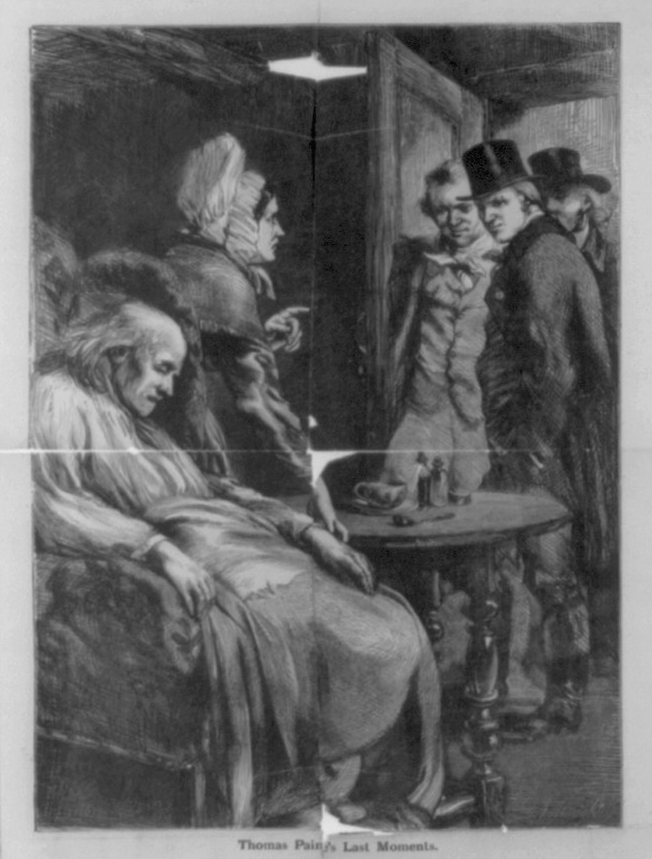
It often surprises me when I discover, as I do from time to time, the story of Paine having supposed to have recanted the opinions he expressed in The Age of Reason. It is difficult to understand why Christian critics of Paine’s theological opinions, some of whom are also critical of his political ideas, although usually reluctant to be explicit on this. I have commented on the story in the past,1 but at a meeting in Sheffield a few weeks ago I was rather taken aback when a distinguished astronomer at a northern university referred in passing to Paine having renounced his views critical of Christianity. When I pressed him later as to how he knew this was the case, he referred to a little book by the Rev. Leith Samuel entitled The Impossibility of Agnosticism (1968). A few days later I was surprised to receive a copy from the professor.
The story of Paine’s “conversion” surfaced within days of his death. In fact there has rarely been a critic of Christianity who has not renounced his critical opinions according to writers such as Mr. Samuel, one-time president of the Protestant Truth Society and author of several evangelical works who also trots out the tale of Voltaire having renounced his opinions. In fact, inventing stories of infidels being converted, usually after encounters with simple, young believers, became a sort of evangelical cottage industry and those familiar with the religious press of the 19th century and later – the most recent I have seen is a piece claiming that F. A. Ridley converted just before his death, this being supposedly based on a claim made by a member of the staff of the nursing home he was in, although the home in question has denied that the person named as the story’s source ever worked there. In fact such tales were a feature of evangelical newspapers and magazines-in the 19th century, and parts of the 20th, as G. W. Foote noted, such tales have ‘been a fertile theme of pulpit eloquence’, and one clergyman named Erskine Neale, even published an entire collection of such claims in a work he called Closing Secrets, which Foote states ‘was at one time, very popular and influential; but its specious character having been exposed, it has fallen into disrepute, or at least into neglect’ (Infidel Death-Beds. London. Pioneer Press, Nd. pp.vii-viii). Though I suppose we must exclude from this Mr. Samuel, not that he refers to it.
The claim that Paine had renounced his theological opinions first surfaced in the memoirs of Stephen Grellet, an American evangelical of Dutch origin who had connections with the Quakers, who claimed that he had got the story from a girl named Mary Roscoe. Samuel also claims that it came from a girl named Mary Hinsdale, its source being one Charles Collins. In fact both girls were one and the same person, Hinsdale being Roscoe’s married name. She was in the employ of a Quaker named Willett Hicks; a friend of Paine’s who conducted his funeral. She claimed to have been sent by her employer to deliver something to Paine and when there to have had a conversation with him during which he is supposed to have caned out ‘with intense feeling Lord Jesus have mercy upon me’, then informed here that, if ever the Devil has had any agency in any work he has had it with me writing that book’ [The Age of Reason]. Paine is also said to have asked the girl’s opinion of his book, and later told her that he wished he had burned it.
Needless to say this tale took on a life of its own and from having supposedly made a single delivery Mary Roscoe had, it was claimed, been in ‘constant attendance’ . According to the Reverend Mr. Samuel, Grellett’s ‘unimpeachable testimony… seemed to outweigh anything found in contrary sources’, as he put it in a letter he wrote to me in 1967 when I had inquired as to what investigation he had made of the story before going into print (I had read his little book many years ago, unknown to my astronomical correspondent). It then transpired that he had not read any criticism of Grellett’s little tale, admitting so in a letter written to me in July 7, 1967, following me having drawn attention to William Cobbett’s investigation into the story.
Cobbett had sought out both Mary Hinsdale and Charles Collins in New York in 1818 while collecting material for his own life of Paine. It seems that Samuel was labouring under the impression that Cobbett was a critic of Paine, as indeed he was when writing as Peter Porcupine, but later he had read Paine’s pamphlet on The Decline and Fail of the English System of Finance (1796) and found the ideas expressed therein coincided with his own, he underwent a genuine ‘conversion’ and became as ardent a supporter of Paine as he had hitherto been a critic. Cobbett asked Collins for evidence of Paine’s conversion and he had in response given him a document containing Roscoe’s statement. Cobbett then called on her at her home 10, Anthony Street, New York, and showed her the document, requesting her to authenticate it. This Hinsdale flatly refused to do, and said she could provide no information about what was in it. She said she had never seen the document before, nor had she authorised Collins to speak in her name. So the story collapsed and that would have been the end of the matter except it was just too good a tale for evangelical propagandists to give up and so we still find the likes of Leith Samuel trotting it out as though it had never been refuted by the very person it is claimed who had made it in the first place.
As for Willard Hicks, he personally denounced the story as a ‘pious fraud and fabrication’, stating that Roscoe had never spoken to Paine. He also spoke of the many bribes and other inducements he had received to produce a statement in which he said Paine had recanted.
We know from various other sources that Paine maintained the opinions he had expressed in The Age of Reason to the last. His friend the painter Wesley Jarvis is on record as stating that there were those who would seek to claim that he had denounced his theological opinions and for that purpose he insisted on there being witnesses present when being interviewed, doing so when he learned of the possible fatal character of his illness he showed no regret about having made public his theological opinions, which he in fact looked on as a defence of Christianity, thus when John Pintard the founder of the Tammany Society, who is now looked upon as one of the originators of what became the modern Democratic Party, a long- time friend of Paine, told him at a dinner in New York held in his honour and attended by many distinguished figures, that he had read The Age of Reason several times and that it had removed any doubts he had about the truth. of revelation, and that his arguments had convinced him ‘of its truth’, Paine was delighted that the intent behind it had been grasped. ‘I may return to my couch tonight with the consolation that I have made at least one Christian’. Paine’s doctor James Manley, a devout Christian but one who usually kept his opinions on the matter private, had informed him of the probable fatal consequences of his illness, and later gave a statement under oath that three days prior his death Paine’s opinions in respect to religion had not changed. He had asked him whether he ‘wished to believe that Jesus Christ is the Son of God?’ To which Paine had replied following a pause of some minutes, I have no wish to believe on that subject.’
I suspect we have not heard the last of the Paine conversion myth as it appears to give some sort of psychological satisfaction to those who continue to retail it. They remind me of ghouls who in mythology are desperate to steal the souls of the dead. Perhaps the likes of the Reverend Leith Samuel should read Matthew 19; 18, where they are told not to bear false witness.