
The Wenatchee daily world (Wenatchee, Wash.), June 10, 1910
THE PAINE MUSEUM
Many Interesting Relics Placed In the Patriot’s Old Home
Although from time to time in the past efforts have been made to honor the memory of Thomas Paine, little was accomplished in this direction until the Thomas Paine National Historical Association was incorporated in 1905. Since then that body, assisted by other clubs, societies and individuals, has spared neither time nor expense to bring Paine into his true place among the founders of American liberty, and some of the fruits of their work are now to be seen in New Rochelle, N. Y.
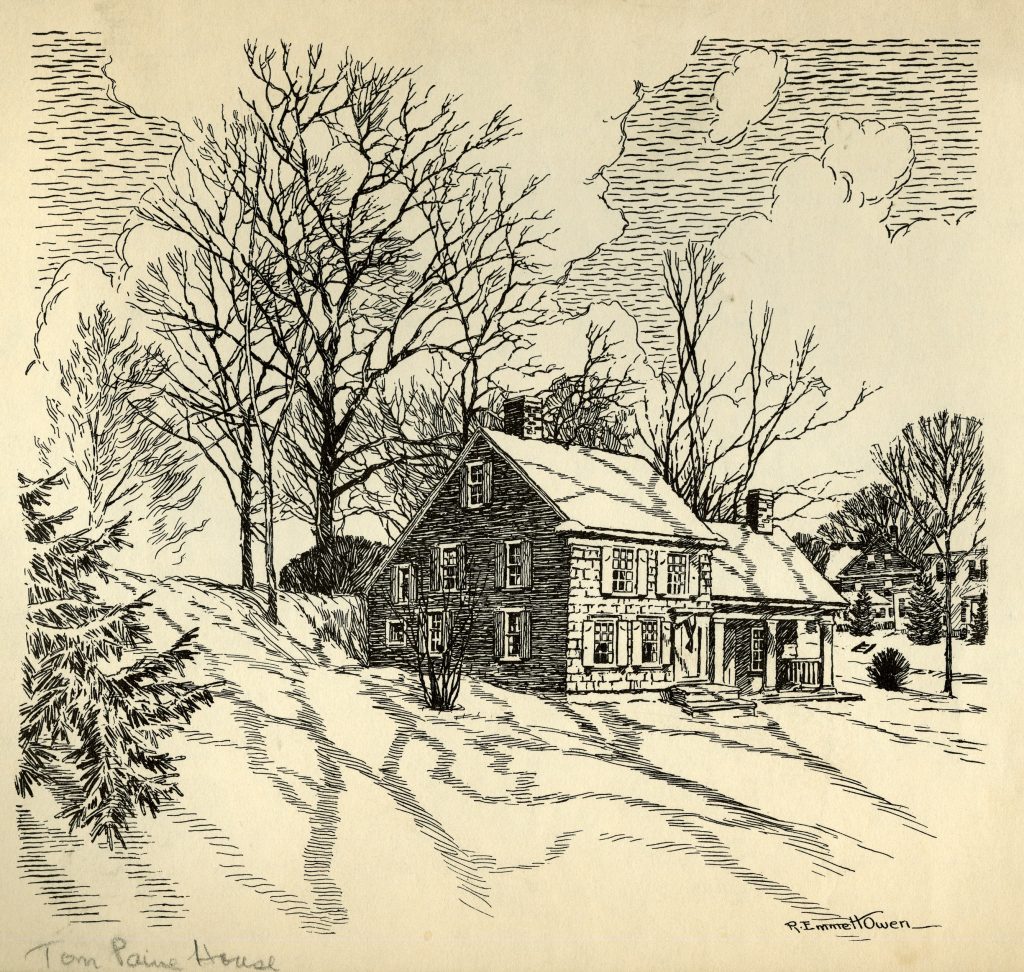
In that beautiful little city, settled in 1657 by Huguenots and named after La Rochelle, France, stands the old house presented to Paine by New York state in 1784 in recognition of his services. That building is now to be called the Thomas Paine National Museum and will contain scores of interesting relics of the patriot.
One of the most prized of these is the very chair he used in his library, a gift of the Badeau family of New Rochelle, and seated in this chair will be a life-sized wax figure of Paine with quill in hand. This figure was modeled from the best picture extant and looks remarkably like him in every detail.
Other reminders of Paine in the museum are numerous cartoons and caricatures, mostly of English origin and appearing shortly after the publication of his Rights of Man. In the collection are also some of the first or early editions of his works and many portraits.
The old house, or the Thomas Paine National Museum, as it is now called, stands on a farm of 277 acres and was confiscated by the state from a Tory named Frederick Devoe.
Near the building is the monument erected by Gilbert Vale, one of Paine’s early biographers, fifty years ago, and behind the museum is the spot where Paine was originally buried.
It was from this grave upon the farm that the body was stolen in the night a few days after burial and taken to England by William Cobbett, the English radical and ardent admirer of the great American patriot.
(Accompanying caption beneath the illustration: “OLD HOME OF THOMAS PAINE, NOW A NATIONAL MUSEUM IN HIS HONOR. House presented to Paine by New York state in 1784 in recognition of his services.”)