
By Richard Briles Moriarty
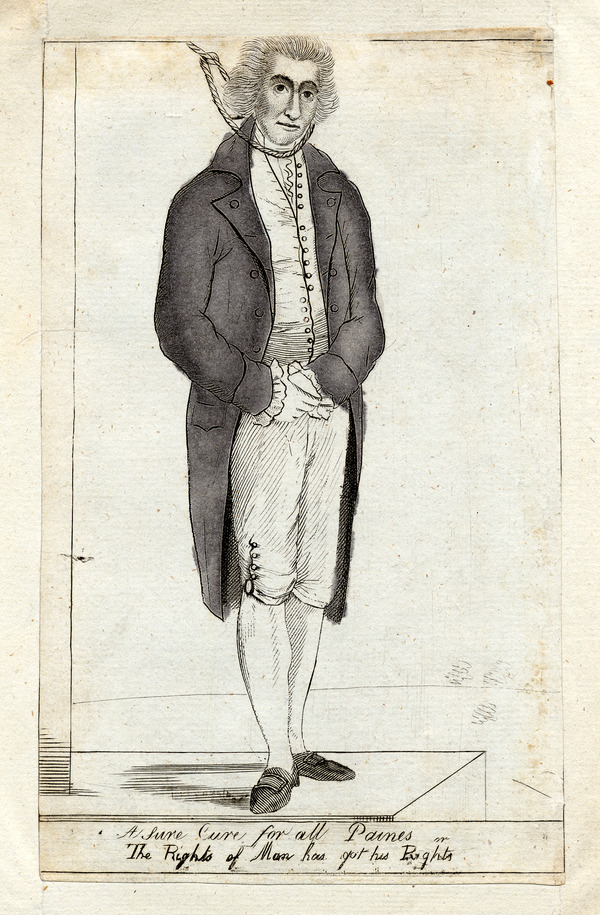
Thomas Paine and the banning of his works have long been intertwined. Suppression of his Rights of Man by the English government raged as he joined the French National Convention.
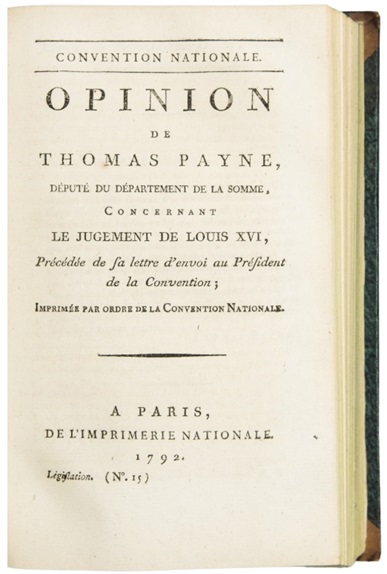
After King Louis XVI was convicted of treason in 1792, Thomas Paine argued that the former king had become “Citizen Louis Capet.” Rather than execute him, Paine said he should be banished to America for immersion and education in republican principles.
During his startlingly bold presentation to the French National Convention, Paine quoted Robespierre’s arguments in 1791 that “the death penalty is essentially unjust and… the most repressive of penalties,” that it “multiplies crimes more than it prevents them” and constitutes “cowardly assassinations” through which one crime is punished by another.
As Marat assaulted Paine’s arguments, Robespierre remained silent, but likely gritted his teeth as Paine quoted his own eloquent and unanswerable plea against capital punishment. Paine’s persuasiveness nearly turned the tide.
Paine’s position was dramatically more radical than that of Robespierre and Marat. Instead of treating Louis as a king gone bad, Paine proposed, consistent with his arguments since Common Sense, that all kings, simply because they are kings, are tyrants.
Paine’s arguments were dangerous to the increasing yet tenuous dominance of Robespierre and the Jacobins. His plea not to kill the king was published by the French government in 1792, yet Paine’s efforts resulted in his 1793 imprisonment.
Now jump ahead in time. Gutzon Borglum, designer of Mount Rushmore, sculpted an eight-foot statue of Paine for unveiling in Paris on the 200th anniversary of his birth in 1937. The statue showed Paine pleading to the National Convention to spare Louis Capet.
When Nazi Germany conquered France, the statue was hidden from the Vichy Government, which at the instigation of the Nazis ordered removal of all “statues and monuments of copper alloys situated in public places and administrative locales,” purportedly “to recycle the metallic components for industrial production.” The real purpose was sending metals to Germany for recycling into military uses.
In 1945, W.E. Woodward predicted that Borglum’s hidden statue would be unveiled in Paris in the near future, which it was in 1948. Despite plans for moving the statue to America, it remains far more appropriately in Paris on display in Parc Mountsouris.
During World War II, Borglum’s statue was at risk less because Paine’s books were banned by the Nazis — although they were — and more because military lust demanded metal.
Governments purportedly devoted to free speech are hardly immune to banning Pane’s books.
R. Wolf Baldassarro observed in a 2011 blog post, “Banned Books Awareness: Thomas Paine,” that Common Sense in the 1950s was barred from U.S. Information Service libraries during the McCarthy era by the government of the United States of America, the country whose name and perhaps existence Paine created through that very pamphlet.
For more than a quarter-century, from 1795 to 1822, Paine’s The Age of Reason was banned in the United Kingdom, reports The Banned Books Compendium by Grigory Lukin. He noted that an English publisher of The Age of Reason was sentenced in 1797 to a year of hard labor.
In 1819, Richard Carlile was prosecuted because he included The Age of Reason in a collection of Paine’s works. Carlile read the entire book into the court record, ensuring even wider publication. He then was sentenced to a year in prison. Carlile actually served six years, Lukin wrote, because “he refused any ‘legal conditions’ on his release.”
Lukin identified the 32 books most often banned worldwide. Two of those books, Rights of Man and The Age of Reason, were authored by Paine.
As true from Common Sense forward, governments purporting to support democracy and free speech will resist the radical impact of Paine’s thoughts. People themselves can seek out his thoughts, absorb and act on them, a bottom-up legacy which would make Paine rejoice.