
By Sanford J. Mock
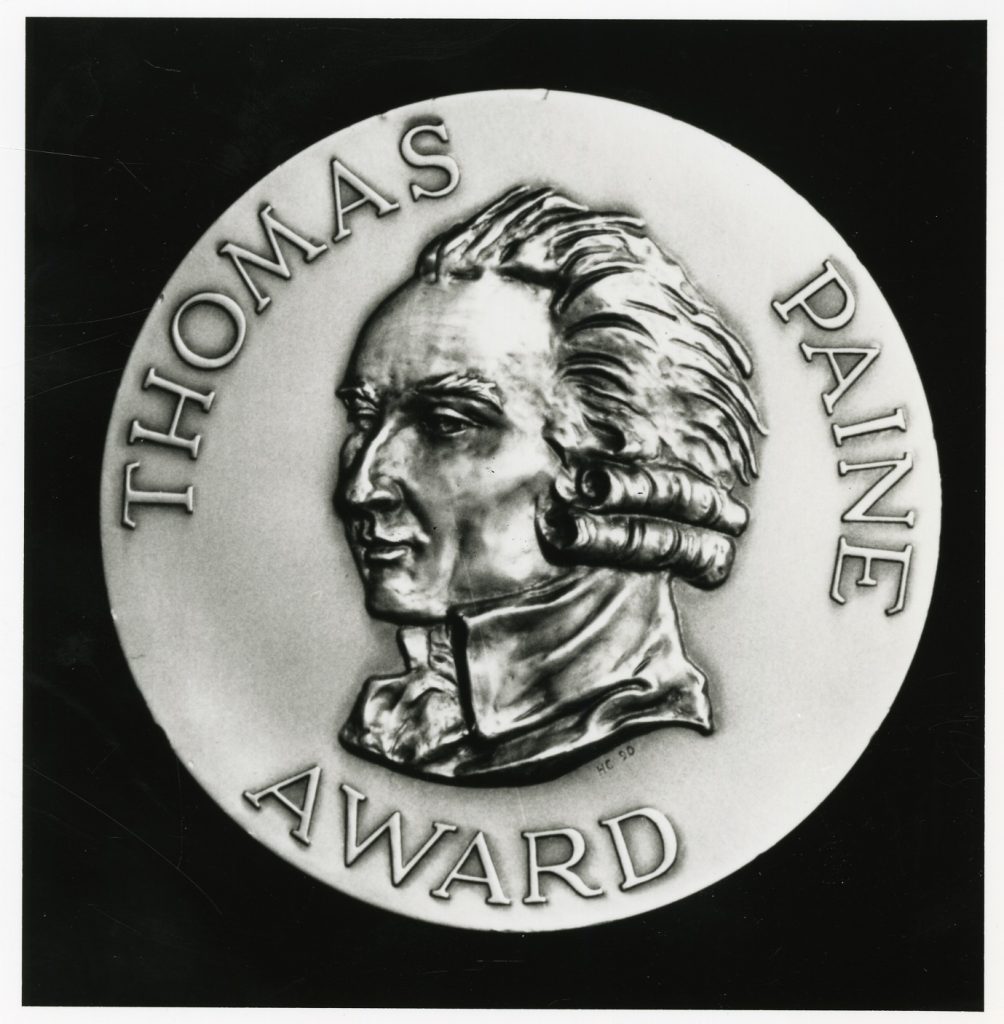
“These are the times that try men’s souls. The summer soldier and the sunshine patriot will, in this crisis, shrink from the service of their country, but he that stands it now deserves the love and thanks of men and women. Tyranny, like hell, is not easily conquered; yet we have this consolation with us that, the harder the conflict, the more glorious the triumph”. Thus wrote Thomas Paine in the first part of The American Crisis papers, two days before Christmas of 1776.
Seven years later, in The American Crisis, Part XIII, he paraphrased his own famous lines. “The times that tried men’s souls are over, and the greatest and completest revolution the world ever knew gloriously and happily accomplished”.
But alas, for Citizen Paine, the bitter trials of his own soul lay ahead – if by the phrase one means rejection, condemnation, banishment, trial, imprisonment, illness, drunkenness and poverty.
British born, this man, more than any other, crystallized the attitudes and emotions of the American colonists. His writings were their supreme inspiration to revolt against English rule. Hailed for his achievement early on, how did he fall from grace and glory?
The young Thomas Paine had sparse education and limited working experience. He started as a corset maker in his father’s shop in Thetford, England, at the age of 13. He failed at a succession of menial jobs before coming to America in 1774 when he was 37. It is remarkable that this person of limited background could have written a monumental pamphlet with such skill and power as he did two years later in Common Sense.
Reflecting on his creation, Paine tells us, “I saw an opportunity, in which I thought I could do some good, and I followed exactly what my heart dictated. I neither read books nor studied other people’s opinions. I thought for myself…”
Before departing for America, after separating from his second wife, who settled £35 on him and thus financed his journey, Paine had developed an intense bitterness toward George III and the whole concept of royalty.
At Lexington, in April 1775, American blood was shed. That incited Paine to pour his bitterness against “the Royal Brute of Britain” into Common Sense. “I rejected the hardened, sullen-tempered Pharaoh of England forever, and disdain the wretch, with that pretended title of Father of His People can unfeelingly hear of their slaughter, and composedly sleep with their blood upon his soul”.
The new world brought a new career – journalism. Thomas wrote articles for a magazine, signed by pseudonyms, as was the custom of the day. He met intelligent men of like mind. Dr.Benjamin Rush, Benjamin Franklin, Samuel Adams and David Rittenhouse read the manuscript of Common Sense before publication, offering few changes.
Common Sense appeared in bookstalls on January 9, 1776, under the by-line, “Written by an Englishman”. It was a sell-out. More copies were printed, and they quickly spread through the colonies. Said Edmund Randolph in Virginia, “The public sentiment which a few weeks before had shuddered at the tremendous obstacles with which independence was environed, over leaped every barrier”.
“The country was ripe for independence”, commented a contemporary, “and only needed some body to tell the people so, with decision, boldness and plausibility”. And Paine, never overburdened with modesty, declared, “I believe, by the end of the year, the number of copies printed and sold in America was not short of 150,000. This was the greatest sale since the use of letters”.
Knowing that Paine was short of money virtually his entire life, we may wonder why, with this best seller (and more to come), he wasn’t rich. While he be
came sophisticated about fi nance, in an intellectual and political sense, he lacked any personal understanding of how to make and keep money. The hope for profit certainly did not motivate him with Common Sense. He donated the first £30 that came from the pamphlet “for the purchase of mittens for the troops ordered on that cold campaign” (the failed attempt to capture Quebec).
At first there was much speculation as to the author, but the truth came out and Paine was immediately a hero to all who espoused independence. Tom, the Englishman, now professed to be an American citizen. After the July 4 Declaration, Paine served as a war correspondent for Philadelphia newspapers. The early phase of combat went against the Americans. When voluntary enlistments expired on December 1, there were not adequate replacements. Washington was in retreat at Trenton, and a British attack on Philadelphia seemed imminent.
Morale, both of civilians and soldiers, was at a low. Strong words were needed. Paine wrote, “in what I may call a passion of patriotism”, an essay named The Crisis. The opening lines are the opening lines of this article. The closing lines were an inspiration to stand and fight:
This is our situation, and who will may know it. By perseverance and fortitude we have the prospect of a glorious issue by cowardice and submission, the sad choice of a variety of evils – a savaged country – a depopulated city – habitations without safety, and a slavery without hope – our homes turned into barracks for bawdy Hessians, , and a future race to provide for, whose fathers we shall doubt of. Look on this picture and weep over it! and if there yet remains one thoughtless wretch who believes it not, let him suffer it unlamented.
Paine restricted the printer to a two cents a copy price. Other publishers up and down the coast reprinted the work, so it received a fast and wide circulation. The second in the Crisis series appeared in the middle of January 1777. By then confidence had returned. In April Crisis No.III attacked English sympathizers and urged the Pennsylvania Assembly to pass a loyalty oath to the new government, ‘Tories’, Pane wrote, ‘are a set of avaricious miscreants, motivated only by avarice, downright villainy, and lust of personal power’. And as for the pacifist Quakers, he had these invectives: They are ‘like antiquated virgins, they see not the havoc deformity has made upon them, but pleasantly mistaking wrinkles for dimples, conceive themselves yet lovely and wonder at the stupid world for not admiring them’.
It is an amusing irony that, when near death in 1809, Paine requested permission to be buried in a Quaker graveyard. ‘I wish to be buried in your burying ground. I could be buried in the Episcopal church, but they are so arrogant, or in the Presbyterian, but they are so hypocritical’. The Quaker congregation turned him down.
Nominated by John Adams, with whom he later became bitter enemies, he was appointed secretary to the Committee for Foreign Affairs. Adams saw that Paine ‘had a capacity and ready pen, and understanding he was poor and destitute, I thought we might put him into employment, where he might be useful and earn a living’.
In the next couple of years, inflation struck. By summer 1779 a paper dollar issued by the Continental Congress was worth less than a copper penny. Hence the phrase, ‘not worth a continental’. The war was going badly. Winter was terrible and spring no better. General Washington expressed his desire in a letter to the Executive Council of Pennsylvania: ‘Every idea you can form of our distress will fall short of the reality. There is such a combination of circumstances to exhaust the patience of the soldiery that it begins to be worn out, and we see in every line of the army the most serious features of mutiny and sedition…Indeed, I have almost ceased to hope’.
In May of 1780, Charlestown was captured. The worst of times had come. There was a desperate need of money for supplies and for bounties to pay volunteers.
Thomas Paine had a plan. He told the wealthy Philadelphia merchants that ‘as it is the rich that will suffer most by the ravages of an enemy it is not only duty but true policy to do something spirited’. Robert Morris got involved, and with pledges of some £300,000, the Bank of Pennsylvania was created, the first bank in the United States. Congress backed the plan with the ‘full faith and credit’ of the nation. ‘By means of this bank’, reported Paine, ‘the army was supplied through the campaign and being at the same time recruited was enables to maintain its ground’.
The tide turned, and Cornwallis surrendered in October of 1781. The war was not over, but the crisis was. Paine, meanwhile, was a journalist without a job. He wrote to General Washington complaining about the country’s lack of appreciation of his contributions to the cause. Washington was sympathetic. He formed a plan with Robert Morris and Robert Livingstone, newly appointed Secretary of Foreign Affairs, to hire Paine to write for the government, a kind of staff propagandist. He would be paid $800 a year from a secret fund. But the war ended in 1783 and so did Paine’s job.
With peace, Paine’s life lacked purpose, as well as money. He expected somehow to be taken care of by a grateful nation, which he had served for seven years. But the nation was now too busy enjoying tranquillity and readjusting to life without battle. Paine wondered what to do. ‘Trade I do not understand. Land I have none… But I have exiled myself from one country without making a home of another’.
On the advice of Robert Livingstone and Robert Morris, Paine petitioned Congress for financial reward for his services. This failed, and he next tried asking the states, one by one. The New York legislature gave him a small farm that had been confiscated from a Tory in New Rochelle. In 1785 Pennsylvania awarded him £500 as “temporary recompense”.
The subject was revived in Congress by President Washington, who asked Elbridge Gerry to help. Paine requested reimbursement for his expenditures since coming to America, at least $6,000. Congress awarded him $3,000. These gifts he considered far less than he deserved. Nevertheless, for the time, he was comfortable financially.
He took leave from politics and immersed himself in designing an iron bridge. His bridge would be constructed with a single arch combining thirteen sections “in commemoration of the thirteen states”. There were then very few bridges in America because the state of the art design was a combination of piers and low arches which would then have been crushed by winter ice.
Paine rented a loft in Philadelphia and began construction of a 13 foot model. The finished product would require 520 tons of wrought iron and would span the Schuykill River in Philadelphia. He presented his designs to Benjamin Franklin, now returned from a decade in Paris, and David Rittenhouse. A committee of the Pennsylvania Assembly examined the model on New Year’s day, 1787. Curiosity was great, conviction mild.
Paine estimated the cost at over $330,000, which was more than the state’s annual budget. Such a project at a time when government debt was high was too impractical. Franklin suggested that Paine take the model to Europe. If he could get approval from the Royal Society in London and the Royal Academy of Sciences in Paris, it would aid his chances for government subsidy and perhaps induce wealthy private investors to support the project.
Benjamin Franklin called Thomas Paine “my adopted political son”, and he wrote letters of recommendation to important persons in Paris. So in April 1787, at the age of 50, Paine sailed from New York harbour bound for France, a crossing which under the best of conditions took a month. Though he planned to return soon, it would be 15 years before he again saw America.
The French Revolution began May 25, 1787, the day before Paine debarked. So intent was he on winning approval for the bridge, that he scarcely seemed aware he had arrived at the onset of a revolution. At first the revolt unfolded peacefully. Lafayette and other moderates hoped for a constitutional monarchy with limited authority for the rulers.
Paine was well known to French intellectuals as the spokesman of the American Revolution, and he was welcomed as a hero. Thomas Jefferson was in Paris as Minister, and his influence induced the Academy of Sciences to study Paine’s bridge. They did approve his plan, but the bridge was never built.
Paine moved on to London to seek endorsement from the Royal Society. He returned to his home in Thetford and was reunited with his 91 year old mother. Paine closely guarded a couple of secrets in his life. One was that over the years from what little money he could spare, he had consistently sent sums to his parents.
While in Thetford he wrote a pamphlet titled Prospects on the Rubicon, in which he, the expatriate Englishman, advises England to avoid a contemplated war with Holland. War “has but one thing certain, and that is to increase taxes…I defend the cause of the poor, of the manufacturer, of the tradesman, of the farmer, and of all those on whom the real burden of taxes fall – but above all, I defend the cause of humanity”.
Endorsement of the bridge by the Royal Society was not forthcoming. Undaunted, Paine set up a workshop with a firm of ironworkers in Rotherham, Yorkshire. There, part of the time, he continued to work on bridge design and other mechanical inventions. In London he was welcomed into the influential American colony, which included Dr.Benjamin West and John Trumbull. He was also on good terms with English politicians Edmund Burke and Charles James Fox.
In the winter of 1788, John Adams, who had been American Minister to England, returned to America and no official representative replaced him. Paine, working closely with Jefferson, actually performed as the ex-officio Minister in London.
On July 14, 1789, the Bastille, symbol of royal tyranny, fell to the mob. Lafayette, friend to both Paine and Jefferson, was made head of the National Guard, an army of the people. Domestic order rapidly deteriorated, Inflation rose, the price of bread skyrocketed. Some 7,000 women in angry protest tramped through twelve miles of mud to Versailles. The King, on Lafayette’s prudent advice, distributed food from the royal supplies. The entire entourage marched back to Paris and the royal family moved to the Tuilleries, effectively under house arrest.
In London, when Paine heard the news, he prepared to leave at once for Paris. “A share in two revolutions”, he exulted, “is living to some purpose”. In a ceremony in the gardens of the Louvre, General Lafayette presented Paine with the key to the Bastille and asked him to give it to President Washington. Lafayette translated Paine’s words to the crowd, “the principles of America opened the Bastille”. Paine’s presence upstaged Gouverneur Morris, who was on a financial mission for Washington. Jealous and resentful, Morris described Thomas as “inflated to the eyes and big with a litter of revolutions”. Expecting France to write a constitution based on the American, Paine returned to London for an exhibition of a revised edition of his bridge, now with a span of 110 feet. Spectators were charged a shilling to see it. The exhibition continued for months, but Paine did only slightly better than break even. He began a series of journeys between England and France. Paine had no qualms about advising the English that their time for democracy had come. A spark was provided by Edmund Burke, the British parliamentary leader, who wrote a defence of royal government called, Reflections on the Revolution in Franca As soon as he read it, Paine began composing his reply. Burke had supported the ideals of the American Revolution during its darkest hours and Paine had been his great admirer. But now Burke attacked the principles of the French Revolution as anarchist and destructive.
Paine’s answer was Rights of Man, Part One, which he dedicated to George Washington. Its essence was that all men have natural rights which cannot be violated. Civil rights grow out of natural rights, and people may choose any form of government they want. A true constitution must be “of the people, and for the people and by the people” – a theme that would be powerfully reiterated 73 years later.
The institution of royalty was a violation of the natural rights of man, “It is by distortedly exalting some men, that others are distortedly debased. A vast mass of mankind are defraudedly thrown into the background of the human picture, to bring forward, with greater glare, the puppet show of state and aristocracy…”
This monumental work was published in England and Ireland, and a few months later in America in 1791. An estimated two million copies were sold in three countries. At three shillings apiece, Paine would have become wealthy had he accepted the profits. He choose not to take pay for what he felt was his obligation to society to tell the truth. So his share went to an obscure group called The Society for Constitutional Information, which embraced the work as its bible. The attack on the institution of monarchy rattled historic tradition and caused a sensation in Great Britain. The author was regarded as a hero at one end of the political spectrum, and at the other, as The Great Satan.
Observed Paine, “…The same fate follows me here (in England) as I first experienced in America, strong friends and violent enemies, but as I have got the ear of the country, I shall go on, and at least show them, what is a novelty here, that there can be a person beyond the reach of corruption”. The work was openly praised in America by Secretary of State Jefferson and James Madison. John Adams disapproved, and President Washington was non-committal.
Paine returned once more to France to work on the second part of Rights of Man and to watch what he thought was to be the peaceful, bloodless, unfolding of the French Revolution.
He stayed at Lafayette’s home and he became friends with various leaders of the uprising, including Maximilien Robespierre, who publicly endorsed Rights of Mart. These two shared the same sentiments for freedom of religion, universal suffrage, abolition of slavery everywhere, hostility to royal power and abolition of the death penalty!
Paine must have recognised that his hopes for non-violent solutions were fading. Louis XVI and Queen Marie Antoinette tried to leave Paris in disguise. They and the entire royal family were caught and imprisoned. Lafayette was thought to have permitted the escape attempt. The mob was developing and the Parisian scene was in process of turning ugly.
Thomas Paine returned to England, where an improved model of his bridge was exhibited in 1792 to general approval. Its cost, however, was still prohibitive. On display for a year, no buyers appeared. Thus ended Paine’s dream.
Ironically, in 1793, one Rowland Burdon improved on Paine’s design* and raised £22,000 to build his version spanning 236 feet of the River Wear in Northern England. This bridge was immediately acclaimed as “one of the most daring structures ever erected in cast iron”.
Rights of Man, Part Two, was released in London in February 1792, dedicated to the Marquis de Lafayette. This was the call to arms. Paine openly urged the people of Great Britain to revolt, to overthrow the monarchy and establish a republic.
The work, over 100 pages long, was a bombshell. The explosion rocked the nation and was even more sought than Common Sense had been in America. In England alone, a million and a half copies were sold, at a price limited by Paine to three shillings. This volume became the best seller in the history of the country to that time.
In it Paine predicts that “monarchy and aristocracy will not continue seven years longer in any of the enlightened countries in Europe”. Revolutions are “the order of the day”. His horizon for change expands to the entire western world. “…the iron is becoming hot all over Europe. The insulted German and the enslaved Spaniard, the Russ and the Pole are beginning to think. The present age will hereafter merit to be called the Age of Reason, and the present generation will appear to the future as the Adam of a new world”.
Paine does a lot more than call for the overthrow of monarchies. He outlines a series of proposals for what government should do for its citizens. The Paine ‘New Deal’ called for the subsidisation of the poor, education of their children by the state. Twenty shillings should be given to every needy woman immediately on the birth of a child.
Social security was part of his programme. At age fifty, a person should receive six pounds a year, and at sixty, when “labour ought to be over, ten pounds until death”. Wages, which were government regulated, should be allowed a free market.
What really must have raised hackles on aristocratic necks were proposals for graduated income tax on the wealthy and inheritance taxes to dismantle great estates. A member of the upper class reacted with, “If Mr.Paine should be able to rouse up the lower classes, their interference will probably be marked by wild work, and all we now possess, whether in private property or public liberty, will be at the mercy of a lawless and furious rabble”.
In the spring of 1792, coal miners threatened a strike. Other labourers demanded higher pay, better working conditions. Insurrection was in the air and the government was clearly frightened. Declared Prime Minister William Pitt, “Principles had been laid down by Mr. Paine, which struck at the hereditary nobility, and which went to the destruction of monarchy and religion, and the total subversion of the established form of government”.
Thomas Paine was accused of seditious libel and ordered to appear for trial. ‘Mad Tom’ escaped by night, one jump ahead of the authorities. At Dover he boarded the ferry for Calais, never again to return to his homeland.
Just prior to his departure the Revolution in France heated up. A mob marched on the Tuileries shouting “down with the fathead!” The Swiss Guard opened fire and a thousand people were killed. The sans culottes, whose long trousers identified them as working class, rallied round a new song, “Aux arms, citoyens! Formez vos bataillons!” Lafayette denounced them and was arrested.
The National Assembly declared a state of emergency. All priests who had opposed the Revolution were given two weeks to leave the country. The Commune, the revolutionary government of Paris, voted honorary citizenship to Americans Thomas Paine, James Madison, Alexander Hamilton and George Washington.
On September 2, 1792, the people’s incendiary anger flared into a three-day killing orgy. Some 1,300 aristocrats and priests were murdered in what came to be known as ‘The September Massacres’. Electoral assemblies met to choose deputies for a National Convention. Paine was welcomed as a hero, “Vive Thomas Paine!” shouted the people of Calais when he landed. He was immediately invited to represent Calais, along with Maximilien Robespierre.
Paine was shocked when he learned of the September Massacres. Most of the victims were murdered in prisons. Such action was anathema to him. “…A prison is as sacred as an altar and those who violated a prison were capable of betraying their own country”. Still, Paine felt that no one was better qualified for government service than he, if the French wanted men skilled “in defending, explaining, and propagating the principles of liberty”.
When Paine appeared in the hall of the Legislative Assembly in Paris, the deputies erupted into cheers. Factionalism was intense. Many different agendas were represented. Paine was to learn, to his sorrow, that the French Revolution was not the American Revolution revisited. This was a different culture with different history and traditions.
In the meantime he was put on trial in absentia in London. The government charged he was “a wicked, malicious, and ill-disposed person…who seditiously had planned to traduce and vilify the government”. He was found guilty, thus giving the government the right to suppress Rights of Man and all his other works, and he was exiled from England forever. “Paine looks a little down at the news from England”, snidely commented Gouverneur Morris, then Minister to France, at a small dinner. “He has been burnt in effigy”.
When King Louis was being judged, Paine proposed imprisonment and then banishment. “Louis XVI is only a weak and narrow-minded man, badly reared. He should be shown some compassion”.
But the mood was not for compassion. The vote of the 707 members of the Assembly took two days. By a majority of one vote, the decision was for death. Three days later the king lost his head to the guillotine and Thomas Paine lost support from the more radical deputies, like Marat, Danton and the man who was once against the death penalty, Robespierre.
France was embattled on many fronts. Prussian soldiers were moving towards Verdun. In 1792 and 1793 the National Convention declared war against Prussia, Austria, Holland, Spain and, finally, England. The monarchies of Europe were understandably eager to topple the mad government of the sans culottes who killed their king.
In addition to attacks from outside there was an economic disaster at home. Inflation and scarcity of food staples were widespread. The Convention created a Committee of Public Safety, whose nine members were given carte blanche to end the chaos.
Paine fell out of favour. Disillusioned, and for his own safety, he retired to St.Denis, where at first he drank himself into oblivion. His increasingly fiery nose and ruddy face attested to that condition (though it was said he consumed “no more than three quarts of rum a week”.
In the fall of 1793, Paine was denounced as an Englishman, and England was France’s enemy. Blood flowed in October. Marie Antoinette was guillotined. Paine’s principal friends in the Assembly were driven through the streets to the taunts of the sans culottes. Singing the Marseillaise they went to the chopping block.
Robespierre, now in power, turned his attention to “foreign conspirators”. Paine continued to stay out of the way in St.Denis, where he was hard at work on a new book. De-christianization was part of the creed of the Revolution, and Paine held views on the subject that were akin to Robespierre’s. He accepted God and life after death. He was a deist, believing that reason proved the existence of God, but rejected divine revelation and the establishment of religious authority.
Since Paine’s general view was consistent with that of the Revolution’s leader, no effort was made to block the printing of the chapters of his new book as they were sent into Paris to the publisher. The Age of Reason was a small work, mainly a vitriolic attack on the Bible.
“Whenever we read the obscene stories, the voluptuous debaucheries, the cruel and torturous executions, the unrelenting vindictiveness, with which more than half the Bible is filled, it would be more consistent that we called it the word of a demon than the Word of God”. The devout shivered with anger at such blasphemy.
When the soldiers came and took away his friends who boarded in the same house in St.Denis, Paine sensed that his own time was near. Three days after Christmas in 1793, the police escorted Citizen Thomas Paine to the Luxembourg, formerly a palace, now remodelled to house up to 1,000 prisoners.
In the Luxembourg inmates were free to wander about in the courtyard and visit each other. Not free was the food. Paine again became a paying border. At first male and female prisoners were accommodated together, and Paine soon found intimate companionship with an actress prisoner, but the genders were separated after the prison acquired the reputation as Paris’ premier brothel.
Paine assumed that incarceration would be brief, but the only effort to get him out came from American friends in Paris, who applied to the Assembly for his release as an American citizen.
The case required delicate handling. True, Paine had come from America, but he was born in England, an enemy country. On the other hand, it was a political reality that France needed the United States for critical supplies. It would not be politic to imprison a famous American without proper cause.
But no such direction came from President Washington. Why he did not interfere is still a matter for speculation. The contention that he didn’t know what had happened to Paine is unlikely. In any event, there was no pressure on Minister Gouverneur Morris, nor from him, to do anything. Morris expressed his contempt.
“In the best of times”, he said, “he had a larger share of every other sense than common sense, and lately the intemperate use of ardent spirits had, I am told, considerably impaired the small stock, which he originally possessed”. Morris felt that since Paine had been a member of the French government he could no longer legally claim to be an American citizen.
Weeks and then months passed. Paine languished. He grew increasingly angry and frustrated. Why had his friends at home deserted him? Why did the french want to detain him?
Robespierre feared that if Paine were allowed to return to America, his pen might provoke a sword. If Paine wrote of what he saw in France, it could potentially damage the Franco-American entente. At the same time, it could cause a storm if Paine were guillotined. Robespierre concluded that the best solution was to neutralize the dangerous author, i.e., keep him imprisoned. “I neither saw, nor heard from, anybody for six months”, lamented Paine.
The problems of the French government intensified and their desperation was reflected in the prison. Discipline was harsh, freedom of movement curtailed. Almost every night up to 50 inmates were carted off to the guillotine. Paine’s friends were victims, one after another. He constantly expected to be next.
His strength of character and courage came to the fore in the ordeal. A survivor said of him later, “His cheerful philosophy under the certain expectation of death, his sensibility of heart, his brilliant powers of conversation, and his sportive vein of wit, rendered him a very general favourite with the companions of misfortune, who found a refuge from evil in the charms of his society. He was the confidante of the unhappy, the counsellor of the perplexed; and to his sympathizing friendship many a devout victim in the hour of death confided the last cares of humanity, and the last wish of tenderness”.
With it all, he kept writing, he produced essays, poetry, a revision of Rights of Man and even an Essay on the Character of Robespierre.
On June 10, 1794, the Convention abolished the rights of accused to have counsel or witnesses. Judges could only acquit or condemn to death. So began ‘The Great Terror’ which prevailed for 47 days. The guillotine claimed 1,376 people. “What rendered the scene more horrible was that they were generally taken away at midnight, so that every man went to bed with the apprehension of never seeing his friends or the world again”.
The strain of the ordeal finally broke Paine’s health. He almost died from a fever, which persisted for five weeks. Only the constant care of two English doctors, fellow prisoners, pulled him through.
‘The Great Terror’ ended with the fall of Robespierre, July 27, 1794. “The monster to be erased from the list of men”, as a surviving official described him, was brought to the Luxembourg, but the jailor would not admit him. Neither would any other jailer in the city. The ‘monster’ was fittingly erased by his favourite device, the guillotine, the next day.
Again, Paine wrote to the Committee of Public Safety asking for his release. No response, Then a piece of good news, Gouverneur Morris was being replaced as Minister by James Monroe. Desperate, Paine immediately wrote to him, at last, a response.
No question in Monroe’s mind that Thomas Paine was an American citizen. “By being with us through the Revolution, you are of our country, as absolutely as if you had been born there; and you are no more of England, than every native of America is”. Monroe met with the appropriate French committees and on November 4, 1794, after more than ten months in prison, Thomas Paine was released. James Monroe wrote to Secretary of State Jefferson that, in spite of his lengthy incarceration, and his age, nearly 58, and a persistent abscess in his side, Paine was in “good spirits”.
Monroe, twenty years Paine’s junior, was in awe of this hero of the American Revolution. Out of respect, he invited him to stay at his house for a while. A year later Monroe wrote that he feared Thomas would stay “till his death or departure for America, however remote either one or the other event may be”.
In a state of extreme weakness, likely brought on by the open wound in his side and his incessant drinking, Paine poured out his wrath against George Washington for having not tried to rescue him from prison. He addressed a long letter to James Madison, then representing Virginia in the House of Representatives. “I owe this illness (from which I have not much prospect of recovering) partly to Robespierre and partly to Mr. Washington… I ought not to have suspected Mr. Washington of treachery, but he had acted towards me the part of a cold blooded traitor”.
Monroe insisted he not send the letter. Paine agreed with reluctance, but later the obsession with Washington inflamed him further, and he had An Open letter to George Washington carried to Philadelphia, where it was published in 1796 by Benjamin Franklin Bache, Ben Franklin’s son-in-law.
His words directly to Washington were bitter and unrestrained. “And as to you, Sir, treacherous in private friendship (for so you have been to me, and that in the day of danger) and a hypocrite in public life, the world will be puzzled to decide whether you are an apostate or an imposter; whether you have abandoned good principles, or whether you ever had any”.
Washington appears to have taken little notice of this diatribe. The letter caused Monroe some embarrassment, so, after a year and a half, he finally asked Paine to move.
At this stage of his life, Paine wanted out of France. But where would he go? He probably would have preferred England, but there, since Rights of Man, he was a convicted felon, exiled for life.
Most of America would never forgive him for the outburst against Washington. And his attack on the Bible in The Age of Reason made him anathema to the devout in America, as well as France and England. When this volume reached America, an outraged John Adams declared, “The Christian religion is, above all the religions that ever prevailed or existed in ancient or modern times, the religion of wisdom, virtue, equity, and humanity, let the blackguard Paine say what he will”.
Unwanted in England or America, only tolerated in France, Thomas Paine was, in essence, a man without a country. Lacking a clear-cut choice of destination, he spent the next eight years living as a house guest of friends or as a boarder in an assortment of homes in and around Paris. He began a ‘brief’ stay with the family of Nicolas de Bonneville, a printer and journalist. Five years later the original ‘Man Who Came to Dinner’ was still there.
He wrote essays prolifically, but without much impact, and he re-appeared before the French Assembly, urging the members not to forget the original principles of the Revolution.
At the time the letter shown here was written, May 23, 1802, Paine was the house guest of Citizen Tenobio. Paine’s penchant for letter writing seemed always at the disposal of his friends. He did not hesitate to espouse their causes, personal or political, . No doubt in this way he was giving thanks for hospitality.
The letter is addressed to ‘Citoyen’ Skipworth. In 1792 the Paris Commune had decreed that this title henceforth be used instead of ‘monsieur’. Fulwar Skipworth, Jefferson’s nephew, was the American Consul General in Paris and a good friend.
The letter read as follows:
Plessis Piquet
30 Florial
Dear my friend,
My friend Tenobio at whose place I now am, has directed his banker in London, Hammersly, to invest the balance of accounts due to him, in American Bank shares, which he has done, and in his letter to him of April 30 says, “We are about to send the necessary deeds to America to have the stock transferred in your name, the interest thereon may be received there in Amsterdam or in London as best suit yourself, but we wish to have your directions that we may give our orders accordingly and at the same time.
It is necessary to send the original deed to America of an attested copy of it, should the original deed rest in the hands of Tenobio? If an attested copy be sent, can more than one be sent in the case at accident, as is done in 1st, 2d, 3d bills of Exchange. Be so kind as to give me your opinion upon this case and add a word of America new if you have any. When you are mounted on your Rosinata and can make a stretch thus far we shall be glad to see you. You can tell us what pigs and cows are worth as Tenobio is going to buy some. give my Compts. to Mr. Purveyance.
The contents of the letter are perhaps surprising, revealing the financial sophistication of a man of little property. Yet we know that Paine was familiar with banking from his association with Robert Morris in forming the Bank of Philadelphia and later as a proponent of the Bank of North America.
He astutely asks whether documents should be sent in sets, like bills of exchange, to insure that at least one makes it through the transporting process, Tenobio’s decision to buy American bank shares (perhaps influenced by Paine?) is also interesting. Though the options for securities investments were few, such shares would have been the growth stocks of the day, and quite speculative.
Paine was pleased to learn that friend Thomas Jefferson had defeated John Adams in the latter’s bid for a second term in 1800. Jefferson offered to provide passage to America for Paine on a government ship. Again, Thomas equivocated. He stayed in France.
Part of his hesitation was a genuine fear that his vessel might be stopped on the high seas by a British warship, which is exactly what happened when James Monroe was en route home. British sailors boarded his ship and “searched every part of it, and down to the hold, for Thomas Paine”. About five months after the Skipworth letter, he finally decided to pack his bags for the journey from Havre-de-Grace. Thomas Paine, now 65, arrived in Baltimore in October 1802. He was greeted with a mixed reception, but was mostly the object of scorn and contempt.
The great men he had known, for the most part, deserted him. Mainly Jefferson, among the political powers of the day, maintained friendship – but that from a distance. Other notable who remained loyal were Robert Fulton, with whom he had earlier collaborated on ideas for a steam boat, and painters Charles Wilson Peale and John Wesley Jarvis. True to form, Paine moved into young Jarvis’ house for five months, where the artist sculpted a bust of him and later a death mask.
During the remaining declining years, Paine wrote incessantly. He addressed eight public letters ‘To the Citizens of the United States’. In these he attacked the Federalists and John Adams. He supported Jefferson’s Republican position for a weak federal government and is acknowledged to have been influential in Jefferson’s re-election in 1804.
Paine moved from home to home in Philadelphia and New York. His writings continued on a variety of subjects, from the cause of yellow fever to the need for more gunboats. His audience diminished, but he still attracted companions with his ongoing humour and wit.
One of them chided him, “Mr. Paine, here you sit, in an obscure, uncomfortable dwelling, powdered with snuff and stupefied with brandy; you, who were once the companion of Washington, Jay and Hamilton, are you now deserted by every good man; and even respectable deists cross the street to avoid you”. To which Paine replied, “I care not a straw for the opinions of the world”. This was not true, but it was too late to curry the world’s favour.
A tumble down the stairs in 1806 precipitated further physical decline. But the old bird was tough, and he died hard over the next three years. Painful external ulcers, and other complications, finished the great man finally on June 8, 1809. He was 72.
His first biographer, one James Cheetham, a publisher and an enemy, wrote a comment which the nation’s press re-printed, “I am unacquainted with his age, but he had lived long, done some good, and much harm”. Thus did America turn the last page on her most famous and influential writer.
Sources:
Adkins, N.F. Paine – Common Sense and Other Political Writings.
Edwards, S. Rebel! A Biography of Tom Paine.
Fruchtman, J. Jr. Thomas Paine, Apostle of Freedom. New York, 1994.
Hawke, D.F. Paine. New York, 1974.
Republished by permission of the National Society of Autograph Collectors